

Location
CoLab, OCB 100
Start Date
25-4-2024 1:30 PM
Document Type
Poster
Description
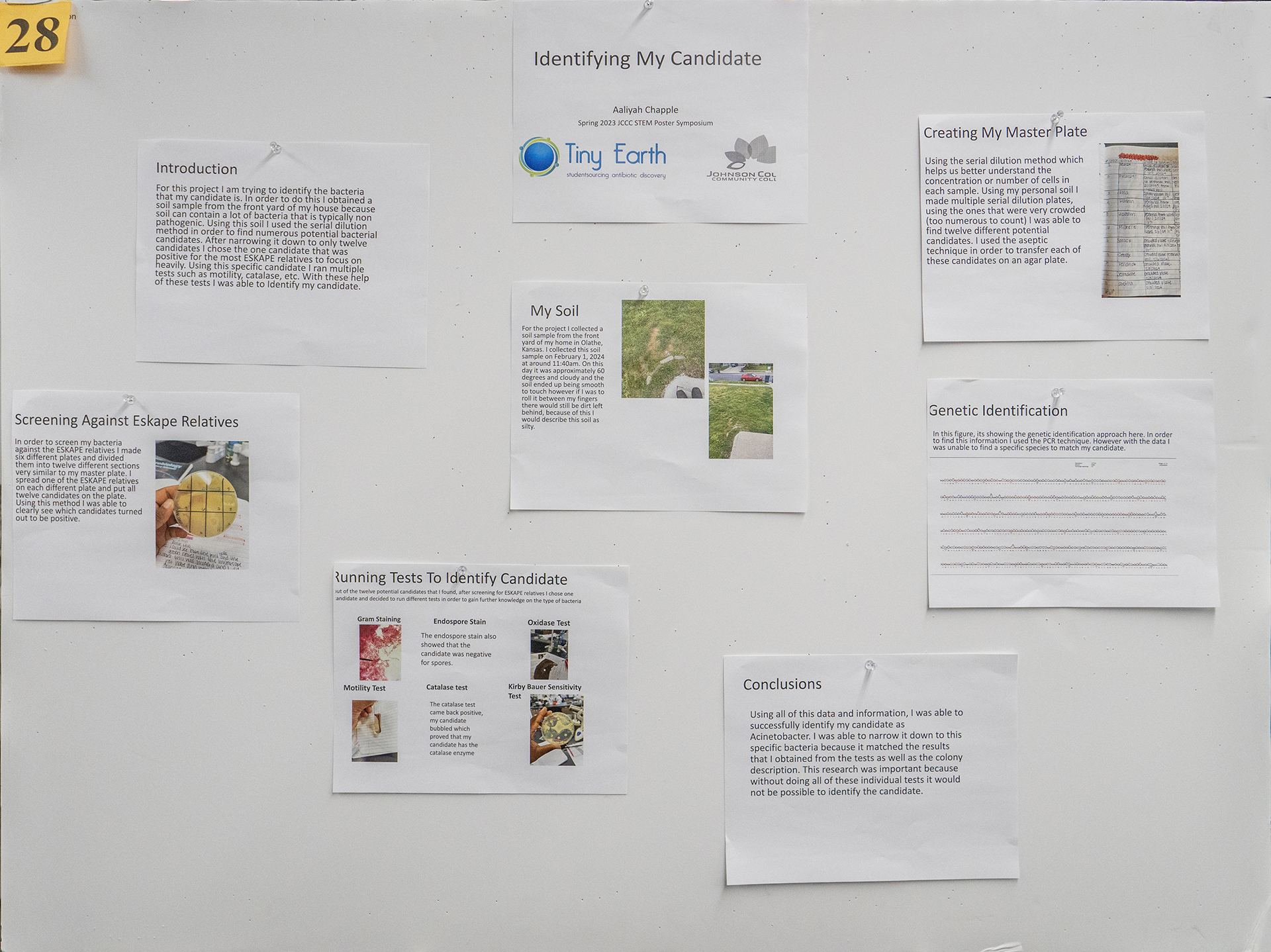
Soil samples have been very helpful because the bacterial communities are very diverse and competitive, because of this soil samples help find antibodies for ESKAPE pathogens. In class, we experimented to see if we could find any candidates that tested positive for any safe ESKAPE relatives. For this experiment, I collected a soil sample from the front yard of my home in Olathe, Kansas. The soil sample that I collected had a silty texture and was a medium brown color. To estimate the sample's concentration, I used serial dilution. After allowing the agar plate to grow for forty-eight hours I discovered twelve different colonies across multiple different agar plates that might be good candidates for antibacterial screening using the serial dilution method. I tested these twelve candidates against the ESKAPE relatives, majority of these candidates did not test positive. However, I had one candidate that tested positive for two ESKAPE relatives whom I named Barack. This candidate tested positive for Escherichia Coli and Acinetobacter Baylyi. I then made a streak plate for this candidate and discovered that the morphology is smooth, flat, and round with an off-white color.
Image
Using Soil Samples to Produce Potential Antibiotic
CoLab, OCB 100
Soil samples have been very helpful because the bacterial communities are very diverse and competitive, because of this soil samples help find antibodies for ESKAPE pathogens. In class, we experimented to see if we could find any candidates that tested positive for any safe ESKAPE relatives. For this experiment, I collected a soil sample from the front yard of my home in Olathe, Kansas. The soil sample that I collected had a silty texture and was a medium brown color. To estimate the sample's concentration, I used serial dilution. After allowing the agar plate to grow for forty-eight hours I discovered twelve different colonies across multiple different agar plates that might be good candidates for antibacterial screening using the serial dilution method. I tested these twelve candidates against the ESKAPE relatives, majority of these candidates did not test positive. However, I had one candidate that tested positive for two ESKAPE relatives whom I named Barack. This candidate tested positive for Escherichia Coli and Acinetobacter Baylyi. I then made a streak plate for this candidate and discovered that the morphology is smooth, flat, and round with an off-white color.
Comments
The faculty mentor for this project was Heather Seitz, Biology.