

Location
CoLab, OCB 100
Start Date
25-4-2024 1:30 PM
Document Type
Poster
Description
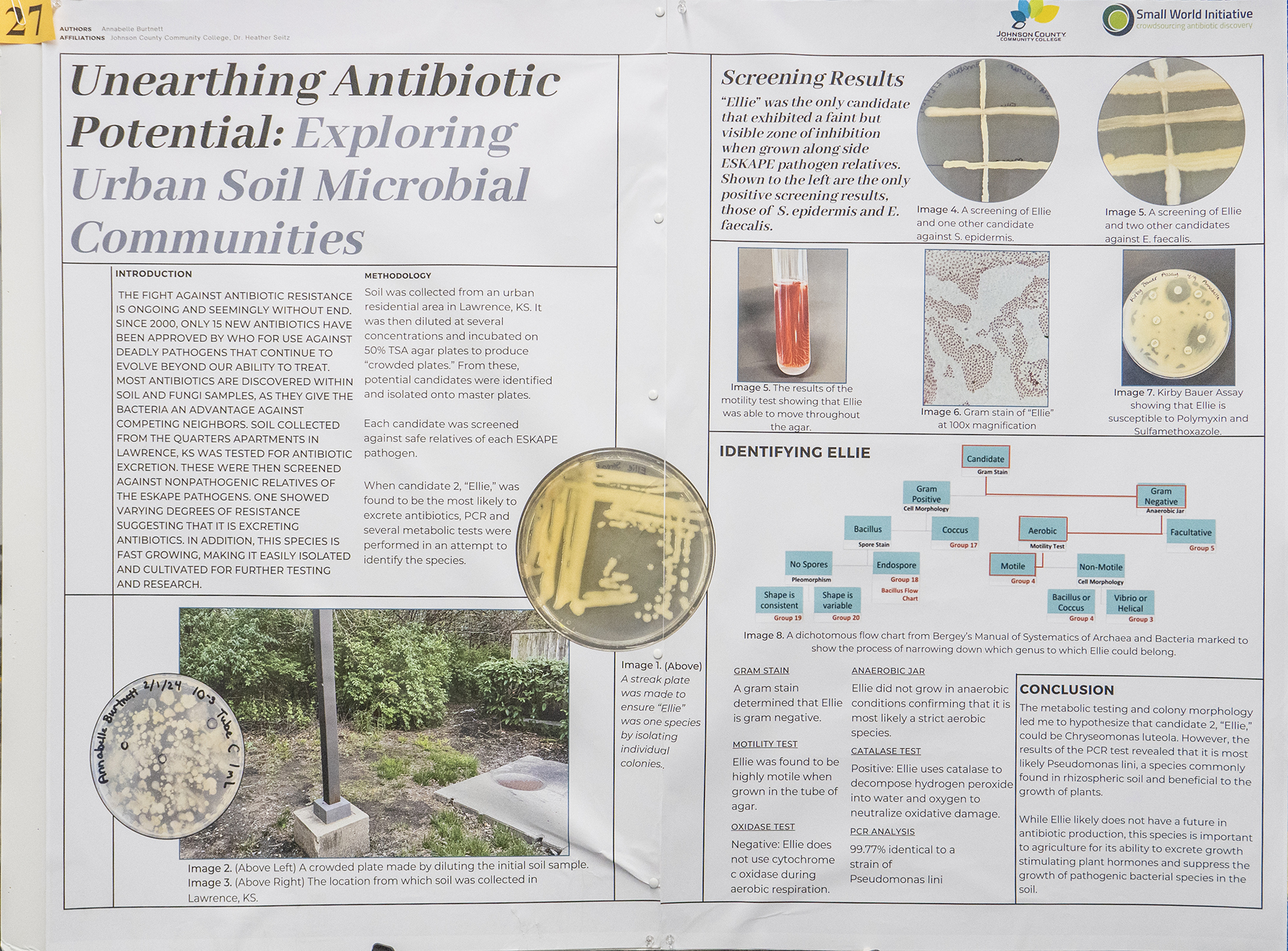
The fight against antibiotic resistance is ongoing and seemingly without end. Since 2000, only 15 new antibiotics have been approved by WHO for use against deadly pathogens that continue to evolve beyond our ability to treat. Most antibiotics are discovered within soil and fungi samples, as they give the bacteria an advantage against competing neighbors. Soil collected from The Quarters apartments in Lawrence, KS was diluted and grown in the lab resulting in 17 initial candidates for antibiotic excretion. These were then screened against the 6 nonpathogenic relatives of the ESKAPE pathogens. While most of the candidates failed to exhibit zones of inhibition when grown alongside the relatives, one showed varying degrees of resistance suggesting that it is excreting antibiotics. In addition, this species is fast growing, making it easily isolated and cultivated for further testing and research.
Image
Unearthing Antibiotic Potential: Exploring Urban Soil Microbial Communities
CoLab, OCB 100
The fight against antibiotic resistance is ongoing and seemingly without end. Since 2000, only 15 new antibiotics have been approved by WHO for use against deadly pathogens that continue to evolve beyond our ability to treat. Most antibiotics are discovered within soil and fungi samples, as they give the bacteria an advantage against competing neighbors. Soil collected from The Quarters apartments in Lawrence, KS was diluted and grown in the lab resulting in 17 initial candidates for antibiotic excretion. These were then screened against the 6 nonpathogenic relatives of the ESKAPE pathogens. While most of the candidates failed to exhibit zones of inhibition when grown alongside the relatives, one showed varying degrees of resistance suggesting that it is excreting antibiotics. In addition, this species is fast growing, making it easily isolated and cultivated for further testing and research.
Comments
The faculty mentor for this project was Heather Seitz, Biology.