

Location
CoLab, OCB 100
Start Date
25-4-2024 1:30 PM
Document Type
Poster
Description
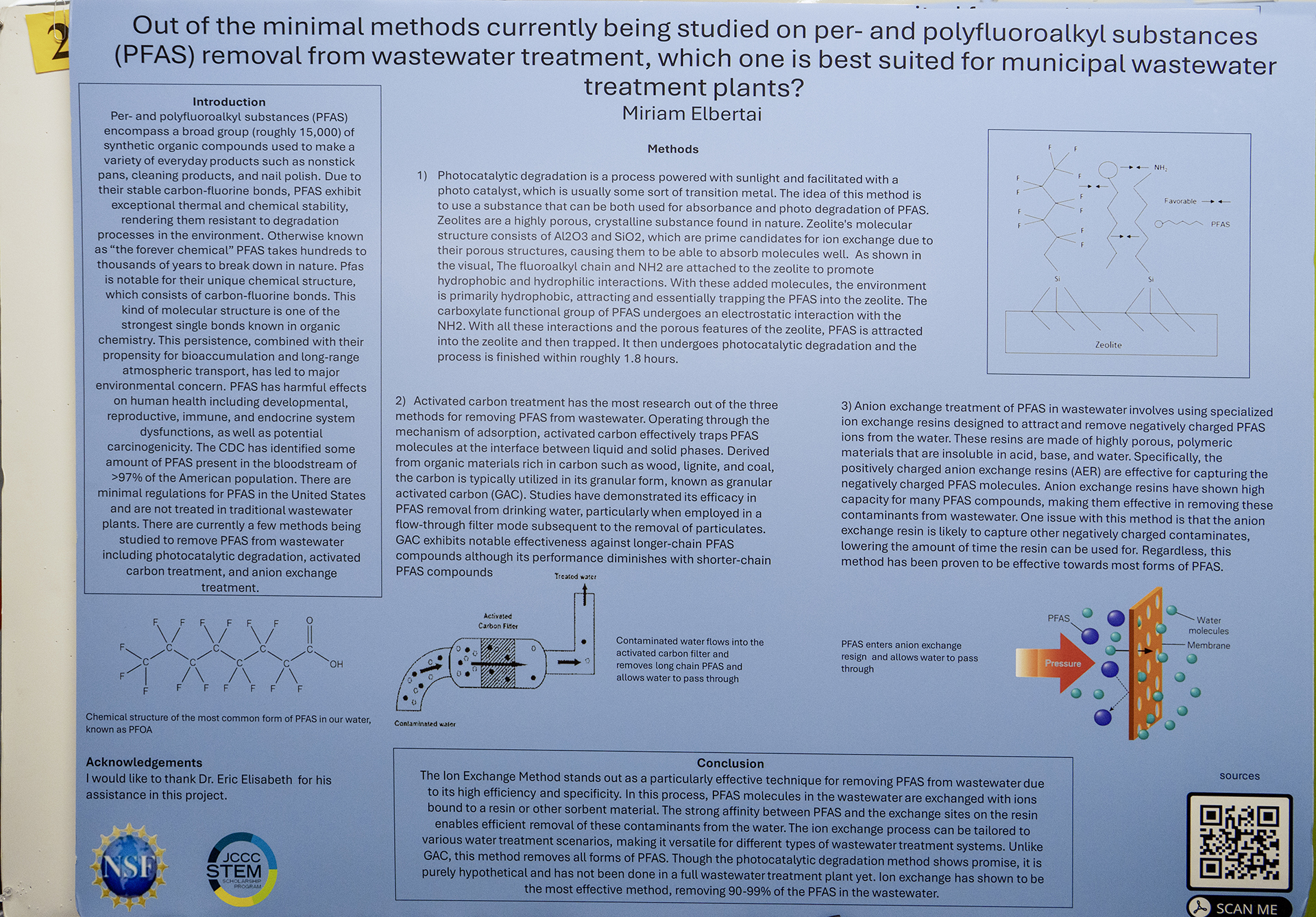
Per- and polyfluoroalkyl substances (PFAS) encompass a broad group (roughly 15,000) of synthetic organic compounds used to make a variety of everyday products such as nonstick pans, cleaning products, and nailpolish. Due to their stable carbon-fluorine bonds, PFAS exhibit exceptional thermal and chemical stability, rendering them resistant to degradation processes in the environment. Otherwise known as “the forever chemical” PFAS takes hundreds to thousands of years to break down in nature. This persistence, combined with their propensity for bioaccumulation and long-range atmospheric transport, has led to major environmental concern. PFAS has harmful effects on human health including developmental, reproductive, immune, and endocrine system dysfunctions, as well as potential carcinogenicity. Research has identified PFAS present in the bloodstream of 99% of the American population. PFAS has minimal regulations in the United States and is not treated in traditional wastewater plants. My research question is: Out of the minimal methods currently being studied on Per- and polyfluoroalkyl substances (PFAS) removal from wastewater treatment, which one is best suited for municipal wastewater treatment plants including factors such as effectiveness, efficiency, and environmental?
Image
Per- and Polyfluoroalkyl Substances (PFAS) Removal from Wastewater Treatment
CoLab, OCB 100
Per- and polyfluoroalkyl substances (PFAS) encompass a broad group (roughly 15,000) of synthetic organic compounds used to make a variety of everyday products such as nonstick pans, cleaning products, and nailpolish. Due to their stable carbon-fluorine bonds, PFAS exhibit exceptional thermal and chemical stability, rendering them resistant to degradation processes in the environment. Otherwise known as “the forever chemical” PFAS takes hundreds to thousands of years to break down in nature. This persistence, combined with their propensity for bioaccumulation and long-range atmospheric transport, has led to major environmental concern. PFAS has harmful effects on human health including developmental, reproductive, immune, and endocrine system dysfunctions, as well as potential carcinogenicity. Research has identified PFAS present in the bloodstream of 99% of the American population. PFAS has minimal regulations in the United States and is not treated in traditional wastewater plants. My research question is: Out of the minimal methods currently being studied on Per- and polyfluoroalkyl substances (PFAS) removal from wastewater treatment, which one is best suited for municipal wastewater treatment plants including factors such as effectiveness, efficiency, and environmental?
Comments
The faculty mentor for this project was Beth Edmonds, STEM Scholars.