

Location
CoLab, OCB 100
Start Date
25-4-2024 1:30 PM
Document Type
Poster
Description
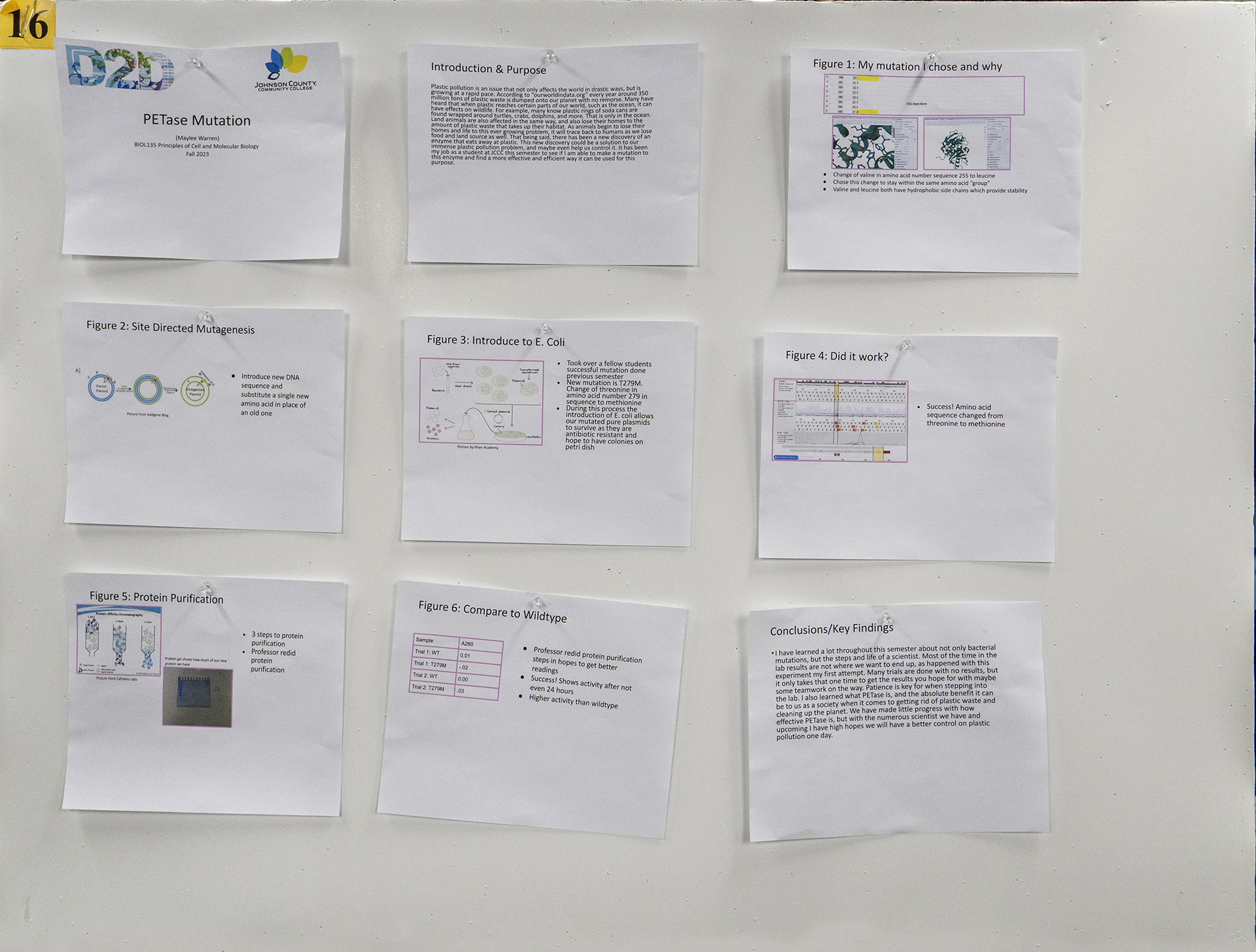
Imagine the Empire State Building, which is 1,250 feet tall, and try to guess how much it would weigh. The answer is 365,000 tons. To put into a better perspective that is around 30,000 school buses. Now imagine 400 Empire State Buildings in weight. That is around how much plastic pollution as a global population we have added to our Earth in a 10 year span. Throughout this semester certain students have been given the opportunity to help find a new way of getting rid of plastic pollution. Scientists in Japan have discovered a plastic eating enzyme. It has been our job as students to see if there are mutations we can make to make this enzyme more effectively and efficiently eat away plastic. I have determined the change of valine to leucine for amino acid 255 in this bacteria's DNA sequence does not provide colonies after transformation of this new DNA sequence. That being said, this plastic eating enzyme was unable to form properly, due to many possibilities. Going forward, I have now taken over a new mutation change, methionine in amino acid 258 to arginine, that has previously been conducted by a fellow JCCC student. Going forward, enzyme activity and stability will help us learn the impact this enzyme is truly capable of.
Image
PETase Mutagenesis Research
CoLab, OCB 100
Imagine the Empire State Building, which is 1,250 feet tall, and try to guess how much it would weigh. The answer is 365,000 tons. To put into a better perspective that is around 30,000 school buses. Now imagine 400 Empire State Buildings in weight. That is around how much plastic pollution as a global population we have added to our Earth in a 10 year span. Throughout this semester certain students have been given the opportunity to help find a new way of getting rid of plastic pollution. Scientists in Japan have discovered a plastic eating enzyme. It has been our job as students to see if there are mutations we can make to make this enzyme more effectively and efficiently eat away plastic. I have determined the change of valine to leucine for amino acid 255 in this bacteria's DNA sequence does not provide colonies after transformation of this new DNA sequence. That being said, this plastic eating enzyme was unable to form properly, due to many possibilities. Going forward, I have now taken over a new mutation change, methionine in amino acid 258 to arginine, that has previously been conducted by a fellow JCCC student. Going forward, enzyme activity and stability will help us learn the impact this enzyme is truly capable of.
Comments
The faculty mentor for this project was Heather Seitz, Biology.