

Location
CoLab, OCB 100
Start Date
25-4-2024 1:30 PM
Document Type
Poster
Description
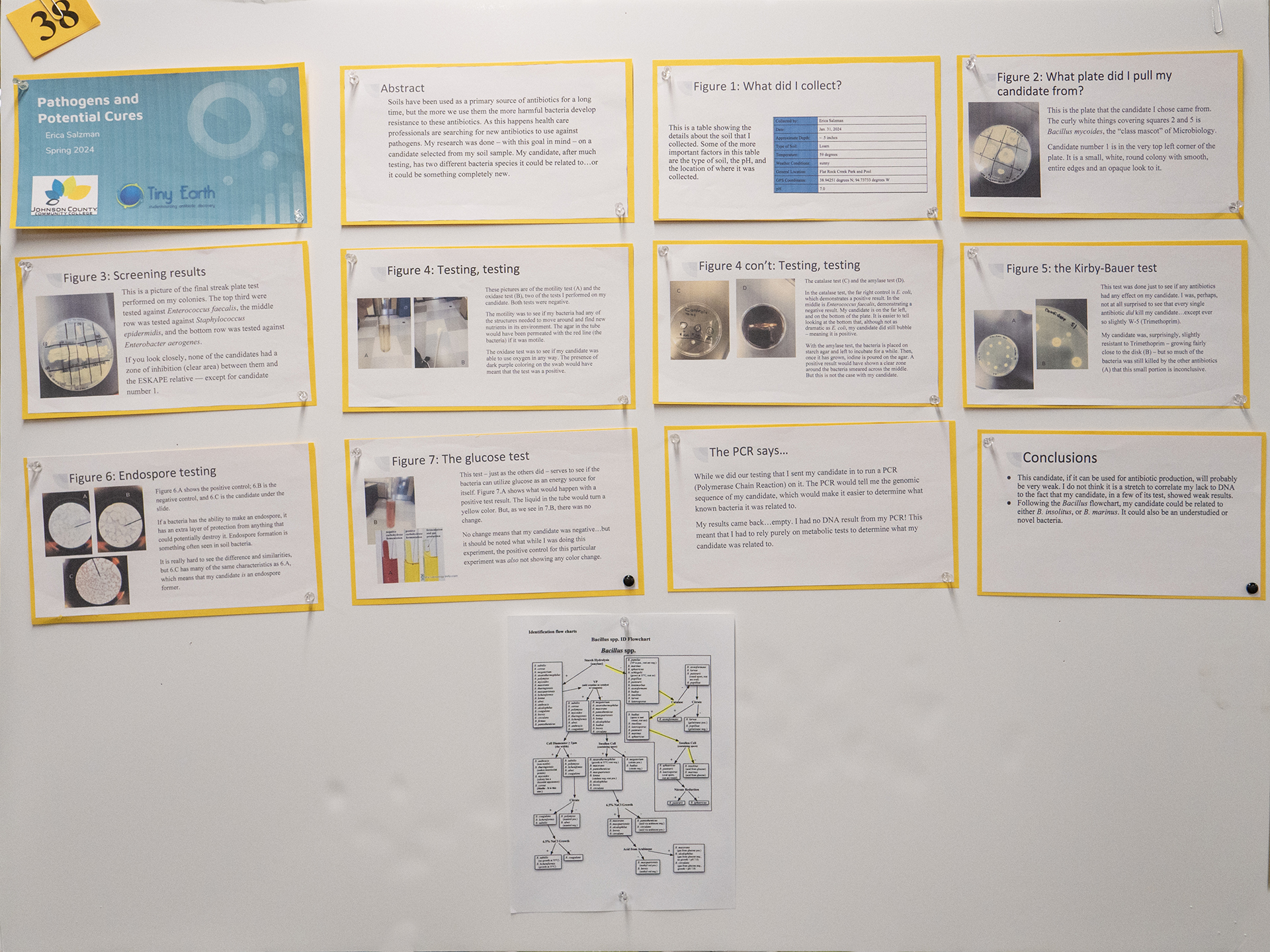
Soil has been used as the main source of antibiotic-producing bacteria for a long time. But as time goes by the viruses we use antibiotics against become more resistant, and soon the antibiotic becomes ineffective. As the antibiotics we use become less effective, we have to search in other places. For my research to find a potentially new antibiotic, I collected a soil sample from Flat Rock Creek Park and Pool. The sample was collected from this location because the park has a lot of people that visit it, and I thought that where there are people – there are pathogens. Thus a soil sample taken from where a lot of people are frequently would have several potential candidates for a new antibiotic. After collecting the soil sample, I took it to be screened. After a long time of testing my various colonies within the sample against different ESKAPE relatives, the colony numbered “1” was inhibiting ESKAPE relative Enterococcus faecalis. The fact that “colony 1” is inhibiting the growth of Enterococcus faecalis could point to the potential that it will inhibit and become a new antibiotic to treat the ESKAPE pathogen Enterococcus faecium, but a lot of testing needs to be done before we can be sure if this could be the case. One of those things to be done is to run a Polymerase Chain Reaction on a sample from this colony to obtain a bit of its DNA. It will be interesting to see the results of the PCR.
Image
Pathogens and Potential Cures
CoLab, OCB 100
Soil has been used as the main source of antibiotic-producing bacteria for a long time. But as time goes by the viruses we use antibiotics against become more resistant, and soon the antibiotic becomes ineffective. As the antibiotics we use become less effective, we have to search in other places. For my research to find a potentially new antibiotic, I collected a soil sample from Flat Rock Creek Park and Pool. The sample was collected from this location because the park has a lot of people that visit it, and I thought that where there are people – there are pathogens. Thus a soil sample taken from where a lot of people are frequently would have several potential candidates for a new antibiotic. After collecting the soil sample, I took it to be screened. After a long time of testing my various colonies within the sample against different ESKAPE relatives, the colony numbered “1” was inhibiting ESKAPE relative Enterococcus faecalis. The fact that “colony 1” is inhibiting the growth of Enterococcus faecalis could point to the potential that it will inhibit and become a new antibiotic to treat the ESKAPE pathogen Enterococcus faecium, but a lot of testing needs to be done before we can be sure if this could be the case. One of those things to be done is to run a Polymerase Chain Reaction on a sample from this colony to obtain a bit of its DNA. It will be interesting to see the results of the PCR.
Comments
The faculty mentor for this project was Heather Seitz, Biology.