

Evolution of Bacteria: Fighting Antimicrobial Resistance
Location
CoLab, COM 198
Start Date
30-4-2026 10:45 AM
Document Type
Poster
Description
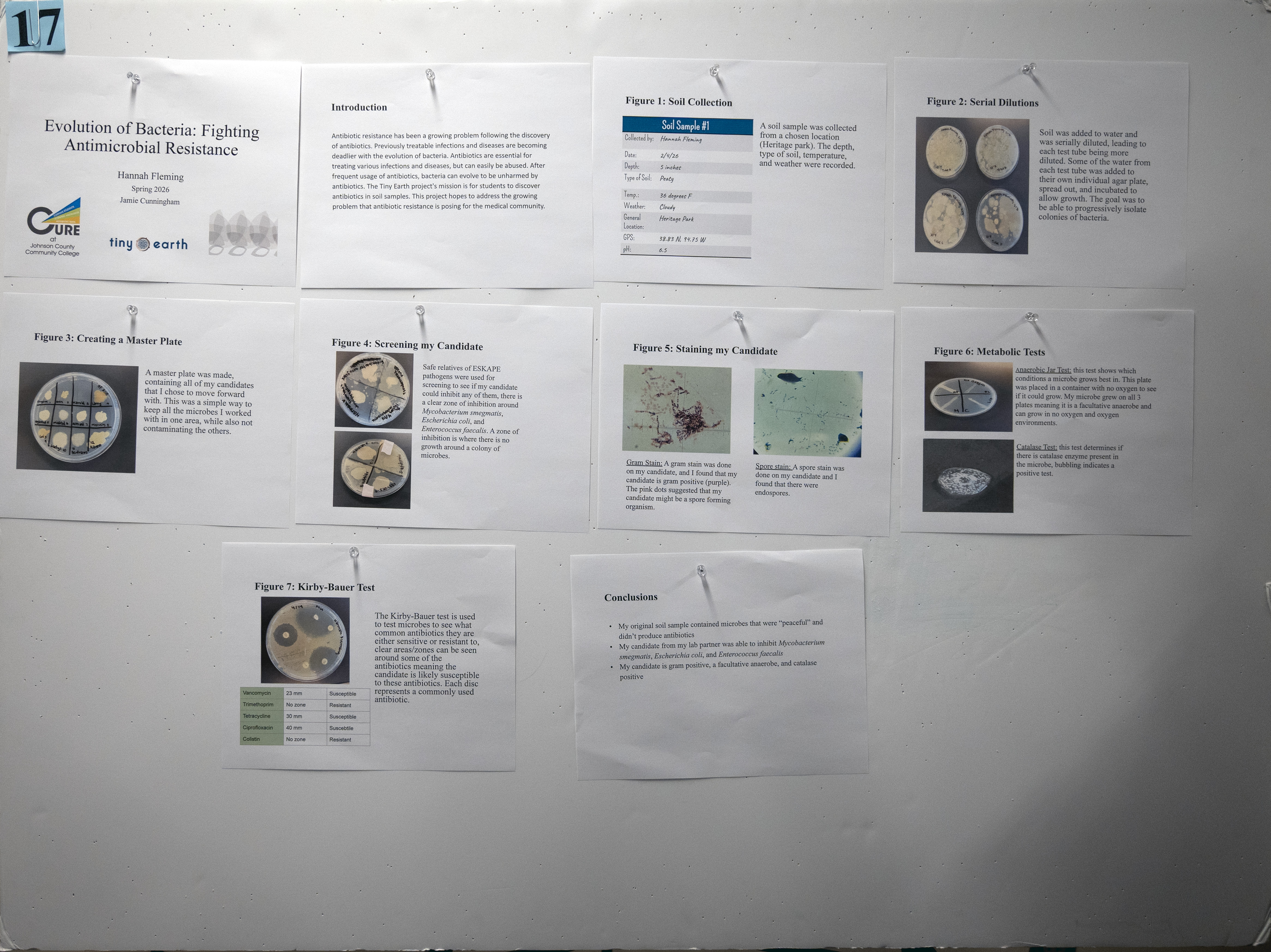
Antibiotic resistance has been a growing problem following the discovery of antibiotics. Previously treatable infections and diseases are becoming deadlier with the evolution of bacteria. Antibiotics are essential for treating various infections and diseases, but can easily be abused. After frequent usage of antibiotics, bacteria can evolve to be unharmed by antibiotics. The Tiny Earth project's mission is for students to discover antibiotics in soil samples. This project hopes to address the growing problem that antibiotic resistance is posing for the medical community. Microbes taken from a soil sample were grown on an agar plate. 12 candidates were chosen from serial dilution plates to continue with screening against various ESKAPE pathogens. ESKAPE pathogens are antibiotic resistant bacteria that pose a serious threat in hospitals. The hope was to find zones of inhibition, meaning clear areas surrounding a colony of bacteria on a screening plate. The chosen candidate was able to inhibit Staphylococcus epidermidis (a relative of MRSA), with clear zones of inhibition. Having zones of inhibition means that this candidate can inhibit Staphylococcus epidermidis and that this microbe may be able to combat this antibiotic resistant pathogen. This project hopes to address antibiotic resistance, while also boosting research on antibiotics. Addressing the problem is the first step in fighting this global issue.
Image
Evolution of Bacteria: Fighting Antimicrobial Resistance
CoLab, COM 198
Antibiotic resistance has been a growing problem following the discovery of antibiotics. Previously treatable infections and diseases are becoming deadlier with the evolution of bacteria. Antibiotics are essential for treating various infections and diseases, but can easily be abused. After frequent usage of antibiotics, bacteria can evolve to be unharmed by antibiotics. The Tiny Earth project's mission is for students to discover antibiotics in soil samples. This project hopes to address the growing problem that antibiotic resistance is posing for the medical community. Microbes taken from a soil sample were grown on an agar plate. 12 candidates were chosen from serial dilution plates to continue with screening against various ESKAPE pathogens. ESKAPE pathogens are antibiotic resistant bacteria that pose a serious threat in hospitals. The hope was to find zones of inhibition, meaning clear areas surrounding a colony of bacteria on a screening plate. The chosen candidate was able to inhibit Staphylococcus epidermidis (a relative of MRSA), with clear zones of inhibition. Having zones of inhibition means that this candidate can inhibit Staphylococcus epidermidis and that this microbe may be able to combat this antibiotic resistant pathogen. This project hopes to address antibiotic resistance, while also boosting research on antibiotics. Addressing the problem is the first step in fighting this global issue.
Comments
The faculty mentor for this project was Jamie Cunningham.