

Candidate 1: Soil Derived Antibiotic Activity Against ESKAPE Relatives
Location
CoLab, COM 189
Start Date
30-4-2026 10:45 AM
Document Type
Poster
Description
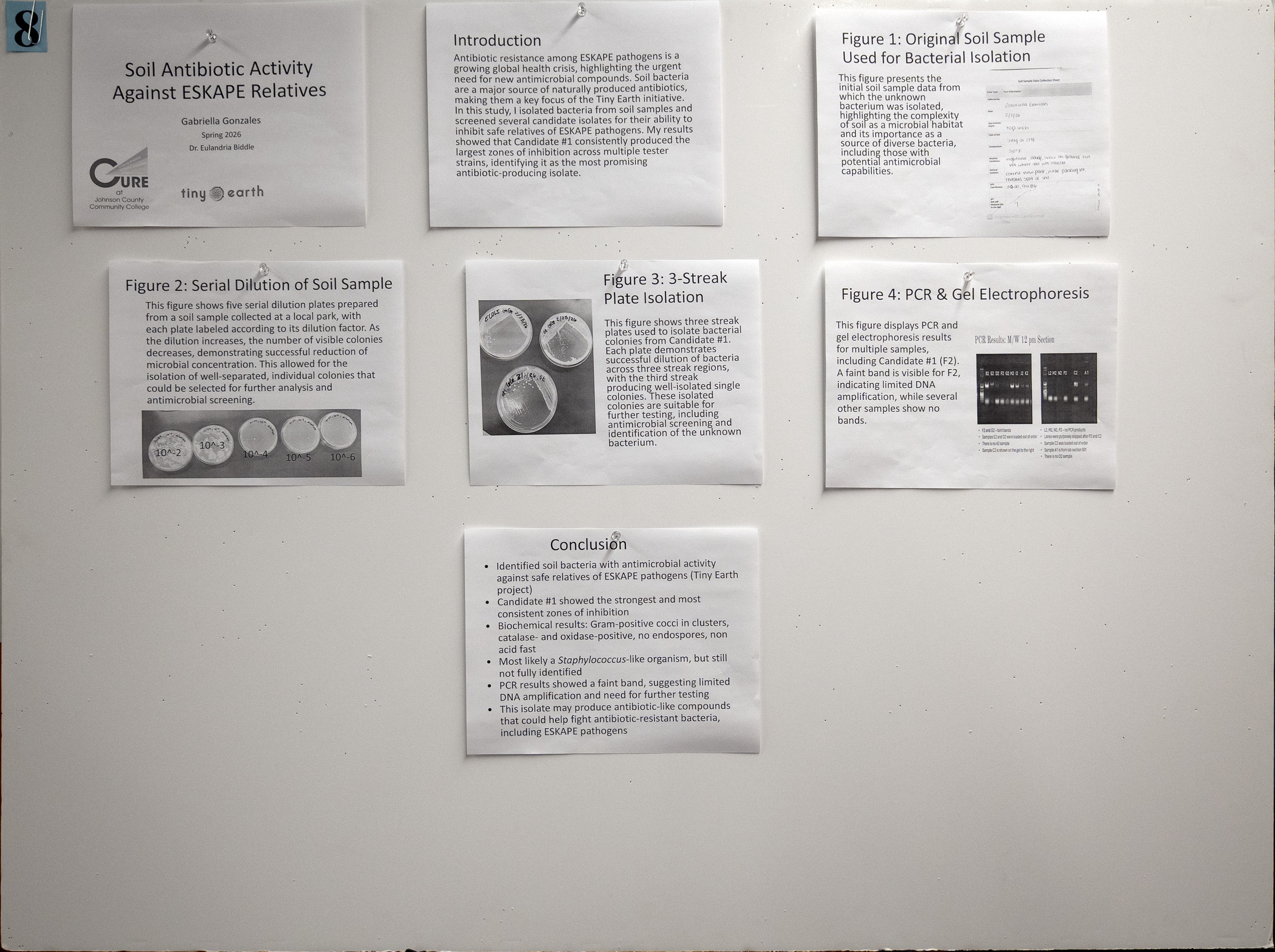
The rapid emergence of antibiotic resistant pathogens, particularly those within the ESKAPE group, presents a critical global health threat and underscores the urgent need for novel antimicrobial compounds. Soil microbiomes serve as a diverse and underexplored source of antibiotic-producing bacteria. In this study, we aimed to identify a candidate antibiotic-producing bacterium capable of inhibiting safe relatives of clinically relevant pathogens as part of the Tiny Earth initiative. We isolated soil derived bacteria and screened seven candidate isolates for antimicrobial activity.. We diluted safe relative bacterial cultures and evenly spread them onto agar plates to create uniform lawns. We then streaked candidate isolates onto the prepared plates and incubated them for several hours. We evaluated antimicrobial activity by observing zones of inhibition. We also performed morphological characterization to further classify the isolates. Several candidates demonstrated antimicrobial activity however, candidate #1 consistently produced the largest and most distinct zones of inhibition across multiple safe relatives. This strong and reproducible inhibitory effect suggests the production of potent antimicrobial compounds. Our findings identify candidate #1 as the most promising antibiotic producing bacterium among the isolates tested. Its consistent inhibition across multiple targets indicates potential broad-spectrum activity. Further investigation, including species identification and compound characterization, is necessary to assess its potential contribution to combating antibiotic resistance.
Image
Candidate 1: Soil Derived Antibiotic Activity Against ESKAPE Relatives
CoLab, COM 189
The rapid emergence of antibiotic resistant pathogens, particularly those within the ESKAPE group, presents a critical global health threat and underscores the urgent need for novel antimicrobial compounds. Soil microbiomes serve as a diverse and underexplored source of antibiotic-producing bacteria. In this study, we aimed to identify a candidate antibiotic-producing bacterium capable of inhibiting safe relatives of clinically relevant pathogens as part of the Tiny Earth initiative. We isolated soil derived bacteria and screened seven candidate isolates for antimicrobial activity.. We diluted safe relative bacterial cultures and evenly spread them onto agar plates to create uniform lawns. We then streaked candidate isolates onto the prepared plates and incubated them for several hours. We evaluated antimicrobial activity by observing zones of inhibition. We also performed morphological characterization to further classify the isolates. Several candidates demonstrated antimicrobial activity however, candidate #1 consistently produced the largest and most distinct zones of inhibition across multiple safe relatives. This strong and reproducible inhibitory effect suggests the production of potent antimicrobial compounds. Our findings identify candidate #1 as the most promising antibiotic producing bacterium among the isolates tested. Its consistent inhibition across multiple targets indicates potential broad-spectrum activity. Further investigation, including species identification and compound characterization, is necessary to assess its potential contribution to combating antibiotic resistance.
Comments
The faculty mentor for this project was Eulandria Biddle.