

Variable Star Research Project
Location
CoLab, COM 183
Start Date
30-4-2026 10:45 AM
Document Type
Poster
Description
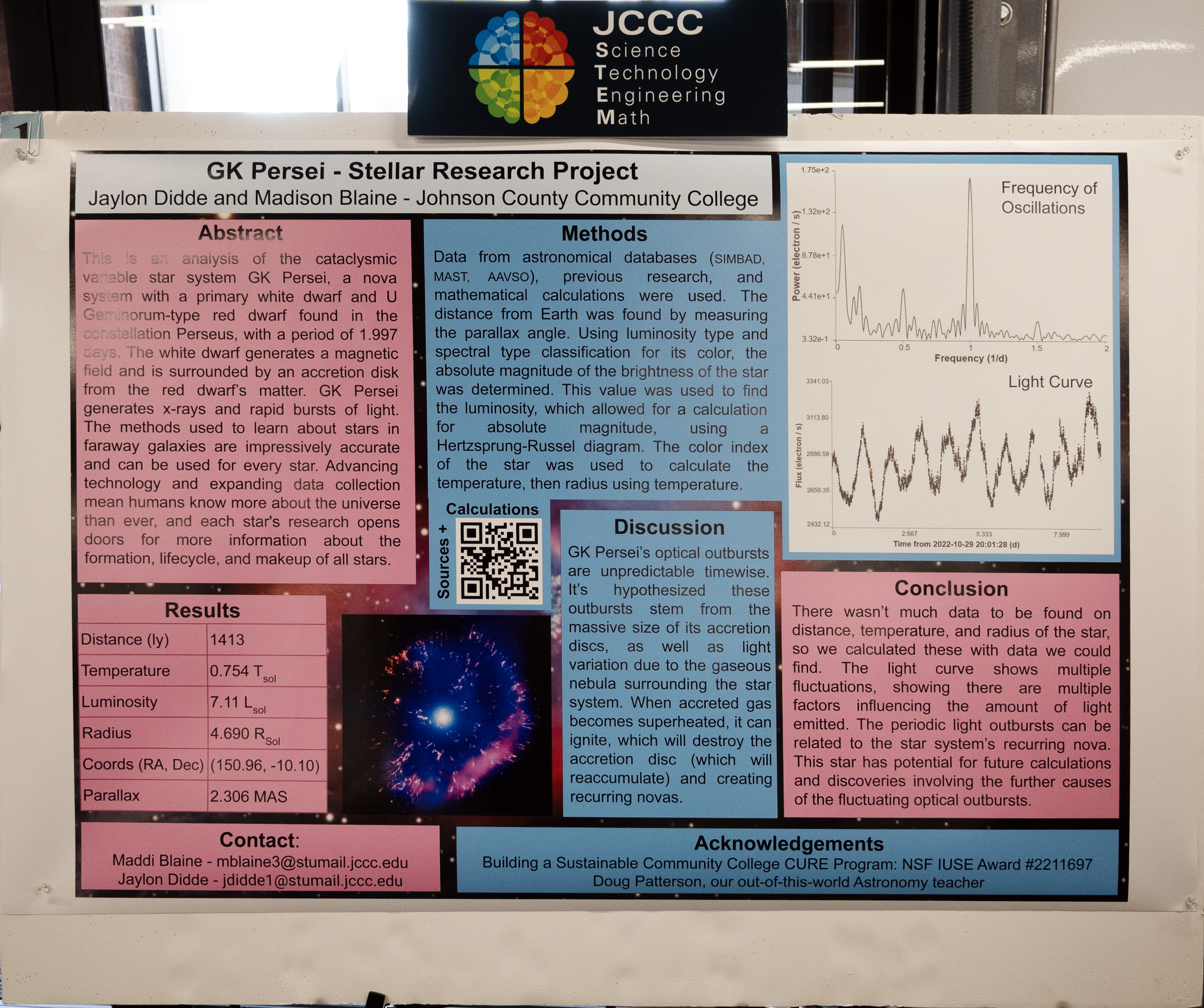
This is an analysis of the variable star system GK Persei using data from astronomical databases, previous research, mathematical calculations, and optical analysis. This is an attempt to verify the data found in databases mathematically and possibly detect light variation optically. GK Persei is a nova system with a primary white dwarf and U Geminorum-type red dwarf found in the constellation Perseus, with a period of 1.9968 days. The white dwarf generates a magnetic field and is surrounded by an accretion disk. GK PER generates x-rays and has rapid bursts of light that occur. The distance between this star system and Earth was found to be 1413 light-years by measuring the parallax angle and finding the reciprocal. The luminosity type of this star system and the spectral type classification for color, the absolute magnitude of the brightness of the star was determined. This value was used to determine the luminosity, which then allowed for a calculation of the absolute magnitude, using a Hertzsprung-Russell diagram. The color index of the star was used to calculate the temperature of the star. Using the temperature, the radius of the star system was found. The methods used to learn about stars in faraway galaxies are impressively accurate and can be used for every star. Advancing technology and expanding data collection mean humans know more about the universe than ever, and each star's research opens doors for more information about the formation and makeup of all stars.
Image
Variable Star Research Project
CoLab, COM 183
This is an analysis of the variable star system GK Persei using data from astronomical databases, previous research, mathematical calculations, and optical analysis. This is an attempt to verify the data found in databases mathematically and possibly detect light variation optically. GK Persei is a nova system with a primary white dwarf and U Geminorum-type red dwarf found in the constellation Perseus, with a period of 1.9968 days. The white dwarf generates a magnetic field and is surrounded by an accretion disk. GK PER generates x-rays and has rapid bursts of light that occur. The distance between this star system and Earth was found to be 1413 light-years by measuring the parallax angle and finding the reciprocal. The luminosity type of this star system and the spectral type classification for color, the absolute magnitude of the brightness of the star was determined. This value was used to determine the luminosity, which then allowed for a calculation of the absolute magnitude, using a Hertzsprung-Russell diagram. The color index of the star was used to calculate the temperature of the star. Using the temperature, the radius of the star system was found. The methods used to learn about stars in faraway galaxies are impressively accurate and can be used for every star. Advancing technology and expanding data collection mean humans know more about the universe than ever, and each star's research opens doors for more information about the formation and makeup of all stars.
Comments
The faculty mentor for this project was Doug Patterson.