

Analysis of Post-Drain Water Hardness in the JCCC Basin
Location
CoLab, COM 174
Start Date
30-4-2026 9:30 AM
Document Type
Poster
Description
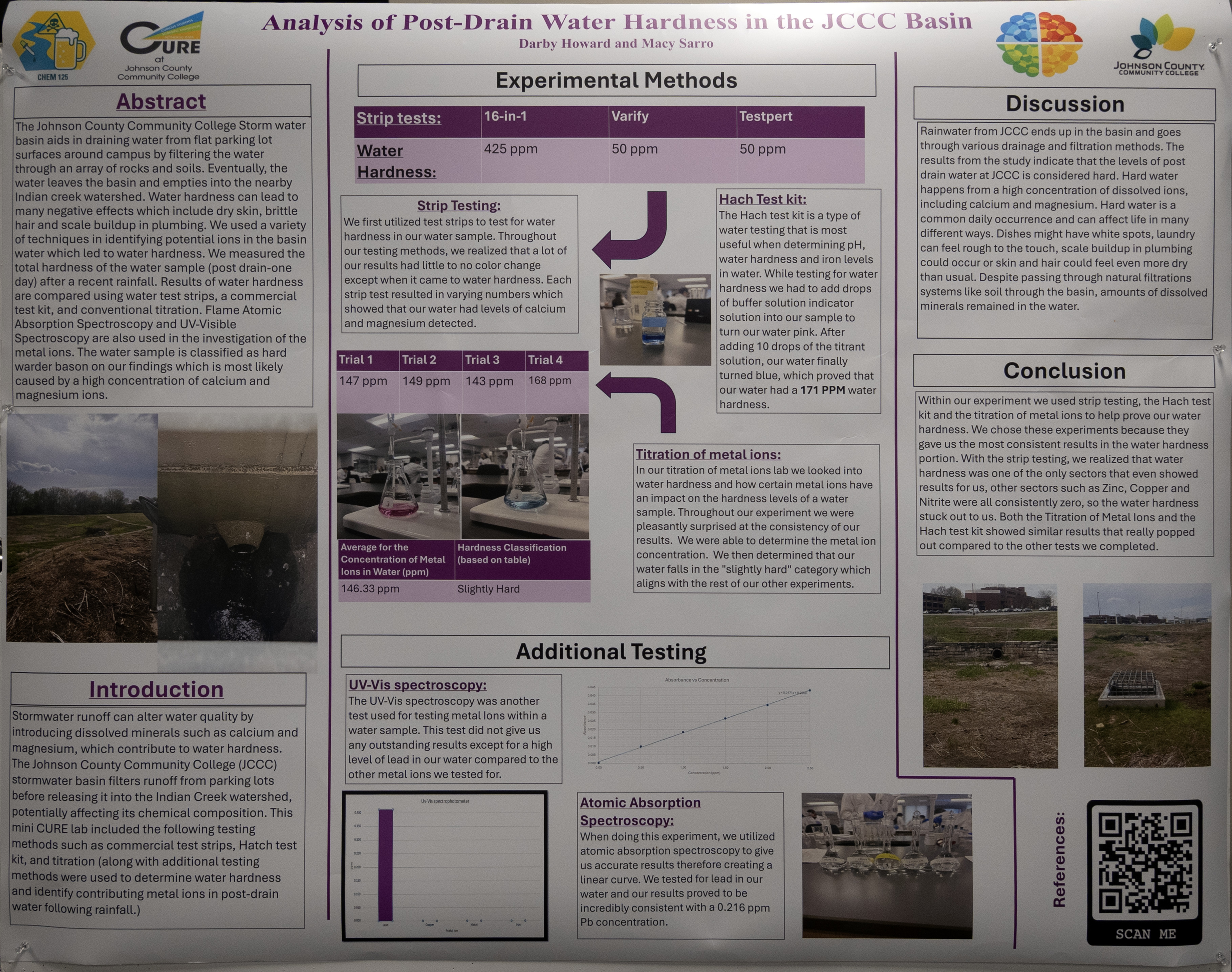
The Johnson County Community College Stormwater basin aids in draining water from flat parking lot surfaces around campus by filtering the water through an array of rocks and soils. Eventually, the water leaves the basin and empties into the nearby Indian creek watershed. Water hardness can lead to many negative effects which include dry skin, brittle hair and scale build up in plumbing. We used a variety of techniques in identifying potential ions in the basin water which led to water hardness. We measured the total hardness of the water sample (post drain - one day) after a recent rainfall. Results of water hardness are compared using water test strips, a commercial test kit, and conventional titration. Flame Atomic Absorption Spectroscopy and UV-Visible Spectroscopy are also used in the investigation of the metal ions. The water sample is classified as hard water based on our findings which is most likely caused by a high concentration of calcium and magnesium ions.
Image
Analysis of Post-Drain Water Hardness in the JCCC Basin
CoLab, COM 174
The Johnson County Community College Stormwater basin aids in draining water from flat parking lot surfaces around campus by filtering the water through an array of rocks and soils. Eventually, the water leaves the basin and empties into the nearby Indian creek watershed. Water hardness can lead to many negative effects which include dry skin, brittle hair and scale build up in plumbing. We used a variety of techniques in identifying potential ions in the basin water which led to water hardness. We measured the total hardness of the water sample (post drain - one day) after a recent rainfall. Results of water hardness are compared using water test strips, a commercial test kit, and conventional titration. Flame Atomic Absorption Spectroscopy and UV-Visible Spectroscopy are also used in the investigation of the metal ions. The water sample is classified as hard water based on our findings which is most likely caused by a high concentration of calcium and magnesium ions.
Comments
The faculty mentor for this project was Lori Slavin.