

Analysis of IM Aur Core Functions
Location
CoLab, COM 142
Start Date
30-4-2026 9:30 AM
Document Type
Poster
Description
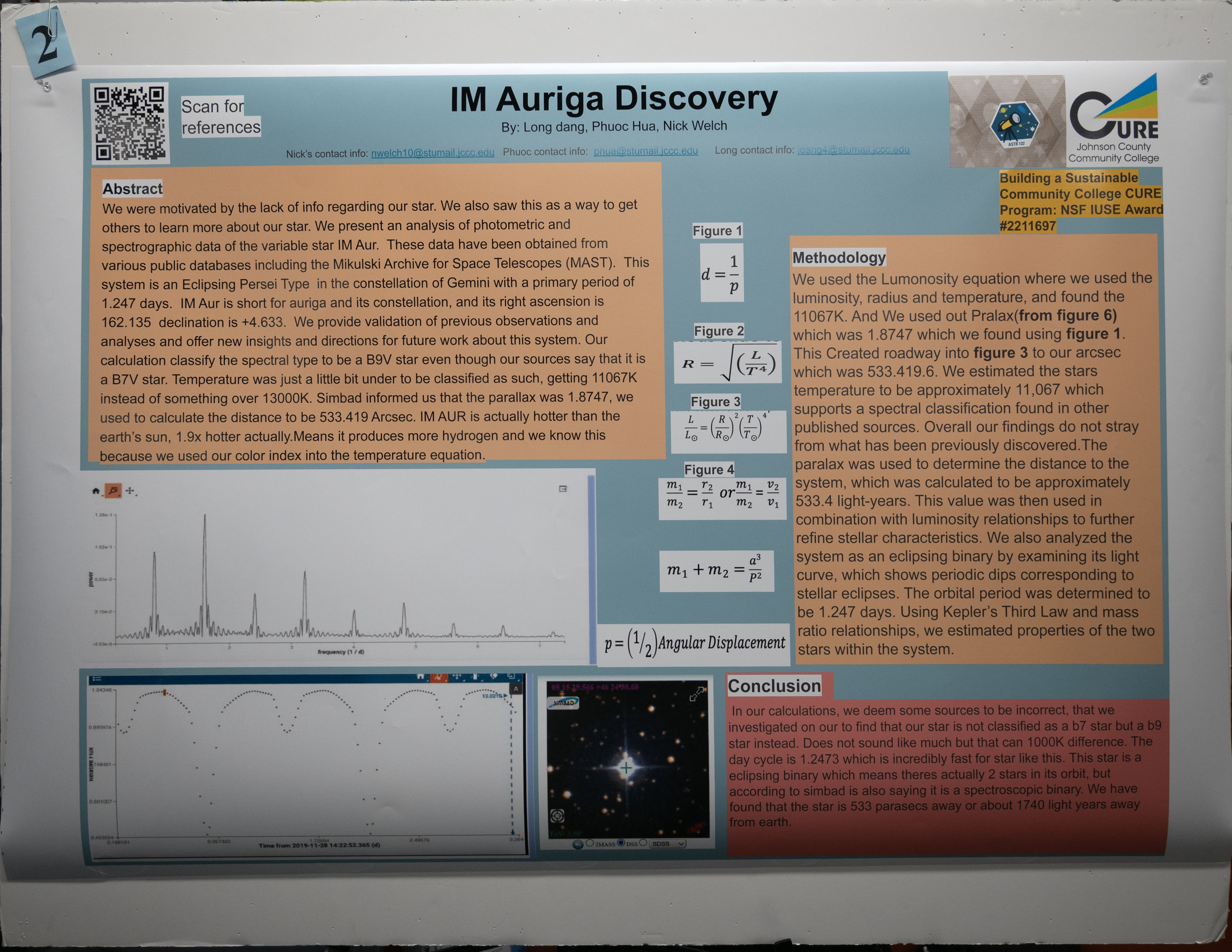
We were motivated by the lack of info regarding our star, we saw this as an opportunity to learn more about our star. We also saw this as a way to get others to learn more about our star. We present an analysis of photometric and spectrographic data of the variable star IM Aur. These data have been obtained from various public databases including the Mikulski Archive for Space Telescopes (MAST). This system is an Eclipsing Persei Type in the constellation of Gemini with a primary period of 1.247 days. IM Aur is short for auriga and its constellation, and its right ascension is 162.135 declination is +4.633. We provide validation of previous observations and analyses and offer new insights and directions for future work about this system. Our calculation classify the spectral type to be a B9V star even though our sources say that it is a B7V star. The temperature was just a little bit under to be classified as such, getting 11067K instead of something over 13000K. Simbad informed us that the parallax was 1.8747, which we used to calculate the distance to be 533.419 Arcsec. And during our studies we figured that our star IM AUR was actually hotter than the earth’s sun, 1.9x hotter actually. Which means it produces more hydrogen and we know this because we used our color index into the temperature equation. We will revise after we have gotten more acquainted with measurements.
Image
Analysis of IM Aur Core Functions
CoLab, COM 142
We were motivated by the lack of info regarding our star, we saw this as an opportunity to learn more about our star. We also saw this as a way to get others to learn more about our star. We present an analysis of photometric and spectrographic data of the variable star IM Aur. These data have been obtained from various public databases including the Mikulski Archive for Space Telescopes (MAST). This system is an Eclipsing Persei Type in the constellation of Gemini with a primary period of 1.247 days. IM Aur is short for auriga and its constellation, and its right ascension is 162.135 declination is +4.633. We provide validation of previous observations and analyses and offer new insights and directions for future work about this system. Our calculation classify the spectral type to be a B9V star even though our sources say that it is a B7V star. The temperature was just a little bit under to be classified as such, getting 11067K instead of something over 13000K. Simbad informed us that the parallax was 1.8747, which we used to calculate the distance to be 533.419 Arcsec. And during our studies we figured that our star IM AUR was actually hotter than the earth’s sun, 1.9x hotter actually. Which means it produces more hydrogen and we know this because we used our color index into the temperature equation. We will revise after we have gotten more acquainted with measurements.
Comments
The faculty mentor for this project was Doug Patterson.