

JCCC Stormwater Basin Effect
Location
CoLab, COM 170
Start Date
30-4-2026 9:30 AM
Document Type
Poster
Description
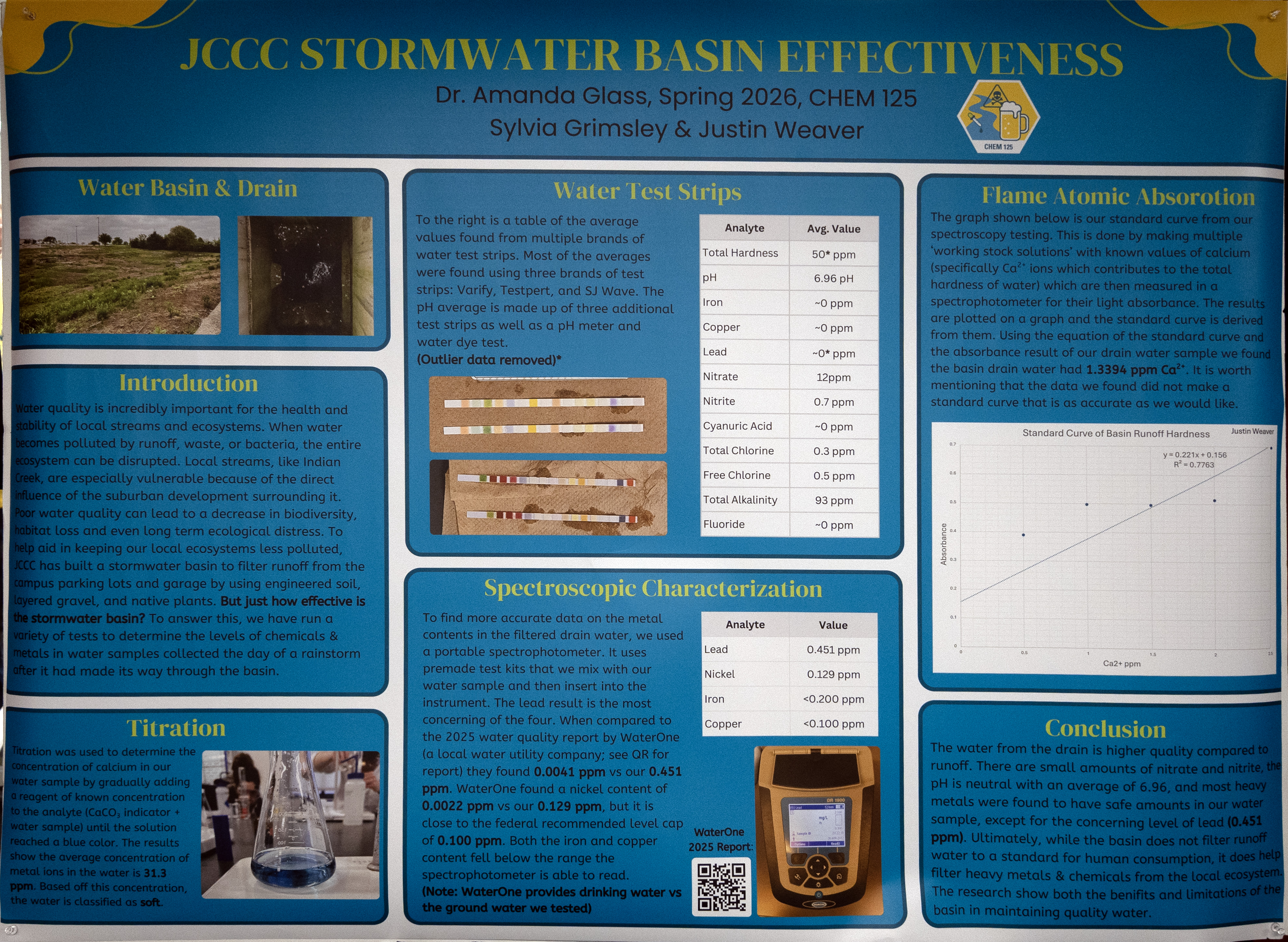
On the south side of campus, JCCC has built a stormwater basin to filter runoff from the parking lots and garage to help aid in keeping our local ecosystems less polluted. But just how effective is the stormwater basin? To answer this, we have run a variety of tests on water samples collected the day of a rainstorm after it had made its way through the basin. We can compare our results to the 2025 water quality report done by WaterOne, a local water utility company that services a large part of Johnson County. They serve as a good reference point, and it is worth clarifying WaterOne has a full-blown water treatment plant versus JCCC’s small scale basin. We found the drain water had an acidity of 7.74pH (7pH being the pH level of pure water) compared to WaterOne’s 9.6pH and a lead content of 451ppb compared to WaterOne’s 4.1ppb. This result is concerning as lead is highly poisonous and our findings are 110 times WaterOne’s amount. We also discovered a nickel content of 129ppb compared to WaterOne’s 2.2ppb while the federal recommended limit is 100ppb. It is worth mentioning pre-basin runoff water had a yellow tint to it versus our post-basin samples which were colorless. Ultimately, while the basin does filter runoff water to a certain degree, it does not meet certain standards. The stormwater basin can not stack up to the four stage process of a water treatment plant.
Image
JCCC Stormwater Basin Effect
CoLab, COM 170
On the south side of campus, JCCC has built a stormwater basin to filter runoff from the parking lots and garage to help aid in keeping our local ecosystems less polluted. But just how effective is the stormwater basin? To answer this, we have run a variety of tests on water samples collected the day of a rainstorm after it had made its way through the basin. We can compare our results to the 2025 water quality report done by WaterOne, a local water utility company that services a large part of Johnson County. They serve as a good reference point, and it is worth clarifying WaterOne has a full-blown water treatment plant versus JCCC’s small scale basin. We found the drain water had an acidity of 7.74pH (7pH being the pH level of pure water) compared to WaterOne’s 9.6pH and a lead content of 451ppb compared to WaterOne’s 4.1ppb. This result is concerning as lead is highly poisonous and our findings are 110 times WaterOne’s amount. We also discovered a nickel content of 129ppb compared to WaterOne’s 2.2ppb while the federal recommended limit is 100ppb. It is worth mentioning pre-basin runoff water had a yellow tint to it versus our post-basin samples which were colorless. Ultimately, while the basin does filter runoff water to a certain degree, it does not meet certain standards. The stormwater basin can not stack up to the four stage process of a water treatment plant.
Comments
The faculty mentor for this project was Amanda Glass.