

Potential New Antibiotics
Location
CoLab, COM 107
Start Date
30-4-2026 8:15 AM
Document Type
Poster
Description
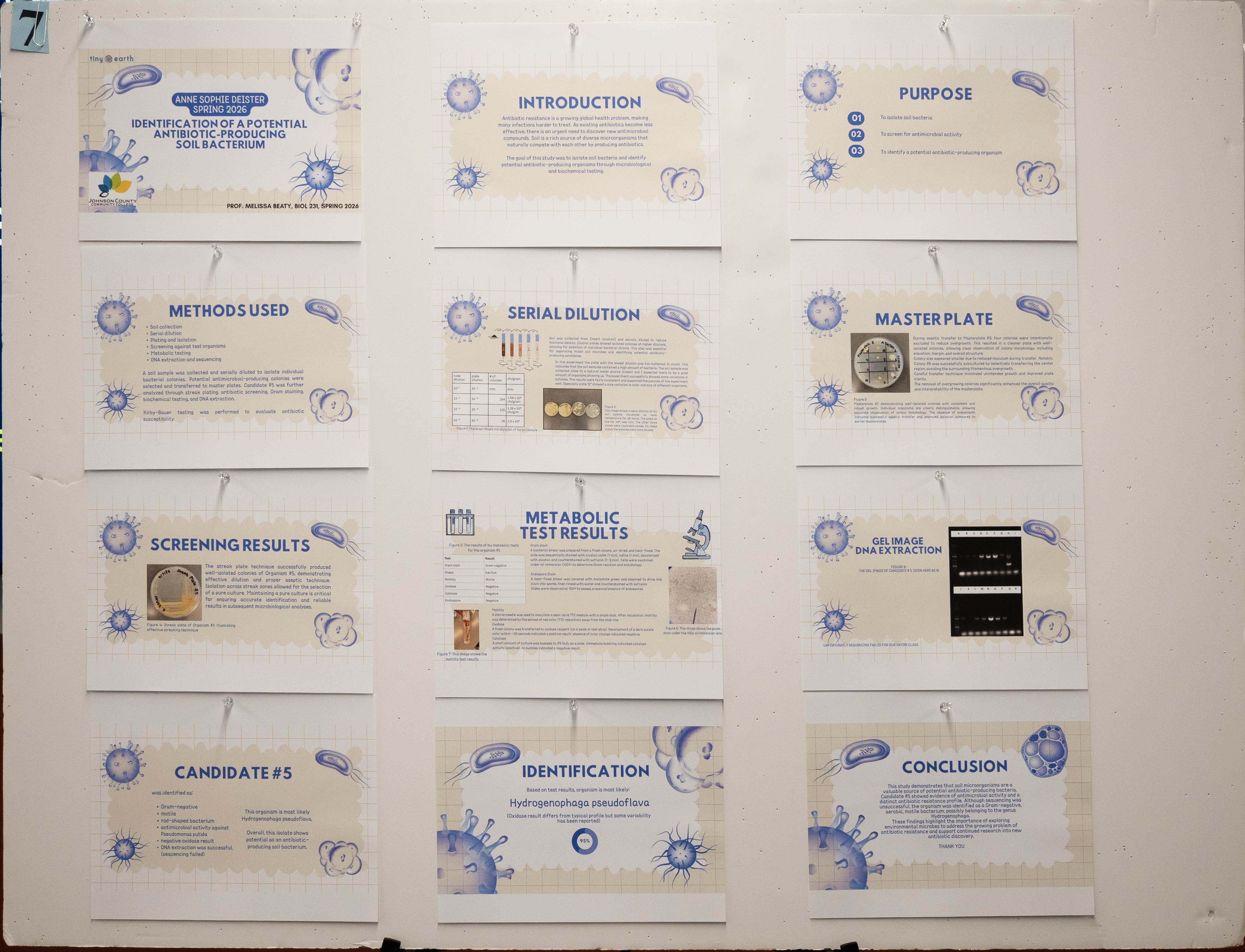
This research is relevant because it helps to identify potential new antibiotics, which are needed to combat the growing problem of antibiotic resistance. Soil is a rich environment containing diverse microorganisms that naturally compete with each other, often by producing antimicrobial compounds. Studying these bacteria can help identify new substances that may be useful in medicine. In this study, I collected soil samples and cultured them to isolate different bacterial colonies, which were then screened for antimicrobial activity using Escherichia coli, Pseudomonas putida, Staphylococcus epidermidis, and Acinetobacter baylyi as tester organisms. The results showed that most isolates did not inhibit the growth of the tester organisms. No clear zones of inhibition were observed on the E. coli or the A. baylyi plates. However, the isolated colonies #3, #5, and #11 produced small clear zones on the P. putida plates, indicating potential antimicrobial activity. In addition, a small zone of inhibition was observed around colony #9 on the S. epidermidis plate. Overall, this study demonstrates that some soil bacteria may produce antimicrobial compounds, although their effectiveness varies.. Further research would be necessary to identify the bacterial species and better characterize the antimicrobial compounds they produce.
Image
Potential New Antibiotics
CoLab, COM 107
This research is relevant because it helps to identify potential new antibiotics, which are needed to combat the growing problem of antibiotic resistance. Soil is a rich environment containing diverse microorganisms that naturally compete with each other, often by producing antimicrobial compounds. Studying these bacteria can help identify new substances that may be useful in medicine. In this study, I collected soil samples and cultured them to isolate different bacterial colonies, which were then screened for antimicrobial activity using Escherichia coli, Pseudomonas putida, Staphylococcus epidermidis, and Acinetobacter baylyi as tester organisms. The results showed that most isolates did not inhibit the growth of the tester organisms. No clear zones of inhibition were observed on the E. coli or the A. baylyi plates. However, the isolated colonies #3, #5, and #11 produced small clear zones on the P. putida plates, indicating potential antimicrobial activity. In addition, a small zone of inhibition was observed around colony #9 on the S. epidermidis plate. Overall, this study demonstrates that some soil bacteria may produce antimicrobial compounds, although their effectiveness varies.. Further research would be necessary to identify the bacterial species and better characterize the antimicrobial compounds they produce.
Comments
The faculty mentor for this project was Melissa Beaty.