

Backyard Antibiotic Search
Location
CoLab, COM 163
Start Date
30-4-2026 9:30 AM
Document Type
Poster
Description
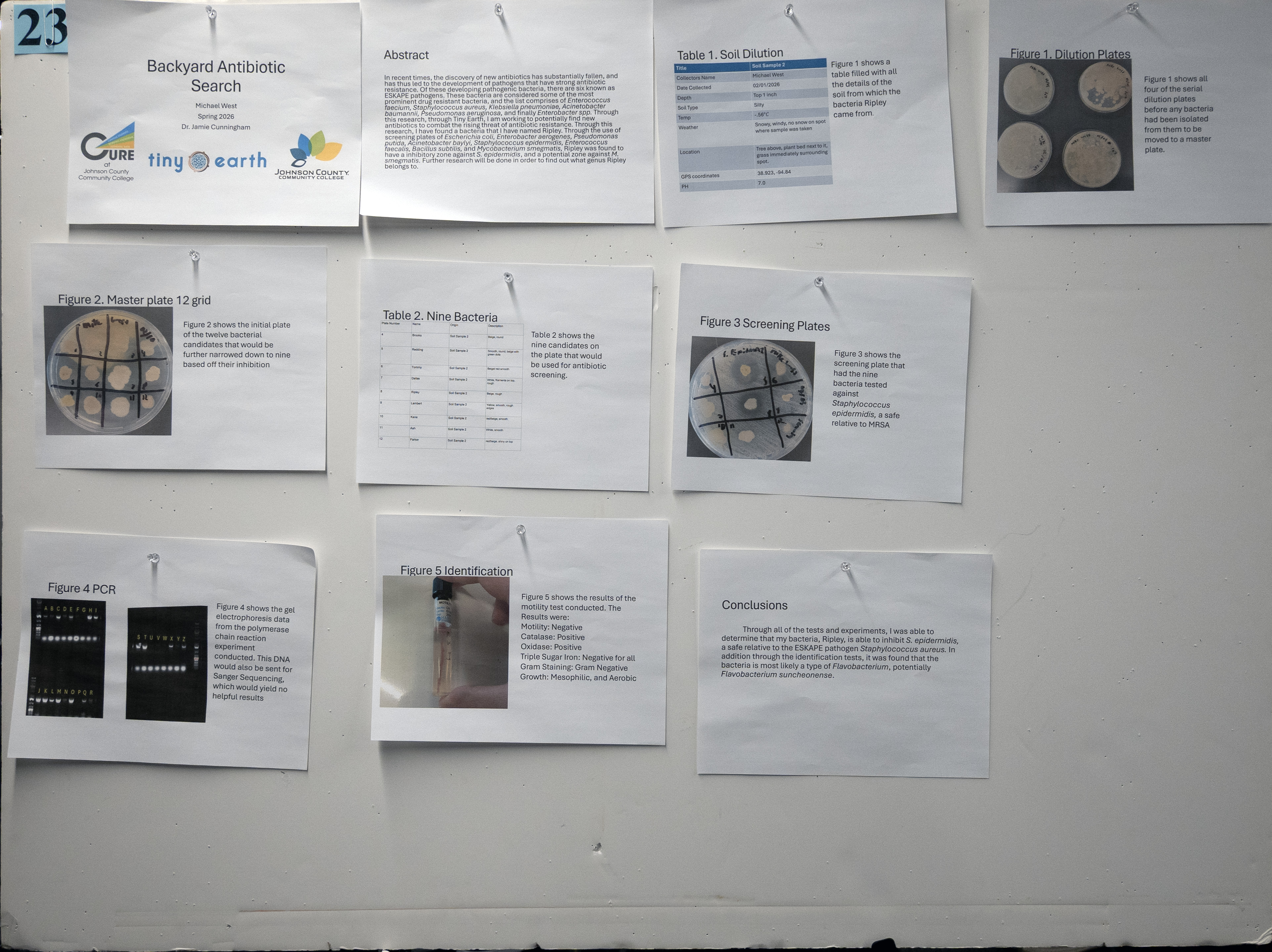
In recent times, the discovery of new antibiotics has substantially fallen, and has thus led to the development of pathogens that have strong antibiotic resistance. Of these developing pathogenic bacteria, there are six known as ESKAPE pathogens. These bacteria are considered some of the most prominent drug resistant bacteria, and the list comprises of Enterococcus faecium, Staphylococcus aureus, Klebsiella pneumoniae, Acinetobacter baumannii, Pseudomonas aeruginosa, and finally Enterobacter spp. Through this research, through Tiny Earth, I am working to potentially find new antibiotics to combat the rising threat of antibiotic resistance. Through this research, I have found a bacteria that I have named Ripley. Through the use of screening plates of Escherichia coli, Enterobacter aerogenes, Pseudomonas putida, Acinetobacter baylyi, Staphylococcus epidermidis, Enterococcus faecalis, Bacillus subtilis, and Mycobacterium smegmatis, Ripley was found to have a inhibitory zone against S. epidermidis, and a potential zone against M. smegmatis. Further research will be done in order to find out what genus Ripley belongs to.
Image
Backyard Antibiotic Search
CoLab, COM 163
In recent times, the discovery of new antibiotics has substantially fallen, and has thus led to the development of pathogens that have strong antibiotic resistance. Of these developing pathogenic bacteria, there are six known as ESKAPE pathogens. These bacteria are considered some of the most prominent drug resistant bacteria, and the list comprises of Enterococcus faecium, Staphylococcus aureus, Klebsiella pneumoniae, Acinetobacter baumannii, Pseudomonas aeruginosa, and finally Enterobacter spp. Through this research, through Tiny Earth, I am working to potentially find new antibiotics to combat the rising threat of antibiotic resistance. Through this research, I have found a bacteria that I have named Ripley. Through the use of screening plates of Escherichia coli, Enterobacter aerogenes, Pseudomonas putida, Acinetobacter baylyi, Staphylococcus epidermidis, Enterococcus faecalis, Bacillus subtilis, and Mycobacterium smegmatis, Ripley was found to have a inhibitory zone against S. epidermidis, and a potential zone against M. smegmatis. Further research will be done in order to find out what genus Ripley belongs to.
Comments
The faculty mentor for this project was Jamie Cunningham.