

Exploring Soil Bacteria for Novel Antibiotic Production
Location
CoLab, COM 162
Start Date
30-4-2026 9:30 AM
Document Type
Poster
Description
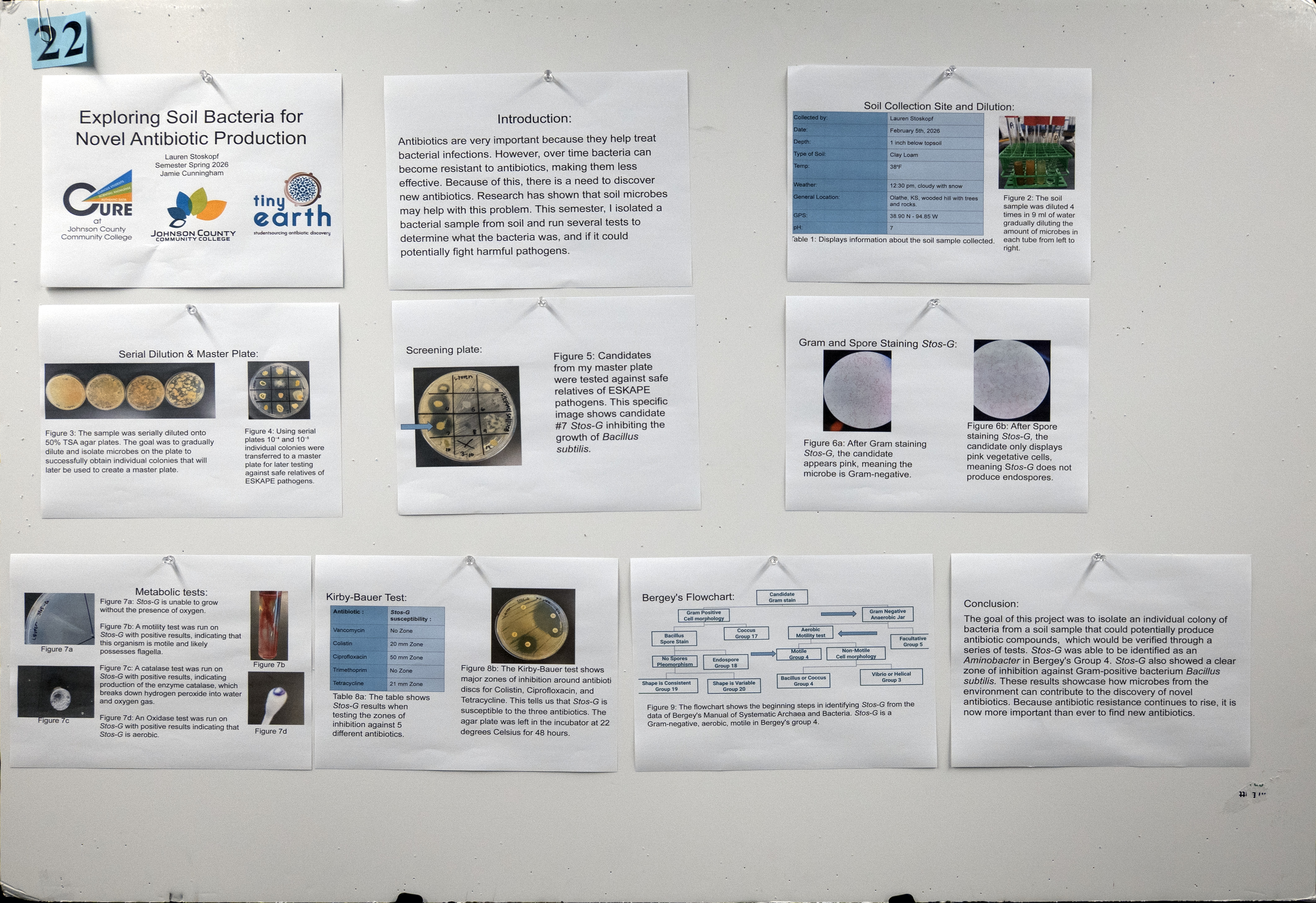
This research was important because it gave me the chance to explore how soil bacteria naturally produce compounds that could act as antibiotics, which is exciting for discovering new ways to fight harmful microbes. I collected soil samples and did serial dilutions to isolate individual bacterial colonies so I could test which ones might stop the growth of target organisms. Using screening plates, I could see which candidates created zones of inhibition, showing which strains might be producing effective antimicrobial compounds. Then, by making streak plates from my selected candidates, I was able to make sure the isolates were pure and that the activity I saw came from just one strain. Throughout this project, I learned how important it is to be careful with dilutions and plating techniques to get accurate results. I also gained hands-on experience reading bacterial growth patterns, understanding how colony shapes and inhibition zones give clues about antibiotic production, and keeping my results organized and reproducible. Overall, this project helped me see the connection between microbiology and antibiotic discovery, practice precise lab techniques, and understand how methodical experiments lead to trustworthy results. Doing this work gave me a better sense of how to screen, isolate, and analyze bacteria, and it showed me how soil bacteria can be a potential source of new antibiotics.
Image
Exploring Soil Bacteria for Novel Antibiotic Production
CoLab, COM 162
This research was important because it gave me the chance to explore how soil bacteria naturally produce compounds that could act as antibiotics, which is exciting for discovering new ways to fight harmful microbes. I collected soil samples and did serial dilutions to isolate individual bacterial colonies so I could test which ones might stop the growth of target organisms. Using screening plates, I could see which candidates created zones of inhibition, showing which strains might be producing effective antimicrobial compounds. Then, by making streak plates from my selected candidates, I was able to make sure the isolates were pure and that the activity I saw came from just one strain. Throughout this project, I learned how important it is to be careful with dilutions and plating techniques to get accurate results. I also gained hands-on experience reading bacterial growth patterns, understanding how colony shapes and inhibition zones give clues about antibiotic production, and keeping my results organized and reproducible. Overall, this project helped me see the connection between microbiology and antibiotic discovery, practice precise lab techniques, and understand how methodical experiments lead to trustworthy results. Doing this work gave me a better sense of how to screen, isolate, and analyze bacteria, and it showed me how soil bacteria can be a potential source of new antibiotics.
Comments
The faculty mentor for this project was Jamie Cunningham.