

Exploration of Antimicrobial Candidates from Leawood Park Soil
Location
CoLab, COM 106
Start Date
30-4-2026 8:15 AM
Document Type
Poster
Description
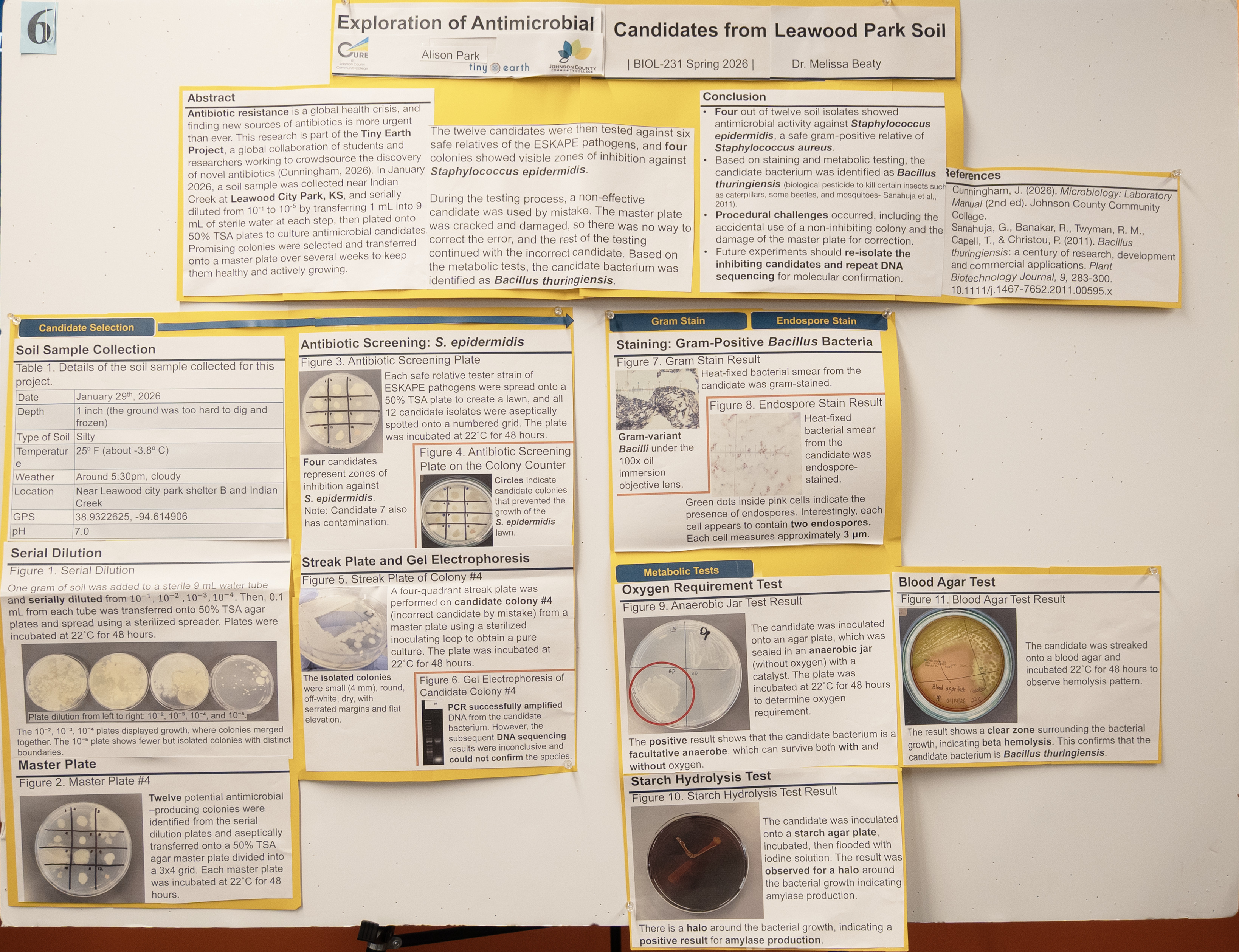
Antibiotic resistance is a global health crisis, and finding new sources of antibiotics is more urgent than ever. This research is part of the Tiny Earth Project, a global collaboration of students and researchers working to crowdsource the discovery of novel antibiotics. In January 2026, a soil sample was collected near Indian Creek at Leawood City Park, KS, and serially diluted from 10-1 to 10-5 by transferring 1 mL into 9 mL of sterile water at each step, then plated onto 50% TSA plates to culture antimicrobial candidates. Promising colonies were selected and transferred onto master plate over several weeks to keep them healthy and actively growing. The twelve candidates were then tested against six safe relatives of the ESKAPE pathogens, and four colonies showed visible zones of inhibition against Staphylococcus epidermidis. One colony was selected for further identification of its genus.
Image
Exploration of Antimicrobial Candidates from Leawood Park Soil
CoLab, COM 106
Antibiotic resistance is a global health crisis, and finding new sources of antibiotics is more urgent than ever. This research is part of the Tiny Earth Project, a global collaboration of students and researchers working to crowdsource the discovery of novel antibiotics. In January 2026, a soil sample was collected near Indian Creek at Leawood City Park, KS, and serially diluted from 10-1 to 10-5 by transferring 1 mL into 9 mL of sterile water at each step, then plated onto 50% TSA plates to culture antimicrobial candidates. Promising colonies were selected and transferred onto master plate over several weeks to keep them healthy and actively growing. The twelve candidates were then tested against six safe relatives of the ESKAPE pathogens, and four colonies showed visible zones of inhibition against Staphylococcus epidermidis. One colony was selected for further identification of its genus.
Comments
The faculty mentor for this project was Melissa Beaty.