

IM TAU - Analysis
Location
CoLab, COM 141
Start Date
30-4-2026 9:30 AM
Document Type
Poster
Description
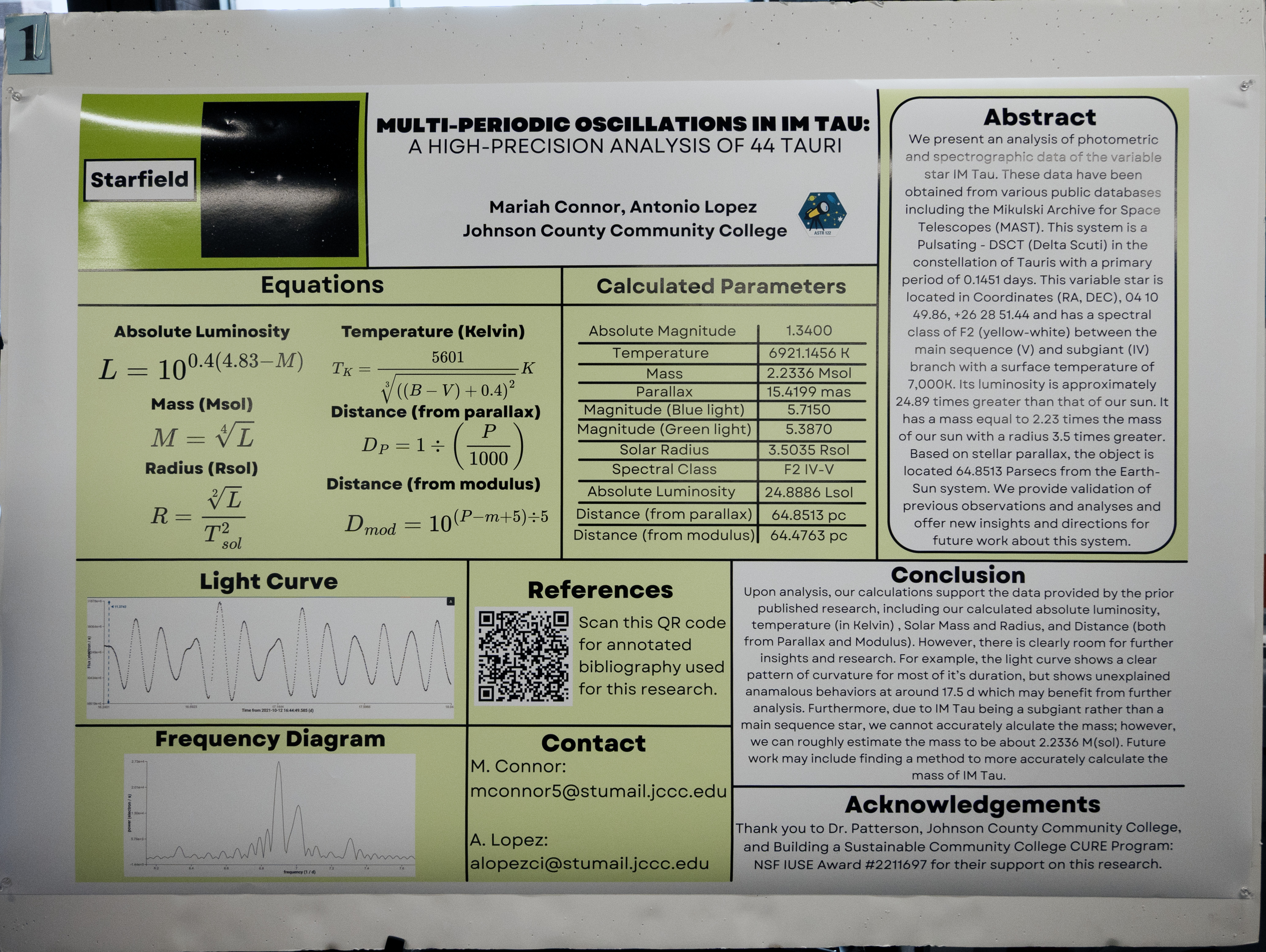
We present an analysis of photometric and spectrographic data of the variable star IM Tau. These data have been obtained from various public databases including the Mikulski Archive for Space Telescopes (MAST). This system is a Pulsating - DSCT (Delta Scuti) in the constellation of Tauris with a primary period of 0.1450670000 days. This variable star is located in Coordinates (RA, DEC), 04 10 49.86, +26 28 51.44 and has a spectral class of F2 (yellow-white) between the main sequence (V) and subgiant (IV) branch with a surface temperature of 7,000K. Its luminosity is approximately 24.89 times greater than that of our sun. It has a mass equal to 2.23 times the mass of our sun with a radius 3.5 times greater. Based on stellar parallax, the object is located 64.8513 Parsecs from the Earth-Sun system. We provide validation of previous observations and analyses and offer new insights and directions for future work about this system.
Image
IM TAU - Analysis
CoLab, COM 141
We present an analysis of photometric and spectrographic data of the variable star IM Tau. These data have been obtained from various public databases including the Mikulski Archive for Space Telescopes (MAST). This system is a Pulsating - DSCT (Delta Scuti) in the constellation of Tauris with a primary period of 0.1450670000 days. This variable star is located in Coordinates (RA, DEC), 04 10 49.86, +26 28 51.44 and has a spectral class of F2 (yellow-white) between the main sequence (V) and subgiant (IV) branch with a surface temperature of 7,000K. Its luminosity is approximately 24.89 times greater than that of our sun. It has a mass equal to 2.23 times the mass of our sun with a radius 3.5 times greater. Based on stellar parallax, the object is located 64.8513 Parsecs from the Earth-Sun system. We provide validation of previous observations and analyses and offer new insights and directions for future work about this system.
Comments
The faculty mentor for this project was Doug Patterson.