

A Global Search: Antibiotic Resistance
Location
CoLab, COM 421
Start Date
30-4-2026 6:45 PM
Document Type
Poster
Description
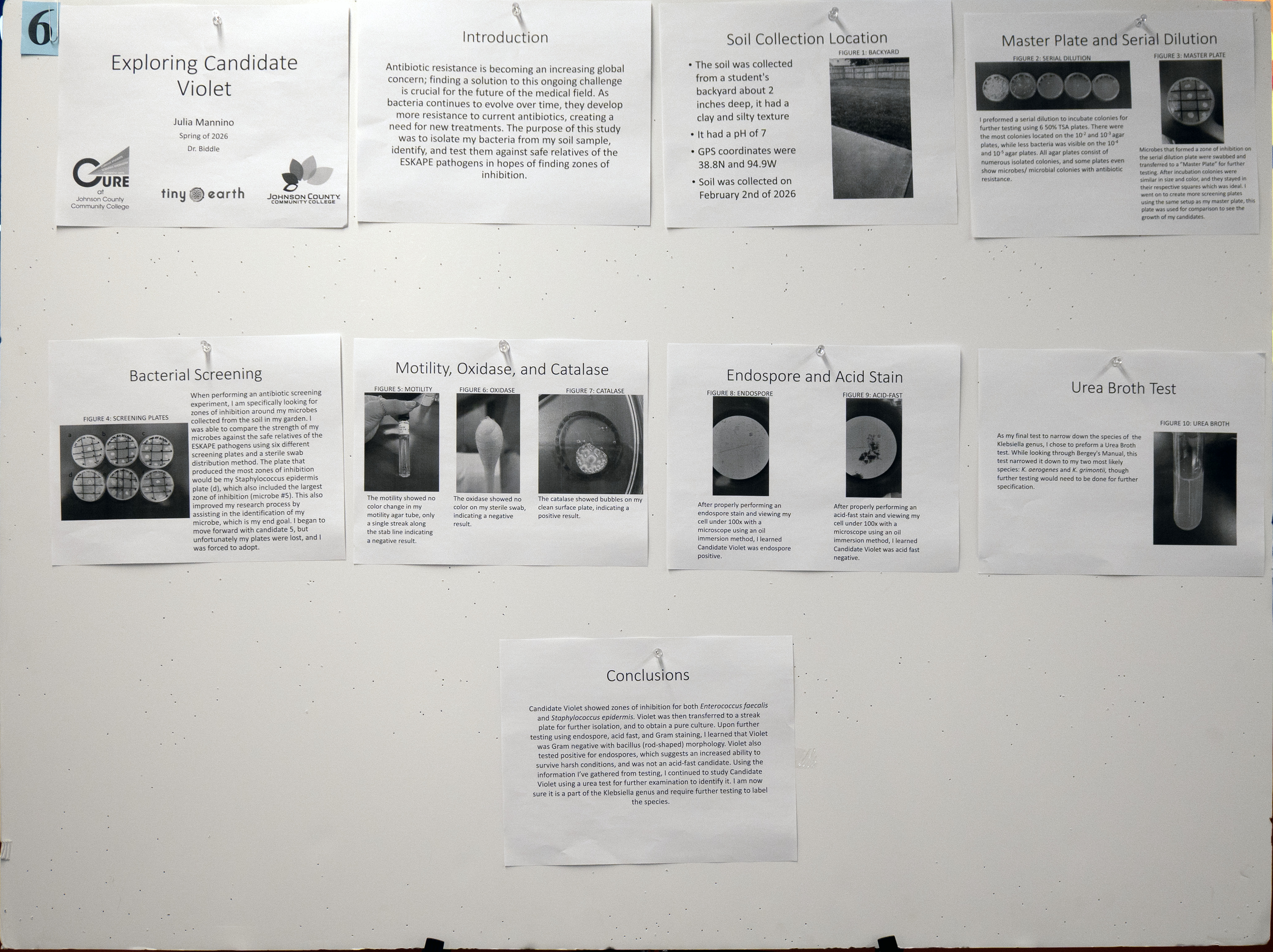
Antibiotic resistance is becoming an increasing global concern; finding a solution to this ongoing global challenge is crucial for the future of the medical field. As bacteria continue to evolve over time, they develop more resistance to current antibiotics, creating a need for new treatments. The purpose of this study was to isolate my bacteria from my soil sample, identify, and test them against safe relatives of the ESKAPE pathogens in hopes of finding zones of inhibition. Candidate Violet showed zones of inhibition for both Enterococcus faecalis and Staphylococcus epidermis. Violet was then transferred to a streak plate for further isolation, and to obtain a pure culture. Upon further testing using endospore, acid fast, and Gram staining, I learned that Violet was Gram negative with bacillus (rod-shaped) morphology. Violet also tested positive for endospores, which suggests an increased ability to survive harsh conditions, and was not an acid fast candidate. Using the information I’ve gathered from testing, I will continue to study Candidate Violet using further examination to identify it.
Image
A Global Search: Antibiotic Resistance
CoLab, COM 421
Antibiotic resistance is becoming an increasing global concern; finding a solution to this ongoing global challenge is crucial for the future of the medical field. As bacteria continue to evolve over time, they develop more resistance to current antibiotics, creating a need for new treatments. The purpose of this study was to isolate my bacteria from my soil sample, identify, and test them against safe relatives of the ESKAPE pathogens in hopes of finding zones of inhibition. Candidate Violet showed zones of inhibition for both Enterococcus faecalis and Staphylococcus epidermis. Violet was then transferred to a streak plate for further isolation, and to obtain a pure culture. Upon further testing using endospore, acid fast, and Gram staining, I learned that Violet was Gram negative with bacillus (rod-shaped) morphology. Violet also tested positive for endospores, which suggests an increased ability to survive harsh conditions, and was not an acid fast candidate. Using the information I’ve gathered from testing, I will continue to study Candidate Violet using further examination to identify it.
Comments
The faculty mentor for this project was Eulandria Biddle.