

Isolation, Testing, and Identification of the Antimicrobial Compounds Produced by Bacteria Isolated from a Soil Sample
Location
CoLab, COM 403
Start Date
30-4-2026 5:30 PM
Document Type
Poster
Description
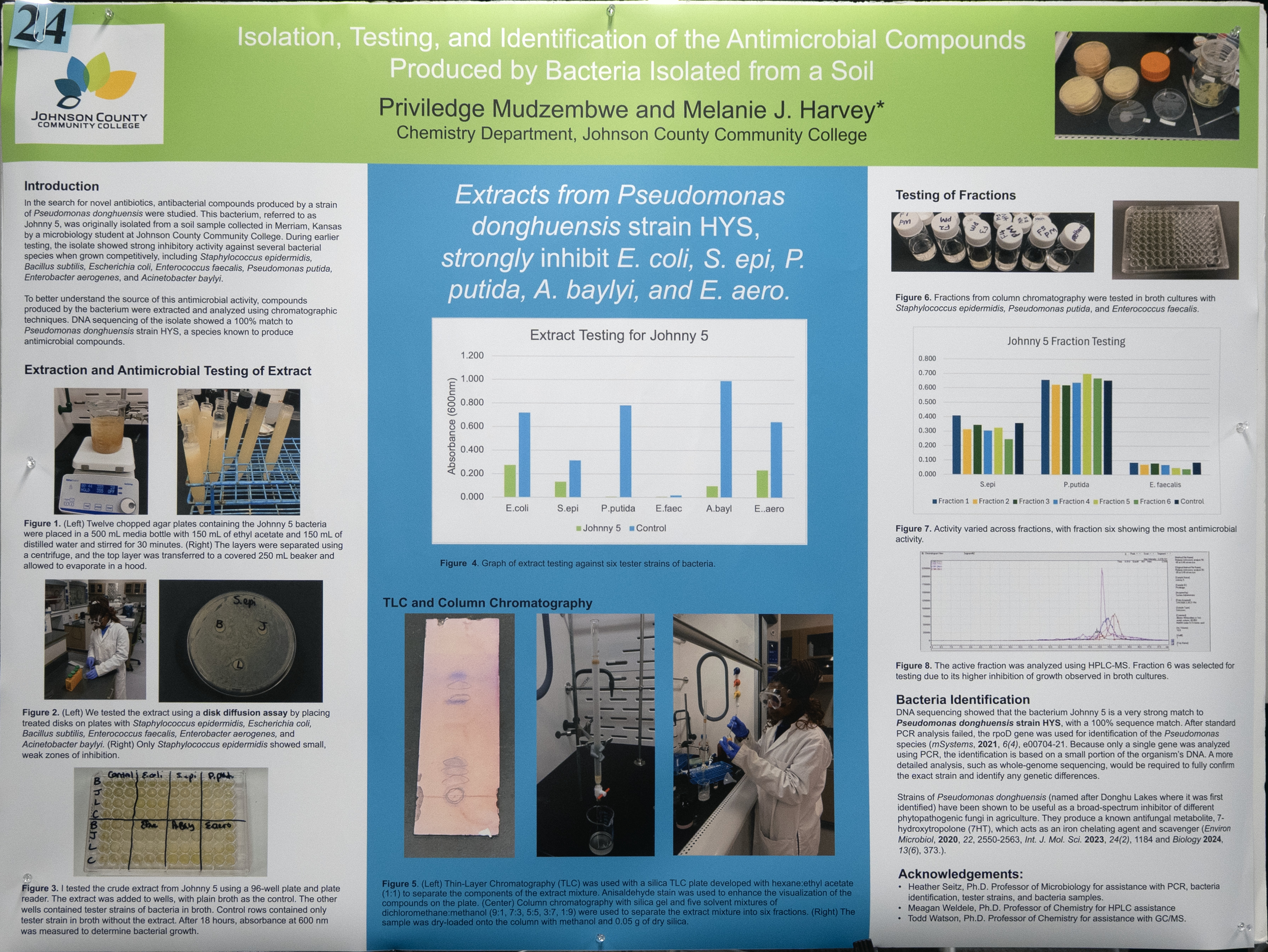
In the search for novel antibiotics, antibacterial compounds produced by a strain of Pseudomonas donghuensis were studied. This bacterium, referred to as Johnny 5, was originally isolated from a soil sample collected in Merriam, Kansas by a microbiology student at Johnson County Community College. During earlier testing, the isolate showed strong inhibitory activity against several bacterial species when grown competitively, including Staphylococcus epidermidis, Bacillus subtilis, Escherichia coli, Enterococcus faecalis, Pseudomonas putida, Enterobacter aerogenes, and Acinetobacter baylyi. To better understand the source of this antimicrobial activity, compounds produced by the bacterium were extracted and analyzed using chromatographic techniques. DNA sequencing of the isolate showed a 100% match to Pseudomonas donghuensis strain HYS, confirming the identity of the bacterium. These results suggest that Johnny 5 is a member of Pseudomonas donghuensis, a species known to produce antimicrobial compounds, which may explain the strong antibacterial activity observed in this study.
Image
Isolation, Testing, and Identification of the Antimicrobial Compounds Produced by Bacteria Isolated from a Soil Sample
CoLab, COM 403
In the search for novel antibiotics, antibacterial compounds produced by a strain of Pseudomonas donghuensis were studied. This bacterium, referred to as Johnny 5, was originally isolated from a soil sample collected in Merriam, Kansas by a microbiology student at Johnson County Community College. During earlier testing, the isolate showed strong inhibitory activity against several bacterial species when grown competitively, including Staphylococcus epidermidis, Bacillus subtilis, Escherichia coli, Enterococcus faecalis, Pseudomonas putida, Enterobacter aerogenes, and Acinetobacter baylyi. To better understand the source of this antimicrobial activity, compounds produced by the bacterium were extracted and analyzed using chromatographic techniques. DNA sequencing of the isolate showed a 100% match to Pseudomonas donghuensis strain HYS, confirming the identity of the bacterium. These results suggest that Johnny 5 is a member of Pseudomonas donghuensis, a species known to produce antimicrobial compounds, which may explain the strong antibacterial activity observed in this study.
Comments
The faculty mentor for this project was Melanie Harvey.