

Bacillus
Location
CoLab, COM 394
Start Date
30-4-2026 5:30 PM
Document Type
Poster
Description
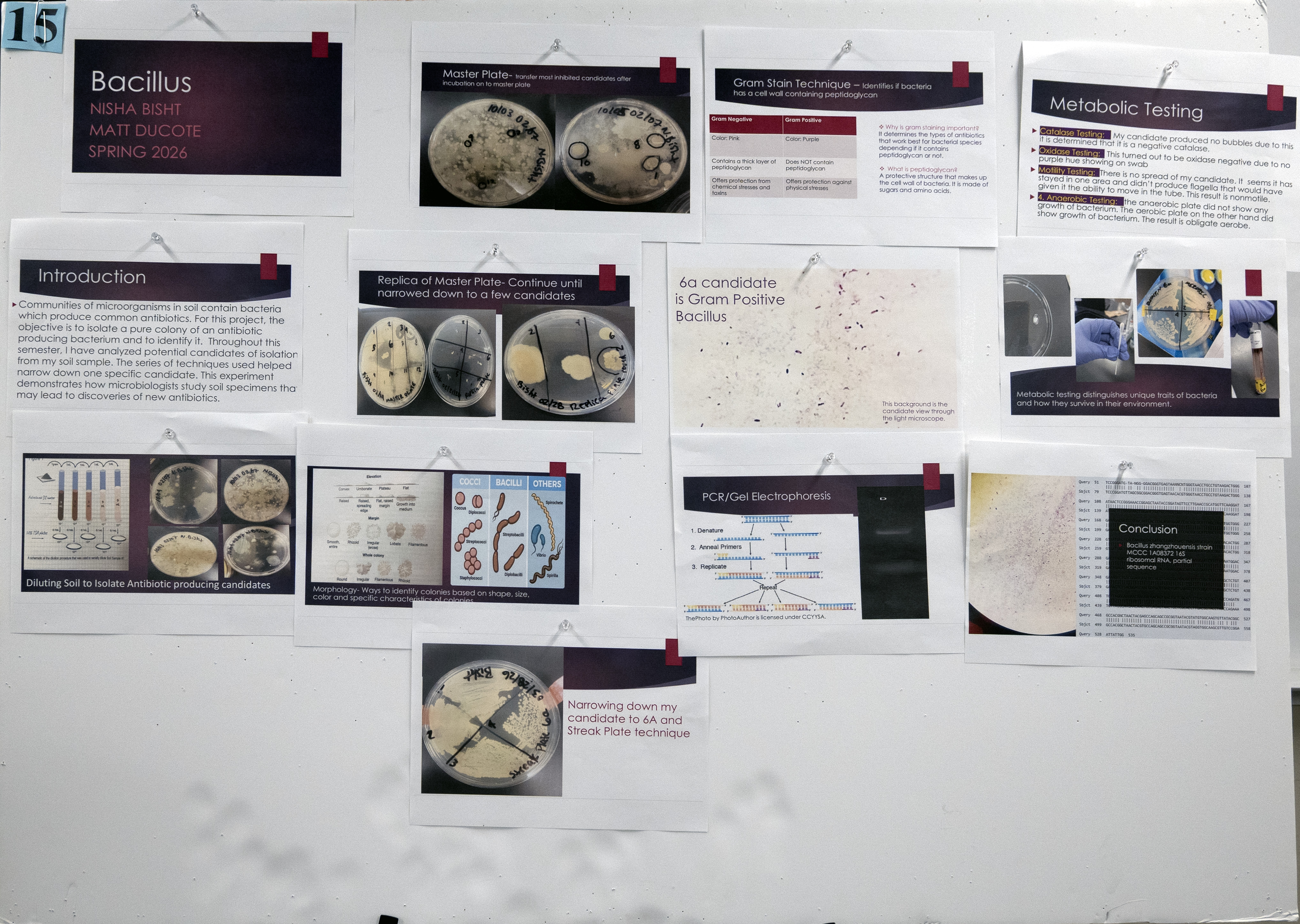
Since the discovery of penicillin in the late 1920’s, the study of antibiotic resistance in bacteria has led to a hallway of doors whose openings have aided in the discovery of various antibiotics. Research by environmental microbiologists has revealed that soil contains antibiotic resistant strains of bacteria that are used in today's medicine. Communities of microorganisms in soil are known to contain bacteria which produce common antibiotics. For this project, the objective is to isolate a pure colony of an antibiotic producing bacterium and to identify it. The origin of the soil sample sourced for this experiment is from Mission, KS. Throughout this semester, I have analyzed potential candidates of isolation from my soil sample. A series of techniques such as soil dilution, streak plating, replica plating, various staining methods, polymerase chain reaction, and gel electrophoresis were used. These techniques helped narrow down one dominant candidate that won the competition of showing growth inhibition of a potential pathogen and to identify the microorganism. This experiment demonstrates how microbiologists study soil specimens that may lead to discoveries of new antibiotics.
Image
Bacillus
CoLab, COM 394
Since the discovery of penicillin in the late 1920’s, the study of antibiotic resistance in bacteria has led to a hallway of doors whose openings have aided in the discovery of various antibiotics. Research by environmental microbiologists has revealed that soil contains antibiotic resistant strains of bacteria that are used in today's medicine. Communities of microorganisms in soil are known to contain bacteria which produce common antibiotics. For this project, the objective is to isolate a pure colony of an antibiotic producing bacterium and to identify it. The origin of the soil sample sourced for this experiment is from Mission, KS. Throughout this semester, I have analyzed potential candidates of isolation from my soil sample. A series of techniques such as soil dilution, streak plating, replica plating, various staining methods, polymerase chain reaction, and gel electrophoresis were used. These techniques helped narrow down one dominant candidate that won the competition of showing growth inhibition of a potential pathogen and to identify the microorganism. This experiment demonstrates how microbiologists study soil specimens that may lead to discoveries of new antibiotics.
Comments
The faculty mentor for this project was Matt Ducote.