

From Soil to Solution: Isolation of a Broad-Spectrum Antimicrobial Bacterium Using Safe-Relative Screening for Antibiotic Discovery
Location
CoLab, COM 364
Start Date
30-4-2026 3:45 PM
Document Type
Poster
Description
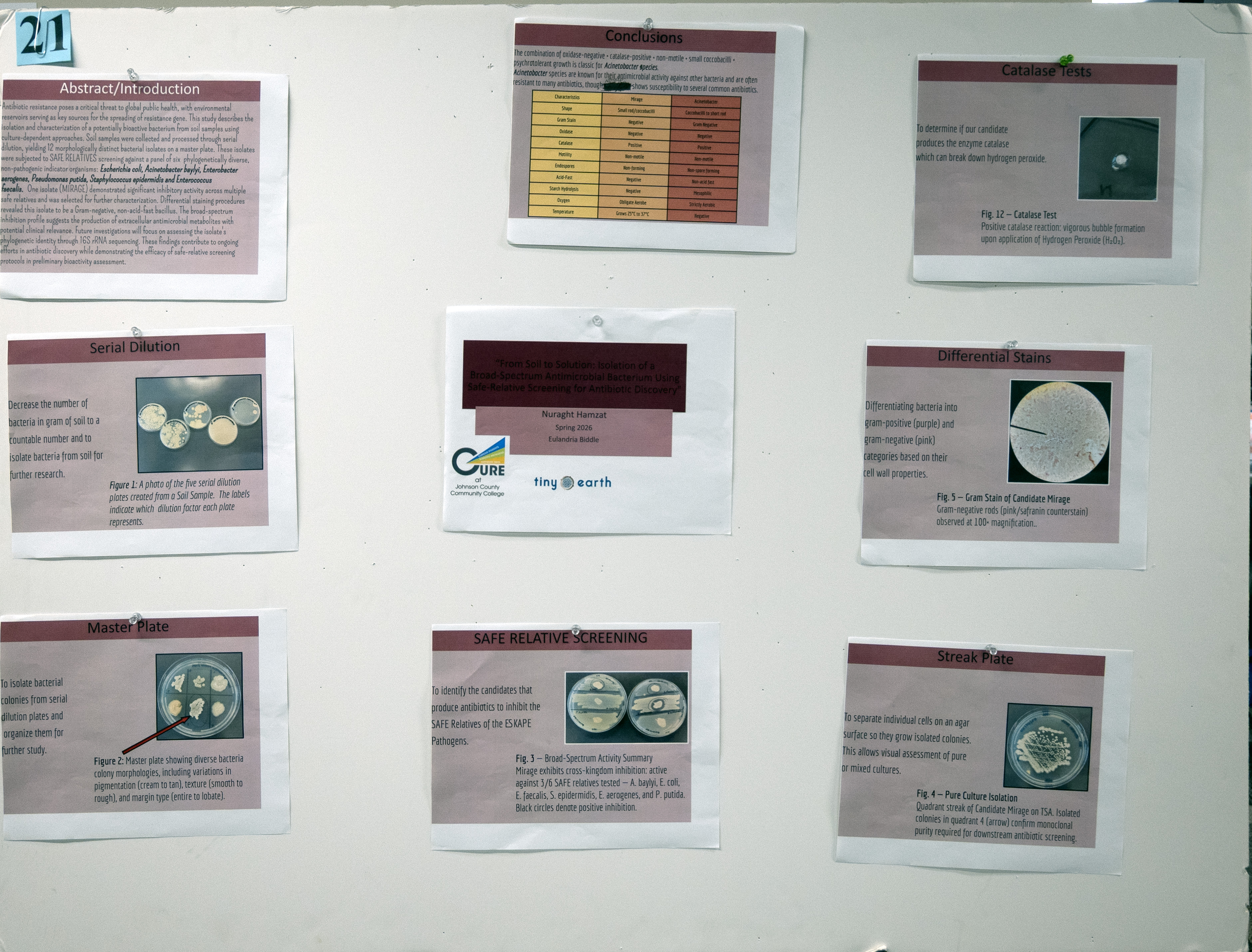
Antibiotic resistance poses a critical threat to global public health, with environmental reservoirs serving as key sources for the spreading of resistance gene. This study describes the isolation and characterization of a potentially bioactive bacterium from soil samples using culture-dependent approaches. Soil samples were collected and processed through serial dilution, yielding 12 morphologically distinct bacterial isolates on a master plate. These isolates were subjected to SAFE RELATIVES screening against a panel of eight phylogenetically diverse, non-pathogenic indicator organisms: Escherichia coli, Acinetobacter baylyi, Enterobacter aerogenes, Pseudomonas putida, Staphylococcus epidermidis, Enterococcus faecalis, Bacillus subtilis, and Mycobacterium smegmatis. One isolate (MIRAGE) demonstrated significant inhibitory activity across multiple safe relatives and was selected for further characterization. Differential staining procedures revealed this isolate to be a Gram-negative, non-acid-fast bacillus. The broad-spectrum inhibition profile suggests the production of extracellular antimicrobial metabolites with potential clinical relevance. This work highlights the continued value of soil microbiome exploration in addressing the antibiotic discovery pipeline, particularly through targeting previously uncultured or underexplored bacterial taxa. Future investigations will focus on assessing the isolate's phylogenetic identity through 16S rRNA sequencing. These findings contribute to ongoing efforts in antibiotic discovery while demonstrating the efficacy of safe-relative screening protocols in preliminary bioactivity assessment.
Image
From Soil to Solution: Isolation of a Broad-Spectrum Antimicrobial Bacterium Using Safe-Relative Screening for Antibiotic Discovery
CoLab, COM 364
Antibiotic resistance poses a critical threat to global public health, with environmental reservoirs serving as key sources for the spreading of resistance gene. This study describes the isolation and characterization of a potentially bioactive bacterium from soil samples using culture-dependent approaches. Soil samples were collected and processed through serial dilution, yielding 12 morphologically distinct bacterial isolates on a master plate. These isolates were subjected to SAFE RELATIVES screening against a panel of eight phylogenetically diverse, non-pathogenic indicator organisms: Escherichia coli, Acinetobacter baylyi, Enterobacter aerogenes, Pseudomonas putida, Staphylococcus epidermidis, Enterococcus faecalis, Bacillus subtilis, and Mycobacterium smegmatis. One isolate (MIRAGE) demonstrated significant inhibitory activity across multiple safe relatives and was selected for further characterization. Differential staining procedures revealed this isolate to be a Gram-negative, non-acid-fast bacillus. The broad-spectrum inhibition profile suggests the production of extracellular antimicrobial metabolites with potential clinical relevance. This work highlights the continued value of soil microbiome exploration in addressing the antibiotic discovery pipeline, particularly through targeting previously uncultured or underexplored bacterial taxa. Future investigations will focus on assessing the isolate's phylogenetic identity through 16S rRNA sequencing. These findings contribute to ongoing efforts in antibiotic discovery while demonstrating the efficacy of safe-relative screening protocols in preliminary bioactivity assessment.
Comments
The faculty mentor for this project was Eulandria Biddle.