

Dilution and Observation of My Backyard Soil
Location
CoLab, COM 325
Start Date
30-4-2026 2:30 PM
Document Type
Poster
Description
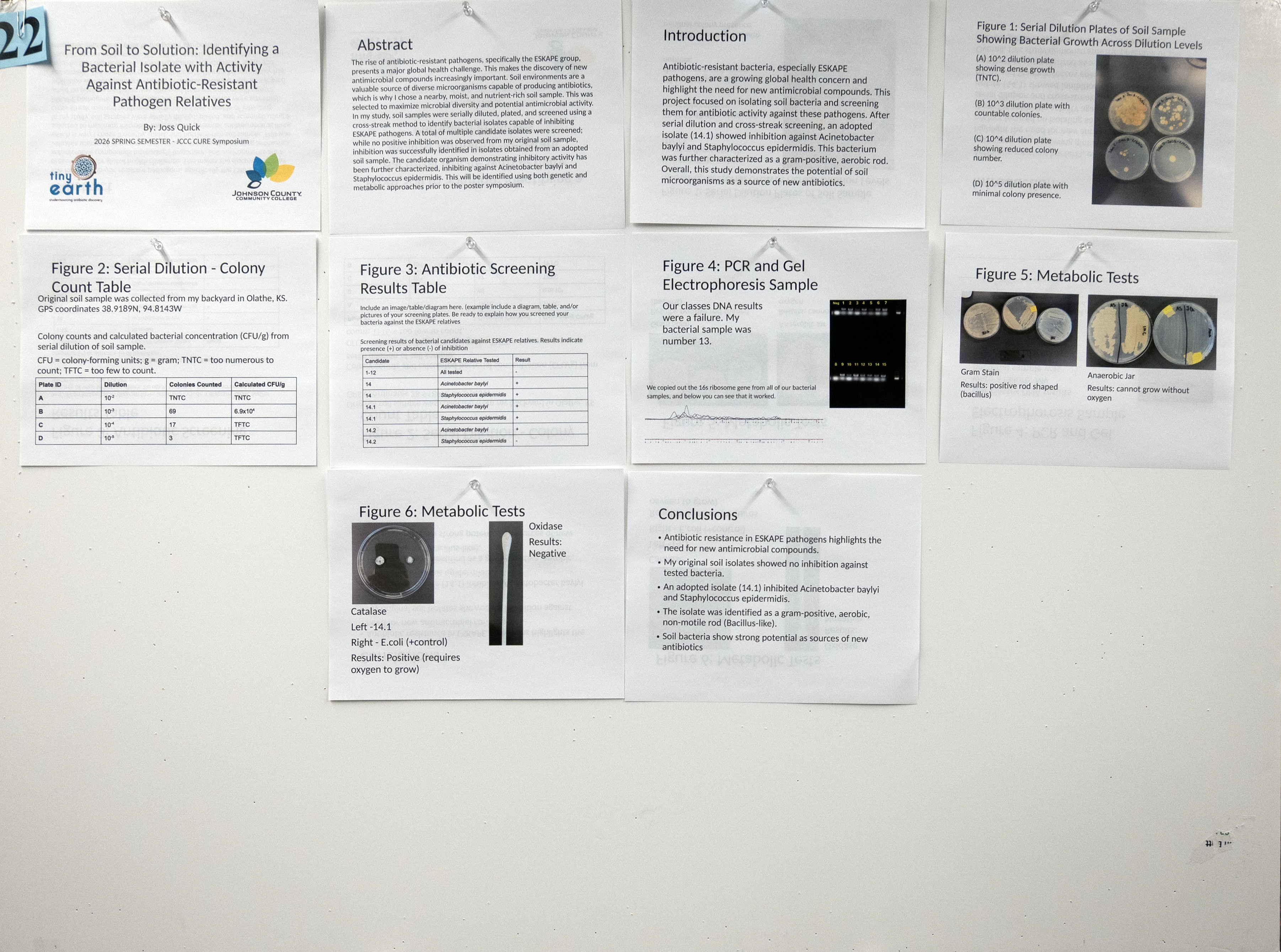
The rise of antibiotic-resistant pathogens, specifically the ESKAPE group, presents a major global health challenge. This makes the discovery of new antimicrobial compounds increasingly important. Soil environments are a valuable source of diverse microorganisms capable of producing antibiotics, which is why I chose a nearby, moist, and nutrient-rich soil sample. This was selected to maximize microbial diversity and potential antimicrobial activity. In my study, soil samples were serially diluted, plated, and screened using a cross-streak method to identify bacterial isolates capable of inhibiting ESKAPE pathogens. A total of multiple candidate isolates were screened; while no positive inhibition was observed from my original soil sample, inhibition was successfully identified in isolates obtained from an adopted soil sample. The candidate organism demonstrating inhibitory activity has been further characterized, inhibiting against Acinetobacter baylyi and Staphylococcus epidermidis. This will be identified using both genetic and metabolic approaches prior to the poster symposium.
Image
Dilution and Observation of My Backyard Soil
CoLab, COM 325
The rise of antibiotic-resistant pathogens, specifically the ESKAPE group, presents a major global health challenge. This makes the discovery of new antimicrobial compounds increasingly important. Soil environments are a valuable source of diverse microorganisms capable of producing antibiotics, which is why I chose a nearby, moist, and nutrient-rich soil sample. This was selected to maximize microbial diversity and potential antimicrobial activity. In my study, soil samples were serially diluted, plated, and screened using a cross-streak method to identify bacterial isolates capable of inhibiting ESKAPE pathogens. A total of multiple candidate isolates were screened; while no positive inhibition was observed from my original soil sample, inhibition was successfully identified in isolates obtained from an adopted soil sample. The candidate organism demonstrating inhibitory activity has been further characterized, inhibiting against Acinetobacter baylyi and Staphylococcus epidermidis. This will be identified using both genetic and metabolic approaches prior to the poster symposium.
Comments
The faculty mentor for this project was Heather Seitz.