

Examining Soil Microbes: Microbial Art, Isolation, and Antibiotic Screening
Location
CoLab, COM 323
Start Date
30-4-2026 2:30 PM
Document Type
Poster
Description
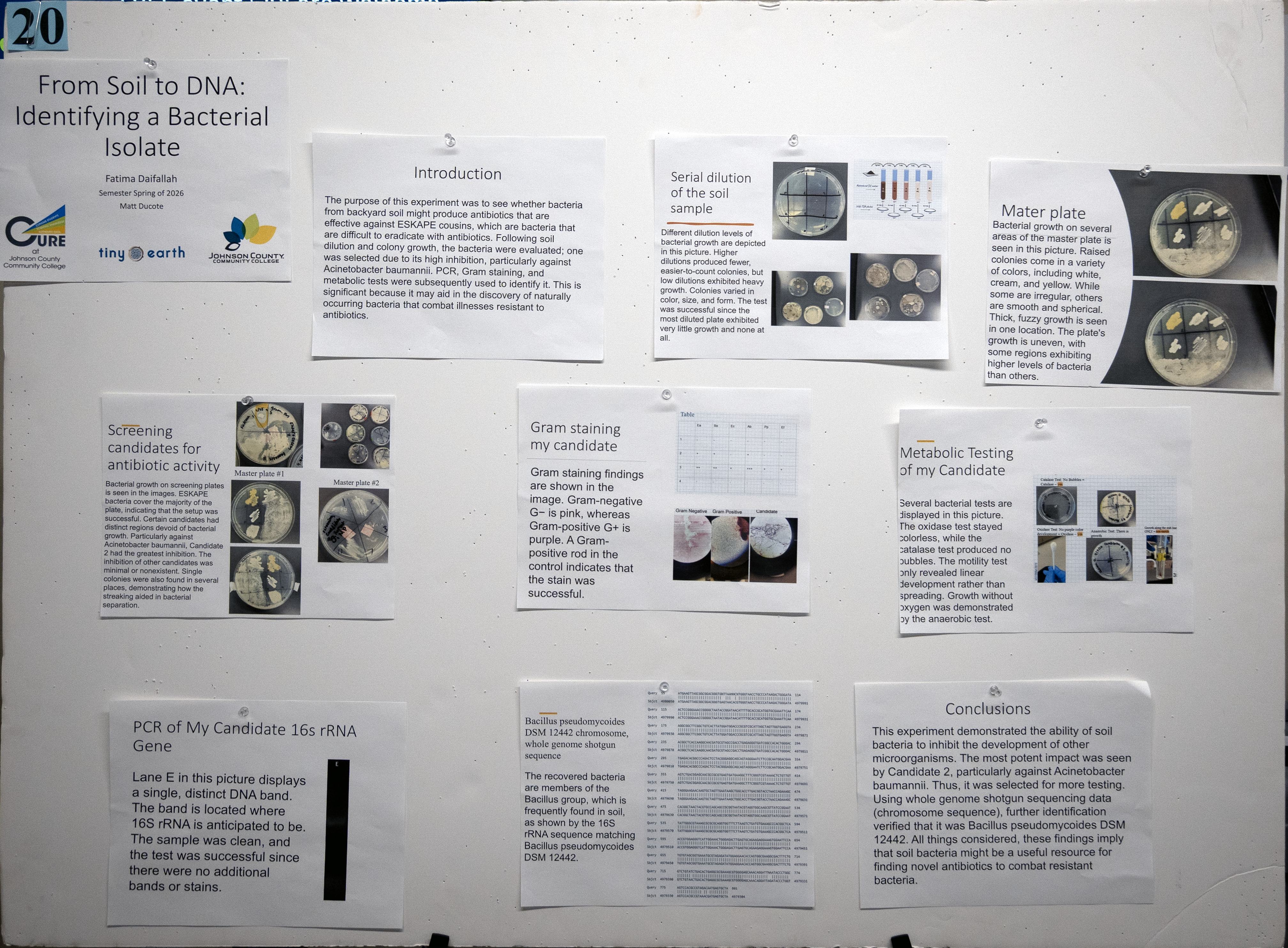
Although microorganisms are everywhere, most people are unaware of their diversity or the methods in which they might be investigated in a laboratory. This experiment is significant because it demonstrates how simple microbiology procedures may be used to isolate, examine, and test soil microorganisms for possible antibiotic activity. The study started with a microbial art project in which environmental samples were used to produce vibrant and diverse growth patterns on agar plates. This exercise provided an interesting visual investigation of microbial variety while highlighting the vast array of colony sizes, forms, and textures that various microorganisms may generate. In order to isolate distinct bacterial colonies, a personal soil sample was then taken and serially diluted. After that, these isolated colonies were moved to a master plate so that certain candidates could be carefully observed and chosen for additional testing. In order to determine whether they might prevent the development of other bacteria, a number of colonies were tested; the results showed distinct zones of inhibition that may indicate antibiotic action. This stage illustrated how soil bacteria may be a source of physiologically active molecules and how they naturally compete with one another. In order to ascertain the cell shape and whether it was Gram-positive or Gram-negative, the most promising colony from the screening was examined using Gram staining. Important details on the fundamental traits of the bacteria were revealed by this procedure. Overall, this effort highlights the significance of environmental bacteria as a possible source of novel antibiotics and demonstrates crucial microbiology skills by demonstrating how microorganisms from commonplace habitats, such as dirt, may be separated, cultivated, and evaluated.
Image
Examining Soil Microbes: Microbial Art, Isolation, and Antibiotic Screening
CoLab, COM 323
Although microorganisms are everywhere, most people are unaware of their diversity or the methods in which they might be investigated in a laboratory. This experiment is significant because it demonstrates how simple microbiology procedures may be used to isolate, examine, and test soil microorganisms for possible antibiotic activity. The study started with a microbial art project in which environmental samples were used to produce vibrant and diverse growth patterns on agar plates. This exercise provided an interesting visual investigation of microbial variety while highlighting the vast array of colony sizes, forms, and textures that various microorganisms may generate. In order to isolate distinct bacterial colonies, a personal soil sample was then taken and serially diluted. After that, these isolated colonies were moved to a master plate so that certain candidates could be carefully observed and chosen for additional testing. In order to determine whether they might prevent the development of other bacteria, a number of colonies were tested; the results showed distinct zones of inhibition that may indicate antibiotic action. This stage illustrated how soil bacteria may be a source of physiologically active molecules and how they naturally compete with one another. In order to ascertain the cell shape and whether it was Gram-positive or Gram-negative, the most promising colony from the screening was examined using Gram staining. Important details on the fundamental traits of the bacteria were revealed by this procedure. Overall, this effort highlights the significance of environmental bacteria as a possible source of novel antibiotics and demonstrates crucial microbiology skills by demonstrating how microorganisms from commonplace habitats, such as dirt, may be separated, cultivated, and evaluated.
Comments
The faculty mentor for this project was Matt Ducote.