

Enhancing the Efficiency of Chlorella for Polyethylene Terephthalate (PET) Degradation
Location
CoLab, COM 310
Start Date
30-4-2026 2:30 PM
Document Type
Poster
Description
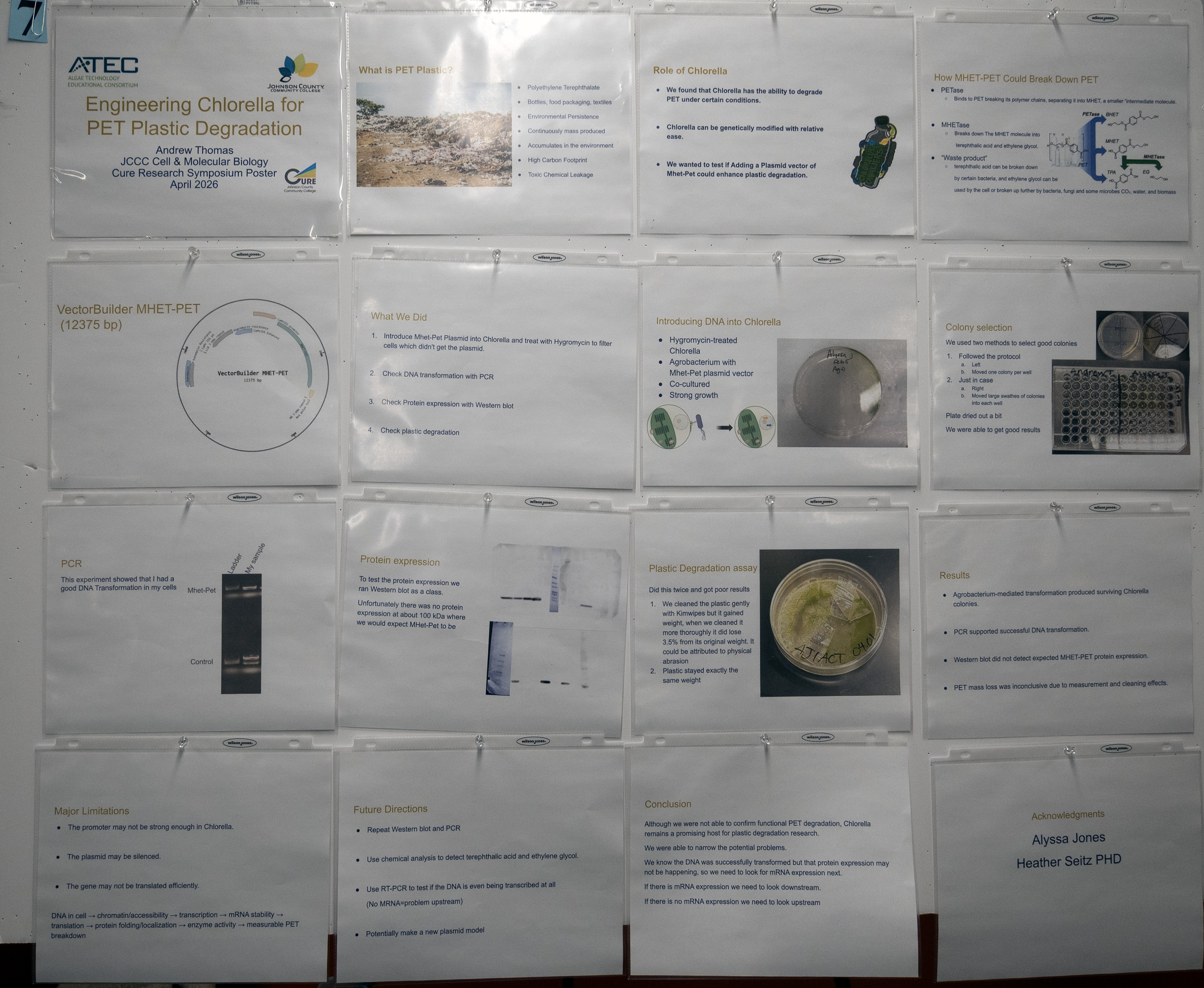
Plastic is a major environmental challenge due to its non-biodegradable nature. We focused on one of the most common plastics in the world, Polyethylene Terephthalate (PET), which is used in plastic bottles, food packaging, polyester materials and more. Previously, our lab discovered that enzymes PETase/MHETase can break down plastic when expressed in Chlorella. Our aim was to validate the previous finding that expressing these enzymes in Chlorella would provide a platform for PET degradation. To do this we obtained Chlorella transformed with PETase/MHETase plasmid construct. We cultured 48 colonies and analyzed the most viable one, based on its growth, for PETase DNA and their ability to interact with and break down PET. Using PCR, we demonstrated successful DNA incorporation. Further, we showed a potential decrease in PET mass compared to control, suggesting protein expression and activity. These results suggest that Chlorella can be used as a platform for PET degradation. Future work will focus on improving gene expression and increasing measurable PET degradation in engineered Chlorella through optimization of promoters, enzyme production, and testing under different environmental conditions. We also aim to determine why only a small amount of PET is degraded and how to sustain and improve degradation over time, as well as to confirm degradation by detecting breakdown products such as terephthalic acid and ethylene glycol.
Image
Enhancing the Efficiency of Chlorella for Polyethylene Terephthalate (PET) Degradation
CoLab, COM 310
Plastic is a major environmental challenge due to its non-biodegradable nature. We focused on one of the most common plastics in the world, Polyethylene Terephthalate (PET), which is used in plastic bottles, food packaging, polyester materials and more. Previously, our lab discovered that enzymes PETase/MHETase can break down plastic when expressed in Chlorella. Our aim was to validate the previous finding that expressing these enzymes in Chlorella would provide a platform for PET degradation. To do this we obtained Chlorella transformed with PETase/MHETase plasmid construct. We cultured 48 colonies and analyzed the most viable one, based on its growth, for PETase DNA and their ability to interact with and break down PET. Using PCR, we demonstrated successful DNA incorporation. Further, we showed a potential decrease in PET mass compared to control, suggesting protein expression and activity. These results suggest that Chlorella can be used as a platform for PET degradation. Future work will focus on improving gene expression and increasing measurable PET degradation in engineered Chlorella through optimization of promoters, enzyme production, and testing under different environmental conditions. We also aim to determine why only a small amount of PET is degraded and how to sustain and improve degradation over time, as well as to confirm degradation by detecting breakdown products such as terephthalic acid and ethylene glycol.
Comments
The faculty mentor for this project was Heather Seitz.