

Lawrence, KS Soil: A Source for Novel Antibiotic Discovery
Location
CoLab, COM 122
Start Date
30-4-2026 8:15 AM
Document Type
Poster
Description
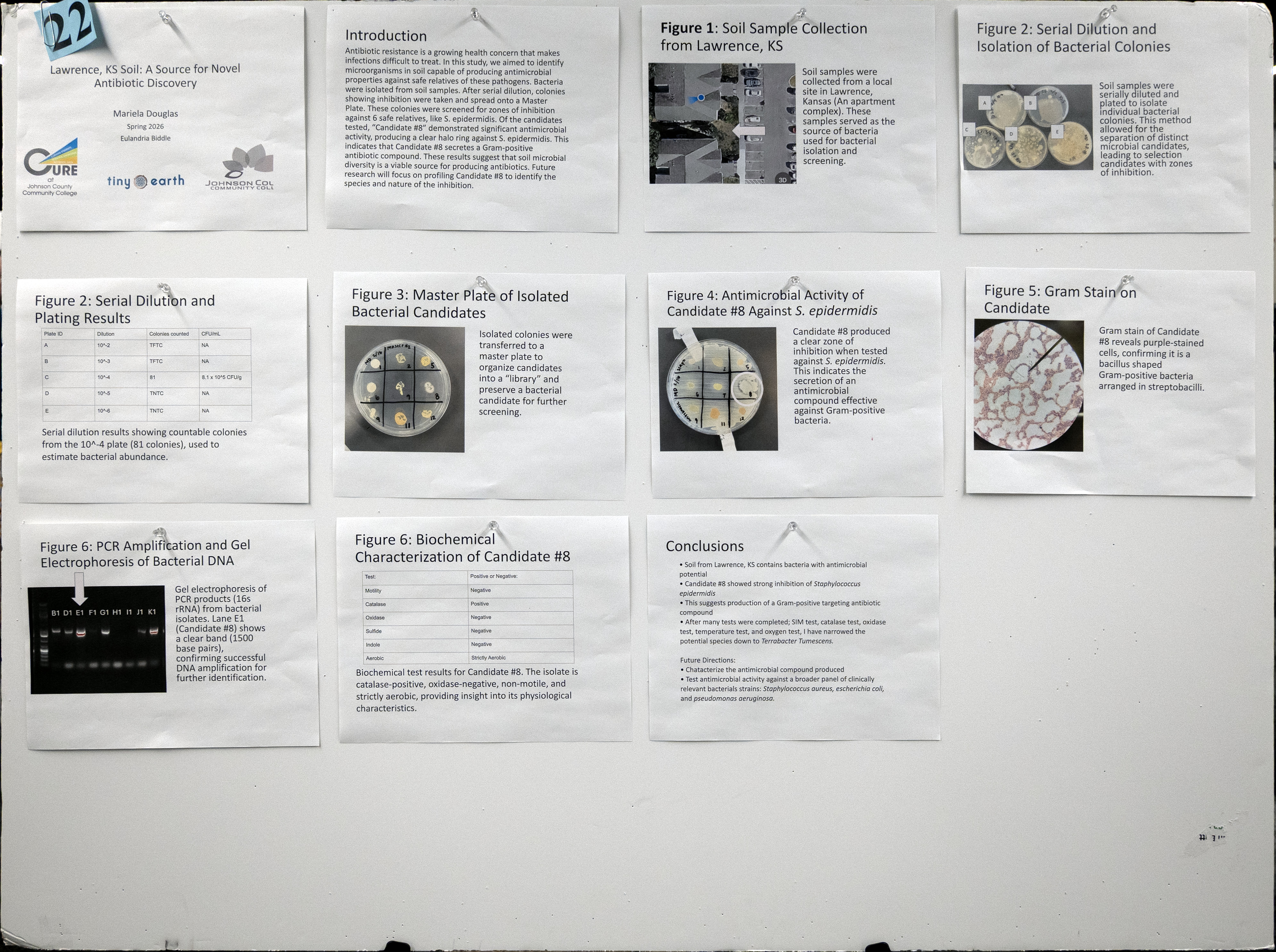
Antibiotic resistance is a growing health concern that affects people globally, making it increasingly difficult to treat certain infections. In this study, we aimed to identify microorganism in the soil that are capable of producing antimicrobial properties against safe relatives of these pathogens. Bacteria samples were isolated from soil samples. After serial dilution was performed, bacterial colonies that showed any signs of inhibition of growth were taken and spread onto a Master Plate. These colonies on the master plate were then screened for zones of inhibition against 6 safe relatives, like S. epidermidis, which is a safe relative of S. aureus. Of the various candidates tested, “Candidate #8” demonstrated significant antimicrobial activity, producing a clear halo ring against the lawn of S. epidermidis. This indicates that Candidate #8 secretes a broad spectrum or Gram-positive antibiotic compound. These results suggest that microbial diversity in soil continues to be a viable source for taking action on producing more antibiotics to help fight this health concern. Future research will focus on the profiling of Candidate #8 to identify the species and the specific nature of the production of inhibition.
Image
Lawrence, KS Soil: A Source for Novel Antibiotic Discovery
CoLab, COM 122
Antibiotic resistance is a growing health concern that affects people globally, making it increasingly difficult to treat certain infections. In this study, we aimed to identify microorganism in the soil that are capable of producing antimicrobial properties against safe relatives of these pathogens. Bacteria samples were isolated from soil samples. After serial dilution was performed, bacterial colonies that showed any signs of inhibition of growth were taken and spread onto a Master Plate. These colonies on the master plate were then screened for zones of inhibition against 6 safe relatives, like S. epidermidis, which is a safe relative of S. aureus. Of the various candidates tested, “Candidate #8” demonstrated significant antimicrobial activity, producing a clear halo ring against the lawn of S. epidermidis. This indicates that Candidate #8 secretes a broad spectrum or Gram-positive antibiotic compound. These results suggest that microbial diversity in soil continues to be a viable source for taking action on producing more antibiotics to help fight this health concern. Future research will focus on the profiling of Candidate #8 to identify the species and the specific nature of the production of inhibition.
Comments
The faculty mentor for this project was Eulandria Biddle.