

Tiny Earth Project: The Search for Antibiotic Producers in Soil
Location
CoLab, COM 317
Start Date
30-4-2026 2:30 PM
Document Type
Poster
Description
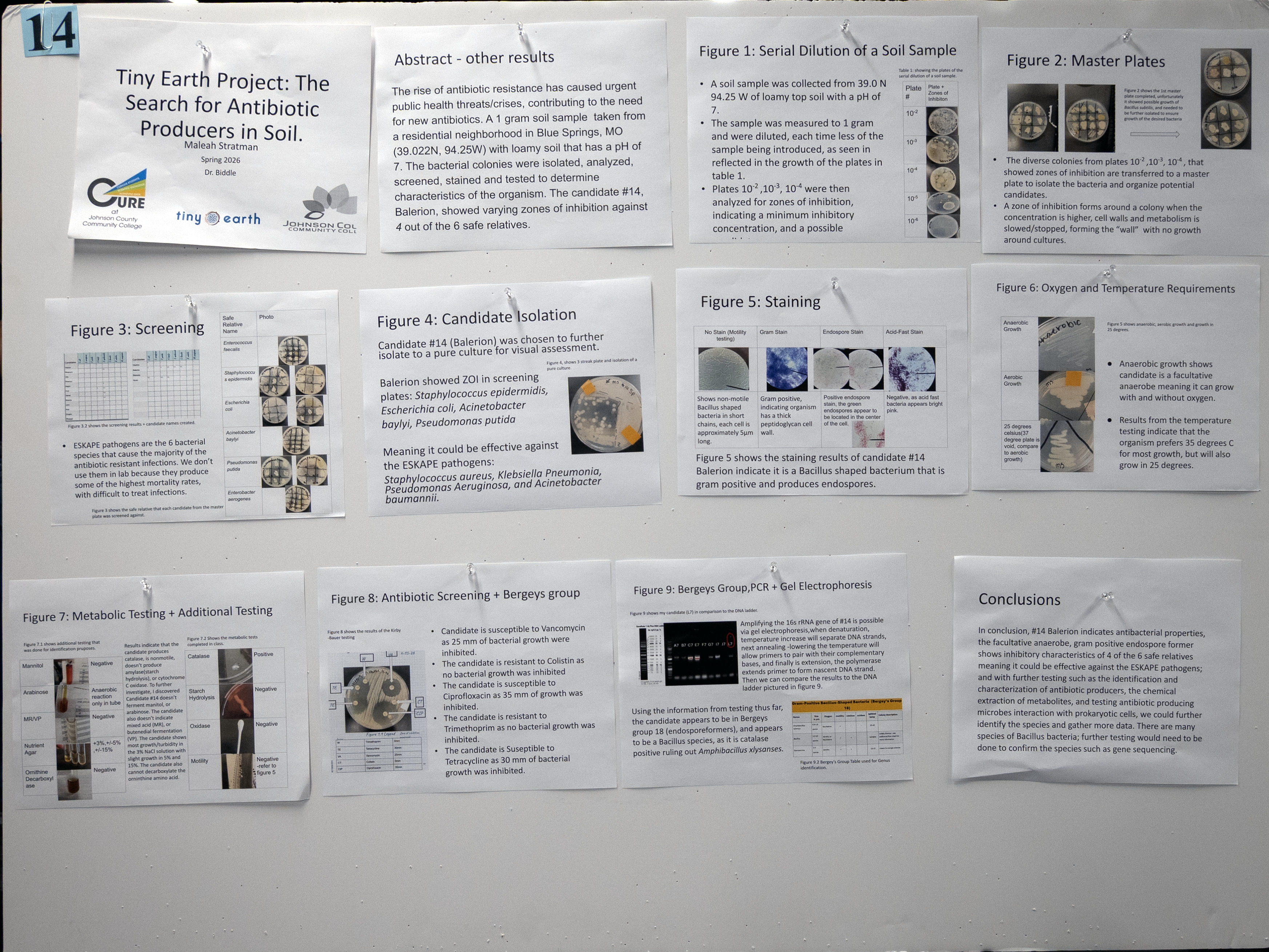
The rise of antibiotic resistance has caused urgent public health threats/crises, contributing to the need for new antibiotics. The Tiny Earth Project seeks to discover new antibiotics through sourcing and experimentation started by students. Aseptic technique was utilized to perform a serial dilution on a 1 gram soil sample taken from a residential neighborhood in Blue Springs, MO (39.022N, 94.25W) with loamy soil that has a pH of 7. The bacterial colonies were isolated, analyzed, then further isolated colonies that showed zones of inhibition on a “master plate” narrowing it down to 18 potential candidates. The isolated bacteria from the master plate were screened against safe relatives for zones of inhibition (region of no bacterial growth), and the candidate was chosen. The candidate #14, Balerion, showed varying zones of inhibition against 4 out of the 6 safe relatives. The Gram stain procedure shows that the candidate is Gram-positive. The acid fast stain showed the candidate has acid fast properties. Meanwhile, the endospore stain reveals green endospores and pink vegetative cells, indicating that the endospores are formed, providing extra protection during harsh conditions. These findings suggest that candidate #14 Balerion could be effective at inhibiting ESKAPE Pathogens: , Staphylococcus aureus, Klebsiella Pneumonia, Pseudomonas Aeruginosa, and Acinetobacter baumannii. This candidate's promising antibacterial properties may contribute to new antibiotic discoveries.
Image
Tiny Earth Project: The Search for Antibiotic Producers in Soil
CoLab, COM 317
The rise of antibiotic resistance has caused urgent public health threats/crises, contributing to the need for new antibiotics. The Tiny Earth Project seeks to discover new antibiotics through sourcing and experimentation started by students. Aseptic technique was utilized to perform a serial dilution on a 1 gram soil sample taken from a residential neighborhood in Blue Springs, MO (39.022N, 94.25W) with loamy soil that has a pH of 7. The bacterial colonies were isolated, analyzed, then further isolated colonies that showed zones of inhibition on a “master plate” narrowing it down to 18 potential candidates. The isolated bacteria from the master plate were screened against safe relatives for zones of inhibition (region of no bacterial growth), and the candidate was chosen. The candidate #14, Balerion, showed varying zones of inhibition against 4 out of the 6 safe relatives. The Gram stain procedure shows that the candidate is Gram-positive. The acid fast stain showed the candidate has acid fast properties. Meanwhile, the endospore stain reveals green endospores and pink vegetative cells, indicating that the endospores are formed, providing extra protection during harsh conditions. These findings suggest that candidate #14 Balerion could be effective at inhibiting ESKAPE Pathogens: , Staphylococcus aureus, Klebsiella Pneumonia, Pseudomonas Aeruginosa, and Acinetobacter baumannii. This candidate's promising antibacterial properties may contribute to new antibiotic discoveries.
Comments
The faculty mentor for this project was Eulandria Biddle.