

Analysis of Bacterial Growth Using Serial Dilution Techniques
Location
CoLab, COM 314
Start Date
30-4-2026 2:30 PM
Document Type
Poster
Description
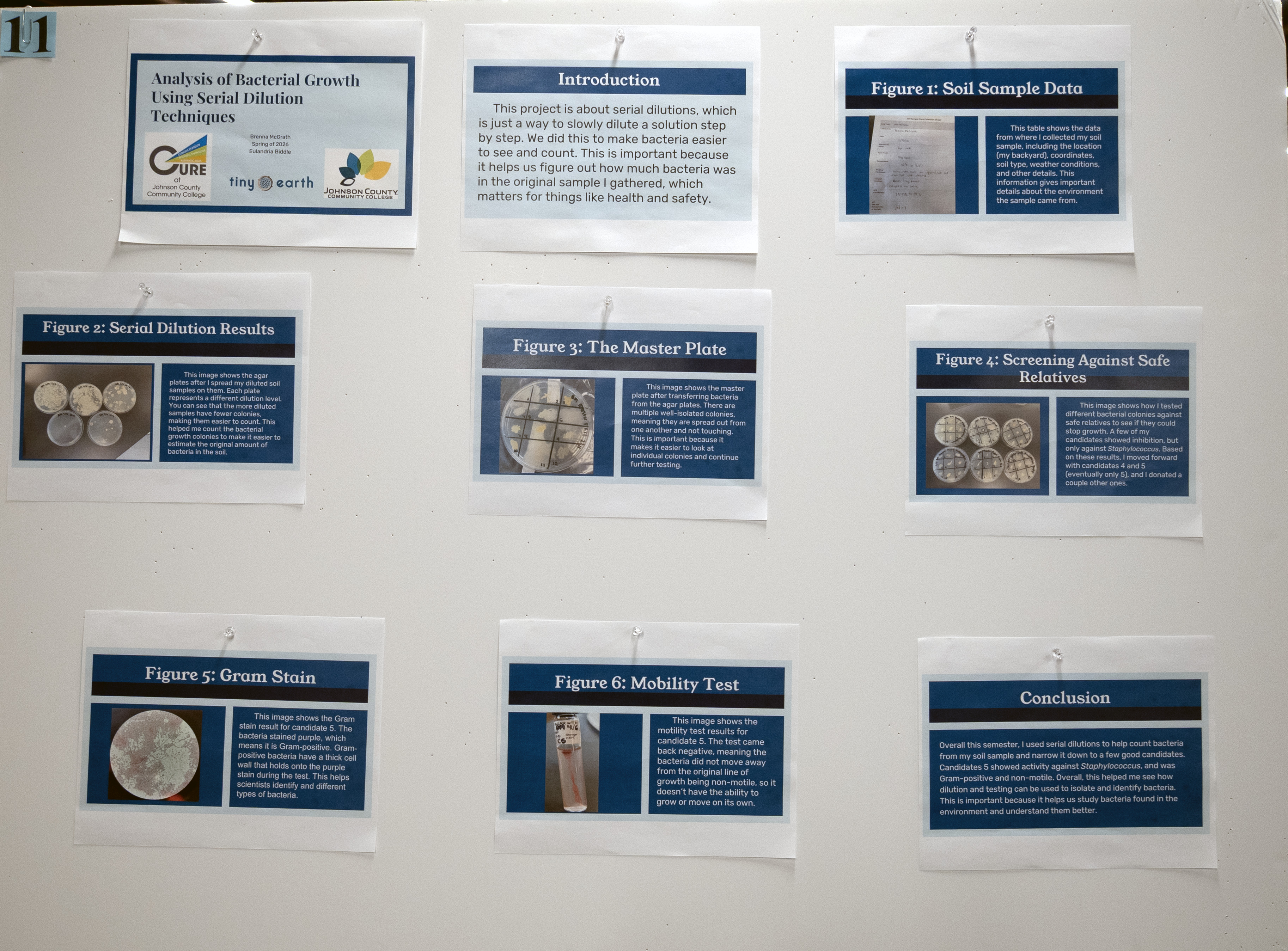
Finding tools and antibiotics is becoming a bigger problem more than ever these days. It’s making it harder to treat infections and fight off the harmful bacteria. Because of this, people are constantly trying to find new antibiotics. Some people may not think of this, but its a brilliant idea- like finding it in places we may not ever think of, like soil. Soil is full of different microorganisms, some of them produce chemicals to kill off bacteria. In this lab, I wanted to see if soil from my own backyard had any bacteria that could stop other bacteria from growing. To do this, I used a serial dilution to spread out the microorganisms in the soil so individual colonies could grow more clearly. After that, I tested those colonies against different types of bacteria, including Staphylococcus aureus, Escherichia coli, Enterobacter aerogenes, Pseudomonas putida, Acinetobacter baylyi, Staphylococcus epidermidis, Enterococcus faecalis, Bacillus subtilis, and Mycobacterium smegmatis. I looked for zones of inhibition (ZOI), which are clear spaces around a colony where bacteria couldn’t grow. In the end, only the Staphylococcus bacteria showed any zones of inhibition. I found five colonies that were able to stop their growth and had visible space astound them. I chose two of them (candidates 4 and 5) to continue my experiment with. I eventually decided to continue with candidate 5 because it showed the most consistent results during my 3 streak plates. Overall, this shows that even a soil sample from a backyard can contain bacteria that produce substances that fight specific microbes. This matters because it could help lead to new antibiotics that help others my fighting off harmful bacteria.
Image
Analysis of Bacterial Growth Using Serial Dilution Techniques
CoLab, COM 314
Finding tools and antibiotics is becoming a bigger problem more than ever these days. It’s making it harder to treat infections and fight off the harmful bacteria. Because of this, people are constantly trying to find new antibiotics. Some people may not think of this, but its a brilliant idea- like finding it in places we may not ever think of, like soil. Soil is full of different microorganisms, some of them produce chemicals to kill off bacteria. In this lab, I wanted to see if soil from my own backyard had any bacteria that could stop other bacteria from growing. To do this, I used a serial dilution to spread out the microorganisms in the soil so individual colonies could grow more clearly. After that, I tested those colonies against different types of bacteria, including Staphylococcus aureus, Escherichia coli, Enterobacter aerogenes, Pseudomonas putida, Acinetobacter baylyi, Staphylococcus epidermidis, Enterococcus faecalis, Bacillus subtilis, and Mycobacterium smegmatis. I looked for zones of inhibition (ZOI), which are clear spaces around a colony where bacteria couldn’t grow. In the end, only the Staphylococcus bacteria showed any zones of inhibition. I found five colonies that were able to stop their growth and had visible space astound them. I chose two of them (candidates 4 and 5) to continue my experiment with. I eventually decided to continue with candidate 5 because it showed the most consistent results during my 3 streak plates. Overall, this shows that even a soil sample from a backyard can contain bacteria that produce substances that fight specific microbes. This matters because it could help lead to new antibiotics that help others my fighting off harmful bacteria.
Comments
The faculty mentor for this project was Eulandria Biddle.