

Uncovering Antimicrobial Producers in Local Soil
Location
CoLab, COM 121
Start Date
30-4-2026 8:15 AM
Document Type
Poster
Description
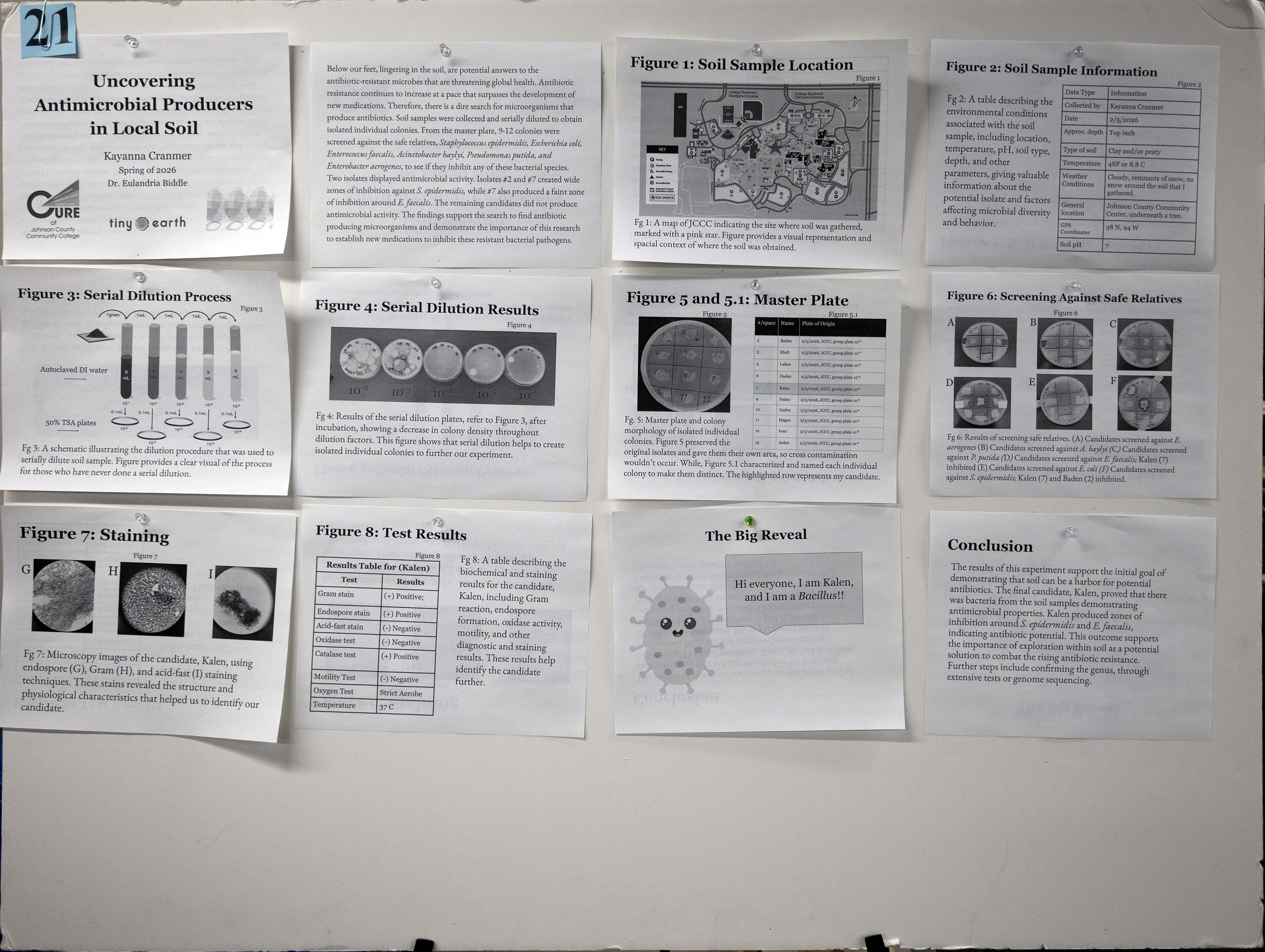
Below our feet, lingering in the soil, are potential answers for the antibiotic-resistant microbes that are threatening global health. Antibiotic resistance continues to increase at a pace that surpasses the development of new medications. Therefore, there is a dire search for microorganisms that produce antibiotics. Soil samples were collected from local areas and subjected to a series of serial dilutions to obtain isolated individual colonies. From the master plate, 9-12 colonies were screened against the safe relatives, Staphylococcus epidermidis, Escherichia coli, Enterococcus faecalis, Acinetobacter baylyi, Pseudomonas putida, and Enterobacter aerogenes, to see if they inhibit any of these bacterial species. Two isolates displayed antimicrobial activity. Isolates #2 and #7 created wide zones of inhibition against S. epidermidis, while #7 also produced a faint zone of inhibition around E. faecalis. The remaining candidates did not produce antimicrobial activity. The findings support the ongoing search to find antibiotic-producing microorganisms and demonstrate the importance of continuing this research to establish new medications to inhibit these resistant bacterial pathogens.
Image
Uncovering Antimicrobial Producers in Local Soil
CoLab, COM 121
Below our feet, lingering in the soil, are potential answers for the antibiotic-resistant microbes that are threatening global health. Antibiotic resistance continues to increase at a pace that surpasses the development of new medications. Therefore, there is a dire search for microorganisms that produce antibiotics. Soil samples were collected from local areas and subjected to a series of serial dilutions to obtain isolated individual colonies. From the master plate, 9-12 colonies were screened against the safe relatives, Staphylococcus epidermidis, Escherichia coli, Enterococcus faecalis, Acinetobacter baylyi, Pseudomonas putida, and Enterobacter aerogenes, to see if they inhibit any of these bacterial species. Two isolates displayed antimicrobial activity. Isolates #2 and #7 created wide zones of inhibition against S. epidermidis, while #7 also produced a faint zone of inhibition around E. faecalis. The remaining candidates did not produce antimicrobial activity. The findings support the ongoing search to find antibiotic-producing microorganisms and demonstrate the importance of continuing this research to establish new medications to inhibit these resistant bacterial pathogens.
Comments
The faculty mentor for this project was Eulandria Biddle.