

Flying Squirrel Acoustic Monitoring
Location
CoLab, COM 301
Start Date
30-4-2026 1:15 PM
Document Type
Poster
Description
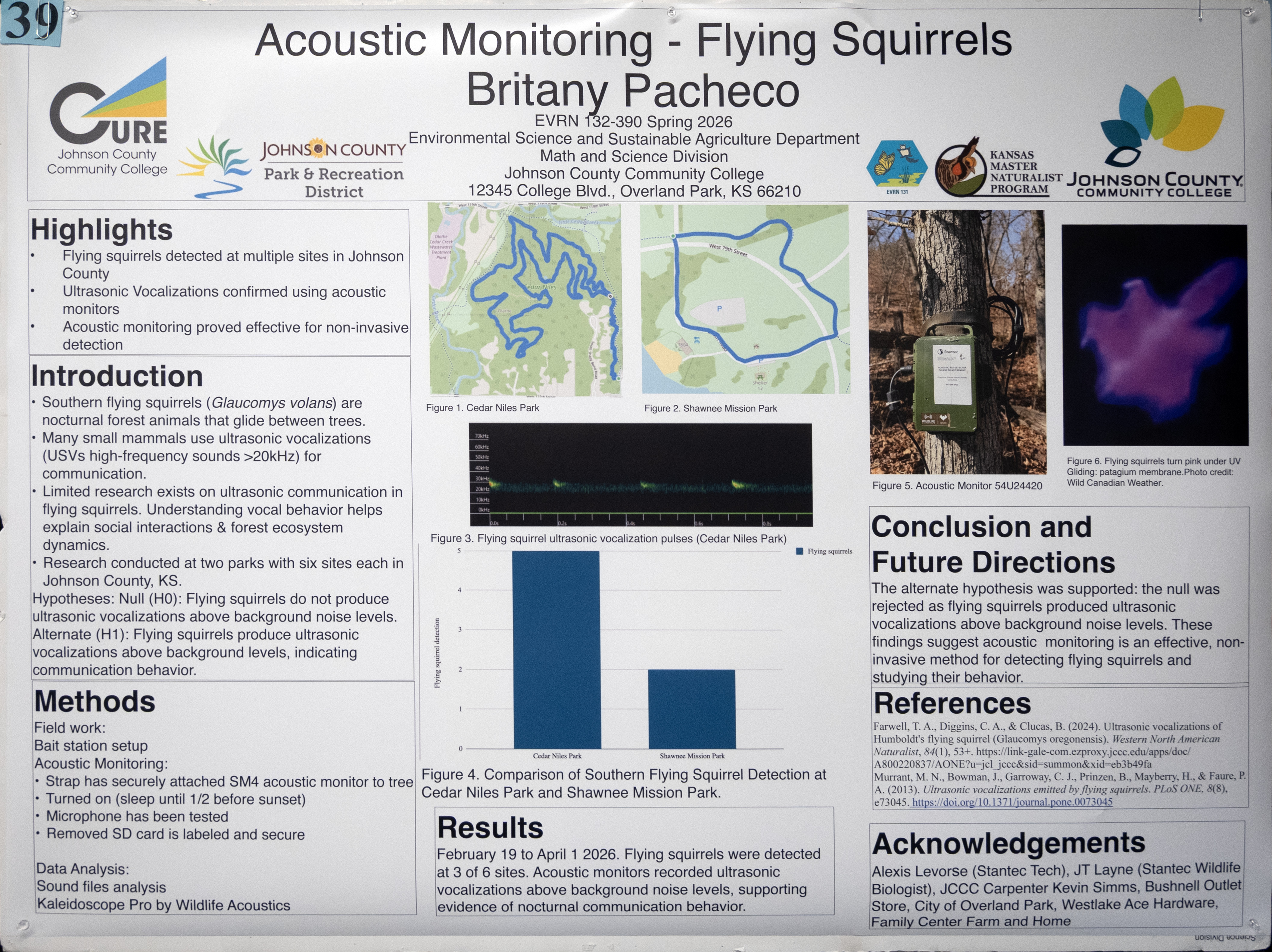
Flying squirrels are nocturnal mammals that rely on communication to locate nest sites, coordinate movement and maintain structure. This research is being conducted to better understand how flying squirrels communicate, with ultrasonic vocalizations. These vocalizations are not audible to humans, acoustic monitoring provides an important non-invasive method for detecting flying squirrels and studying their behavior. This research is important because communication plays a critical role in survival especially during winter when flying squirrels rely on shared nest sites for warmth. Female flying squirrels and their offspring typically occupy nests together, while males occupy separate nests. Coordinating among flying squirrels requires effective communication. Ultrasonic vocalizations facilitate social interaction, navigation, and nest site location. Understanding these vocalizations also improves detection accuracy for a species that is difficult to observe. The research will be conducted using non-invasive sampling methods such as trail cameras, nest boxes, bait and acoustic monitors capable of detecting ultrasonic frequencies. These methods allow for comparison of detection rates, monitoring techniques and habitat types without disturbing animals. The students hypothesize that flying squirrels will be detected more frequently through acoustic monitoring of ultrasonic vocalizations than through trail cameras or nest boxes. As a back up hypothesis, the students predict that the occurrence of ultrasonic vocalizations will differ between forest sites. Findings from this study may be used by wildlife managers and conservation agencies to improve monitoring strategies and inform forest management decisions.
Image
Flying Squirrel Acoustic Monitoring
CoLab, COM 301
Flying squirrels are nocturnal mammals that rely on communication to locate nest sites, coordinate movement and maintain structure. This research is being conducted to better understand how flying squirrels communicate, with ultrasonic vocalizations. These vocalizations are not audible to humans, acoustic monitoring provides an important non-invasive method for detecting flying squirrels and studying their behavior. This research is important because communication plays a critical role in survival especially during winter when flying squirrels rely on shared nest sites for warmth. Female flying squirrels and their offspring typically occupy nests together, while males occupy separate nests. Coordinating among flying squirrels requires effective communication. Ultrasonic vocalizations facilitate social interaction, navigation, and nest site location. Understanding these vocalizations also improves detection accuracy for a species that is difficult to observe. The research will be conducted using non-invasive sampling methods such as trail cameras, nest boxes, bait and acoustic monitors capable of detecting ultrasonic frequencies. These methods allow for comparison of detection rates, monitoring techniques and habitat types without disturbing animals. The students hypothesize that flying squirrels will be detected more frequently through acoustic monitoring of ultrasonic vocalizations than through trail cameras or nest boxes. As a back up hypothesis, the students predict that the occurrence of ultrasonic vocalizations will differ between forest sites. Findings from this study may be used by wildlife managers and conservation agencies to improve monitoring strategies and inform forest management decisions.
Comments
The faculty mentor for this project was Stephanie Ferrero.