

Age Estimation of Unknown 1
Location
CoLab, COM 297
Start Date
30-4-2026 1:15 PM
Document Type
Poster
Description
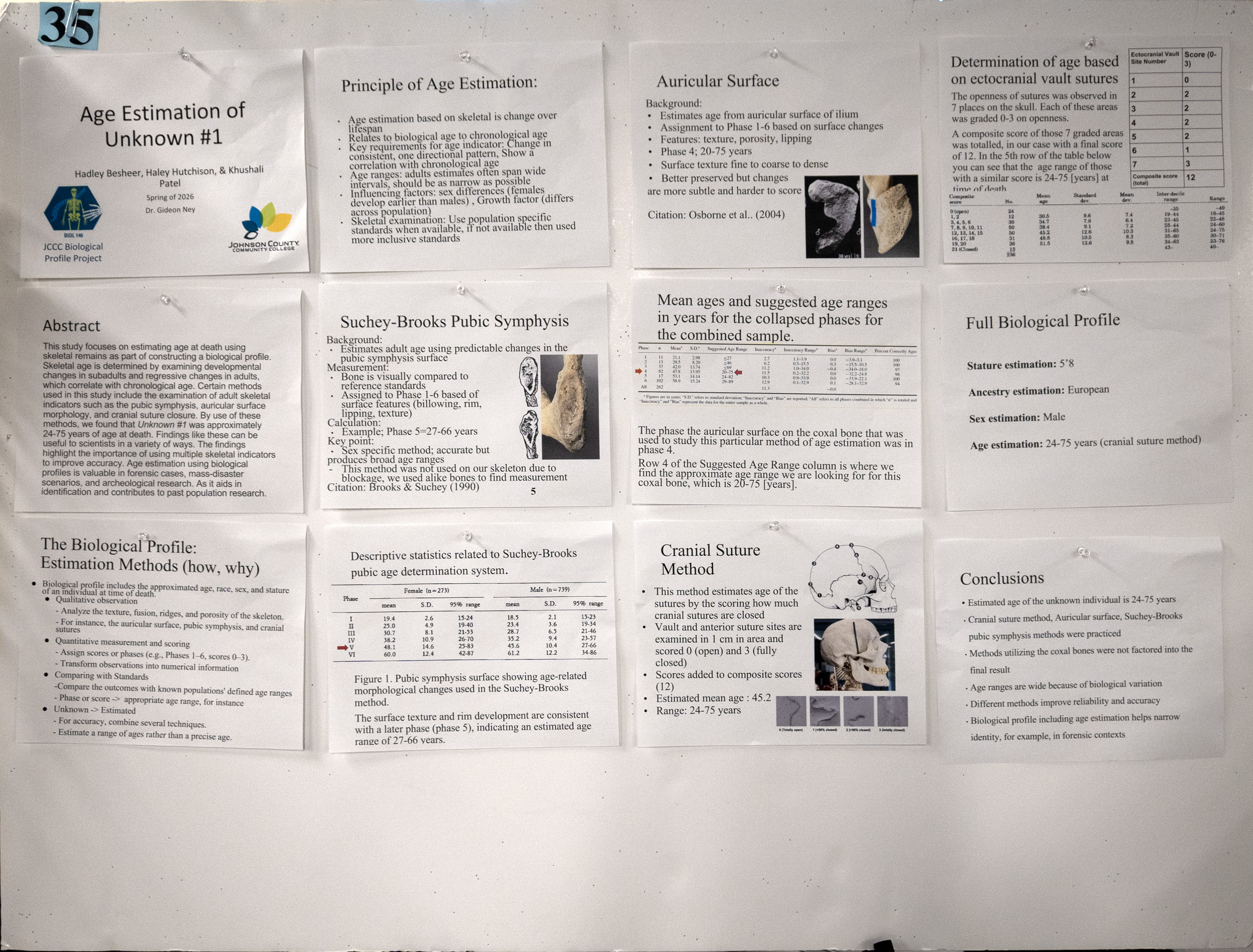
This study focuses on estimating age at death using skeletal remains as part of constructing a biological profile. Skeletal age is determined by examining developmental changes in subadults and regressive changes in adults, which correlate with chronological age. Based on the observable skeletal features, understanding these changes allows researchers to assign individuals to age ranges. Certain methods used in this study include the examination of adult skeletal indicators such as the pubic symphysis, auricular surface morphology, and cranial suture closure. There are certain methods, such as the Suchey-Brooks pubic symphysis method, that cannot be applied because the relevant surfaces are not visible due to the use of articulated skeletons. In order to proceed with this method, disarticulated coxal bones were used for practice and comparison. In our case, the auricular surface method and cranial suture scoring were utilized instead. By use of these methods, we found that Unknown #1 was approximately 21-70 years of age at death. Age ranges can be determined with average accuracy, and variability increases with older individuals due to differences in lifestyle and health. Thus, adults are assigned a wider age range than younger individuals. Findings like these can be useful to scientists in a variety of ways. The findings highlight the importance of using multiple skeletal indicators to improve accuracy. Age estimation using biological profiles is valuable in forensic cases, mass-disaster scenarios, and archeological research. As it aids in identification and contributes to past population research.
Image
Age Estimation of Unknown 1
CoLab, COM 297
This study focuses on estimating age at death using skeletal remains as part of constructing a biological profile. Skeletal age is determined by examining developmental changes in subadults and regressive changes in adults, which correlate with chronological age. Based on the observable skeletal features, understanding these changes allows researchers to assign individuals to age ranges. Certain methods used in this study include the examination of adult skeletal indicators such as the pubic symphysis, auricular surface morphology, and cranial suture closure. There are certain methods, such as the Suchey-Brooks pubic symphysis method, that cannot be applied because the relevant surfaces are not visible due to the use of articulated skeletons. In order to proceed with this method, disarticulated coxal bones were used for practice and comparison. In our case, the auricular surface method and cranial suture scoring were utilized instead. By use of these methods, we found that Unknown #1 was approximately 21-70 years of age at death. Age ranges can be determined with average accuracy, and variability increases with older individuals due to differences in lifestyle and health. Thus, adults are assigned a wider age range than younger individuals. Findings like these can be useful to scientists in a variety of ways. The findings highlight the importance of using multiple skeletal indicators to improve accuracy. Age estimation using biological profiles is valuable in forensic cases, mass-disaster scenarios, and archeological research. As it aids in identification and contributes to past population research.
Comments
The faculty mentor for this project was Gideon Ney.