

Age Estimation of Skeleton 6
Location
CoLab, COM 295
Start Date
30-4-2026 1:15 PM
Document Type
Poster
Description
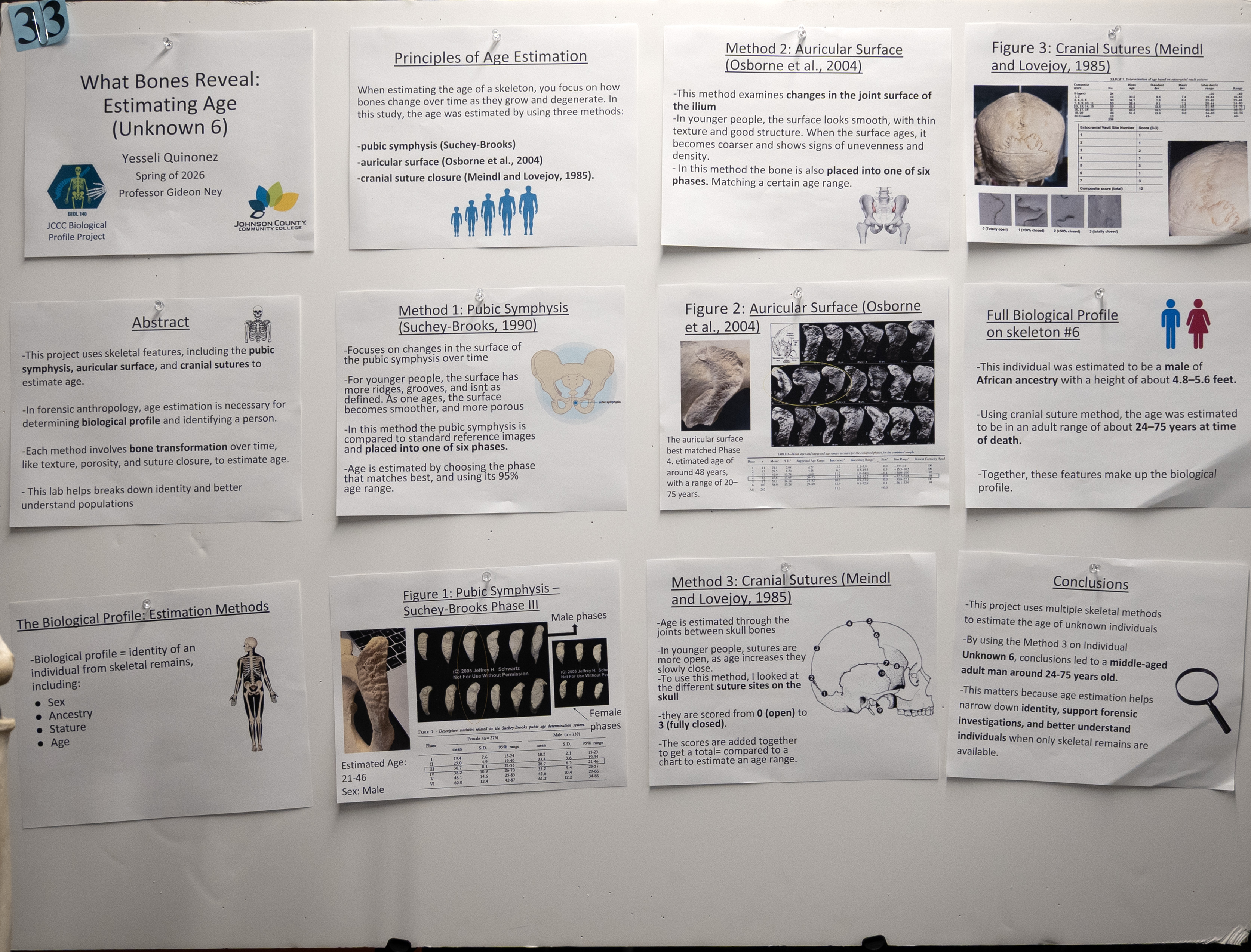
Age estimation is an important part of building a biological profile in forensic anthropology, especially when you need to identify unknown individuals. This lab focuses on estimating age using skeletal features that change over time, especially in the pubic symphysis, auricular surface, and cranial sutures. Being able to understand these changes helps connect biological age to chronological age, even though variation exists between people. Multiple methods were used to estimate age. The Suchey-Brooks method was used on the pubic symphysis by assigning a phase based on surface features and using corresponding age ranges. The auricular surface method (Osborne et al. 2004) was used by evaluating texture, porosity, and structural changes to determine a phase and estimated age range. The Meindl and Lovejoy (1985) method was used to score cranial suture closure and calculate a composite score for age estimation. Because articulated skeletons can limit visibility of some features, alternative observable traits were used when necessary. The estimated results suggest the individual falls within a broad adult age range, with slight variation depending on the method used. Some methods produced narrower ranges, while others were more generalized due to biological variability and preservation. Overall, this lab shows that using multiple skeletal indicators provides a more reliable age estimate than relying on a single method. Age estimation is useful and important in forensic and archaeological science because it helps narrow down identity and better understand populations, even though exact age cannot be determined.
Image
Age Estimation of Skeleton 6
CoLab, COM 295
Age estimation is an important part of building a biological profile in forensic anthropology, especially when you need to identify unknown individuals. This lab focuses on estimating age using skeletal features that change over time, especially in the pubic symphysis, auricular surface, and cranial sutures. Being able to understand these changes helps connect biological age to chronological age, even though variation exists between people. Multiple methods were used to estimate age. The Suchey-Brooks method was used on the pubic symphysis by assigning a phase based on surface features and using corresponding age ranges. The auricular surface method (Osborne et al. 2004) was used by evaluating texture, porosity, and structural changes to determine a phase and estimated age range. The Meindl and Lovejoy (1985) method was used to score cranial suture closure and calculate a composite score for age estimation. Because articulated skeletons can limit visibility of some features, alternative observable traits were used when necessary. The estimated results suggest the individual falls within a broad adult age range, with slight variation depending on the method used. Some methods produced narrower ranges, while others were more generalized due to biological variability and preservation. Overall, this lab shows that using multiple skeletal indicators provides a more reliable age estimate than relying on a single method. Age estimation is useful and important in forensic and archaeological science because it helps narrow down identity and better understand populations, even though exact age cannot be determined.
Comments
The faculty mentor for this project was Gideon Ney.