

Soil to Solution Small Microbes Big Impact
Location
CoLab, COM 287
Start Date
30-4-2026 1:15 PM
Document Type
Poster
Description
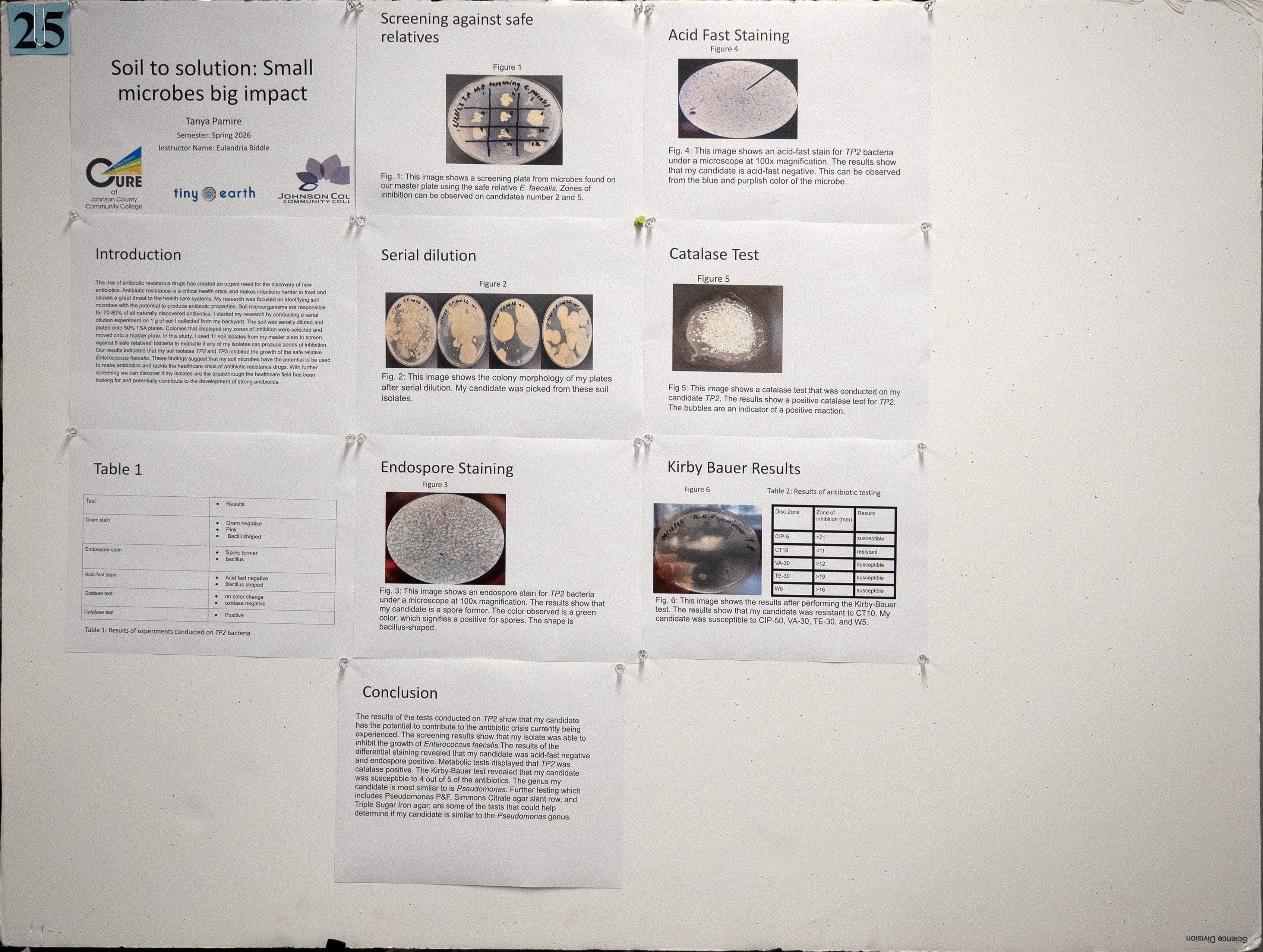
The rise of antibiotic resistance drugs has created an urgent need for the discovery of new antibiotics. Antibiotic resistance is a critical health crisis and makes infections harder to treat and causes a great threat to the health care systems. My research was focused on identifying soil microbes with the potential to produce antibiotic properties. Soil microorganisms are responsible for 70-80% of all naturally discovered antibiotics. I started my research by conducting a serial dilution experiment on 1 g of soil I collected from my backyard. The soil was serially diluted and plated onto 50% TSA plates. Colonies that displayed any zones of inhibition were selected and moved onto a master plate. In this study, I used 11 soil isolates from my master plate to screen against 6 safe relatives’ bacteria to evaluate if any of my isolates can produce zones of inhibition. Our results indicated that my soil isolates TP2 and TP5 inhibited the growth of the safe relative Enterococcus faecalis. These findings suggest that my soil microbes have the potential to be used to make antibiotics and tackle the healthcare crisis of antibiotic resistance drugs. With further screening we can discover if my isolates are the breakthrough the healthcare field has been looking for and potentially contribute to the development of strong antibiotics.
Image
Soil to Solution Small Microbes Big Impact
CoLab, COM 287
The rise of antibiotic resistance drugs has created an urgent need for the discovery of new antibiotics. Antibiotic resistance is a critical health crisis and makes infections harder to treat and causes a great threat to the health care systems. My research was focused on identifying soil microbes with the potential to produce antibiotic properties. Soil microorganisms are responsible for 70-80% of all naturally discovered antibiotics. I started my research by conducting a serial dilution experiment on 1 g of soil I collected from my backyard. The soil was serially diluted and plated onto 50% TSA plates. Colonies that displayed any zones of inhibition were selected and moved onto a master plate. In this study, I used 11 soil isolates from my master plate to screen against 6 safe relatives’ bacteria to evaluate if any of my isolates can produce zones of inhibition. Our results indicated that my soil isolates TP2 and TP5 inhibited the growth of the safe relative Enterococcus faecalis. These findings suggest that my soil microbes have the potential to be used to make antibiotics and tackle the healthcare crisis of antibiotic resistance drugs. With further screening we can discover if my isolates are the breakthrough the healthcare field has been looking for and potentially contribute to the development of strong antibiotics.
Comments
The faculty mentor for this project was Eulandria Biddle.