

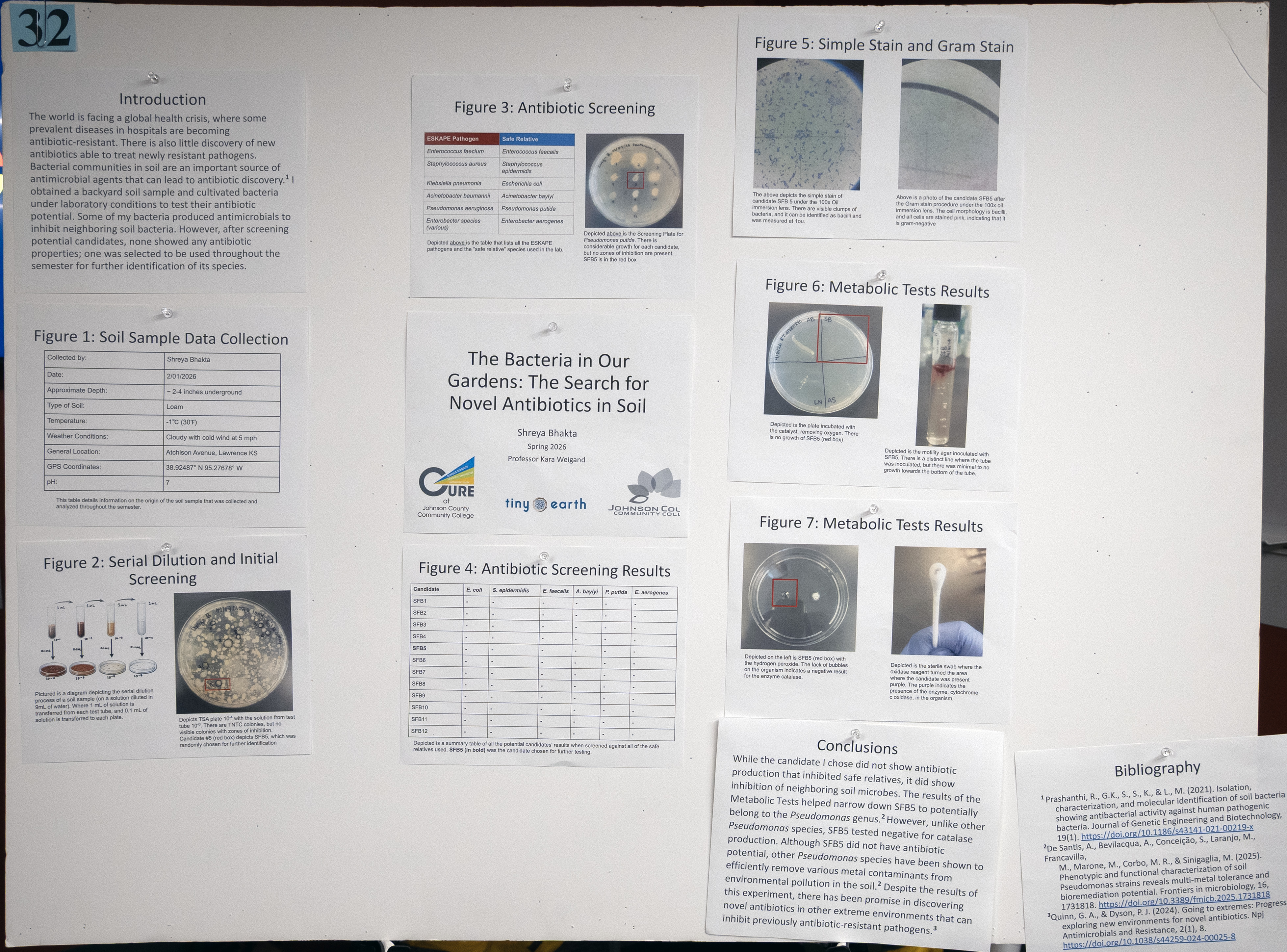
The Bacteria in our Gardens: The Search for Novel Antibiotics in Soil
Location
CoLab, COM 252
Start Date
30-4-2026 12:00 PM
Document Type
Poster
Description
Currently, the world is facing a global health crisis, where pathogenic bacteria responsible for some of the most prevalent diseases in hospitals are evolving to become increasingly resistant to antibiotic treatment. While simultaneously, there is very little discovery of new antibiotics that are able to treat these newly resistant diseases. Our Microbiology class has partnered with the Tiny Earth Network, which mobilizes students around the world to collect and analyze samples in the environment to look for new species of bacteria that produce antibiotic properties. Our class has chosen to obtain environmental samples from soil, since a majority of bacteria that have produced antibiotics have been discovered in the soil. I have obtained a soil sample from my backyard garden and cultivated colonies of bacteria under laboratory conditions to test their antibiotic potential. Some of my bacterial colonies have been shown to produce antimicrobial properties to prevent the growth of other neighboring bacteria. However, after screening these colonies or potential candidates, they did not show any antibiotic properties; one will be selected to be used throughout the semester for further identification of its species.
Image
The Bacteria in our Gardens: The Search for Novel Antibiotics in Soil
CoLab, COM 252
Currently, the world is facing a global health crisis, where pathogenic bacteria responsible for some of the most prevalent diseases in hospitals are evolving to become increasingly resistant to antibiotic treatment. While simultaneously, there is very little discovery of new antibiotics that are able to treat these newly resistant diseases. Our Microbiology class has partnered with the Tiny Earth Network, which mobilizes students around the world to collect and analyze samples in the environment to look for new species of bacteria that produce antibiotic properties. Our class has chosen to obtain environmental samples from soil, since a majority of bacteria that have produced antibiotics have been discovered in the soil. I have obtained a soil sample from my backyard garden and cultivated colonies of bacteria under laboratory conditions to test their antibiotic potential. Some of my bacterial colonies have been shown to produce antimicrobial properties to prevent the growth of other neighboring bacteria. However, after screening these colonies or potential candidates, they did not show any antibiotic properties; one will be selected to be used throughout the semester for further identification of its species.
Comments
The faculty mentor for this project was Kara Weigand.