

The Search for Antibiotics in Backyard Soil
Location
CoLab, COM 251
Start Date
30-4-2026 12:00 PM
Document Type
Poster
Description
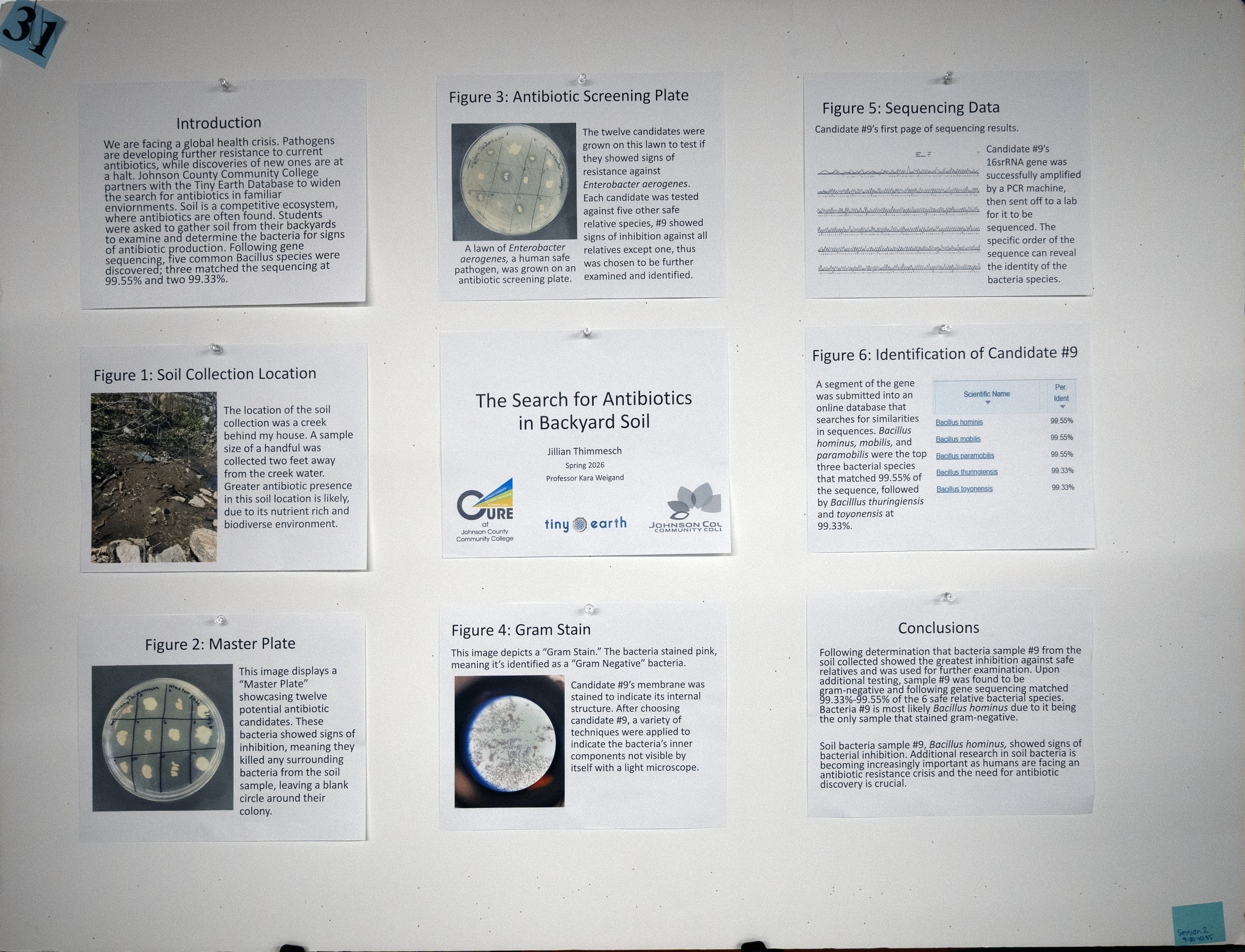
Bacterial resistance to antibiotic drugs that are used to treat illnesses is rapidly increasing. The need for newly discovered antibiotics is important so that treatment for bacterial infections remain available. The microbiology class at Johnson County Community College partners with the Tiny Earth Database to attempt to discover antibiotic producing bacteria. Soil samples were collected and method protocols were followed. My soil sample contained 12 potential candidate bacterial colonies that showed signs of inhibition, meaning they potentially produce antibodies. These candidates were tested against 6 pathogens that are safe to use in a lab setting, Escherichia coli, Staphylococcus epidermidis, Enterococcus faecalis, Acinetobacter baylyi, Pseudomonas putida, and Enterobacter aerogenes. Post incubation, signs of inhibition were found in around 5 of the candidates, but candidate 9 displayed the most in all the antibiotic screening plates. Candidate 9, named “Ella” showed signs of inhibition against all the pathogens except for Acinetobacter baylyi. I am currently working on identifying Ella’s species.
Image
The Search for Antibiotics in Backyard Soil
CoLab, COM 251
Bacterial resistance to antibiotic drugs that are used to treat illnesses is rapidly increasing. The need for newly discovered antibiotics is important so that treatment for bacterial infections remain available. The microbiology class at Johnson County Community College partners with the Tiny Earth Database to attempt to discover antibiotic producing bacteria. Soil samples were collected and method protocols were followed. My soil sample contained 12 potential candidate bacterial colonies that showed signs of inhibition, meaning they potentially produce antibodies. These candidates were tested against 6 pathogens that are safe to use in a lab setting, Escherichia coli, Staphylococcus epidermidis, Enterococcus faecalis, Acinetobacter baylyi, Pseudomonas putida, and Enterobacter aerogenes. Post incubation, signs of inhibition were found in around 5 of the candidates, but candidate 9 displayed the most in all the antibiotic screening plates. Candidate 9, named “Ella” showed signs of inhibition against all the pathogens except for Acinetobacter baylyi. I am currently working on identifying Ella’s species.
Comments
The faculty mentor for this project was Kara Weigand.