

The Underground Cure
Location
CoLab, COM 247
Start Date
30-4-2026 12:00 PM
Document Type
Poster
Description
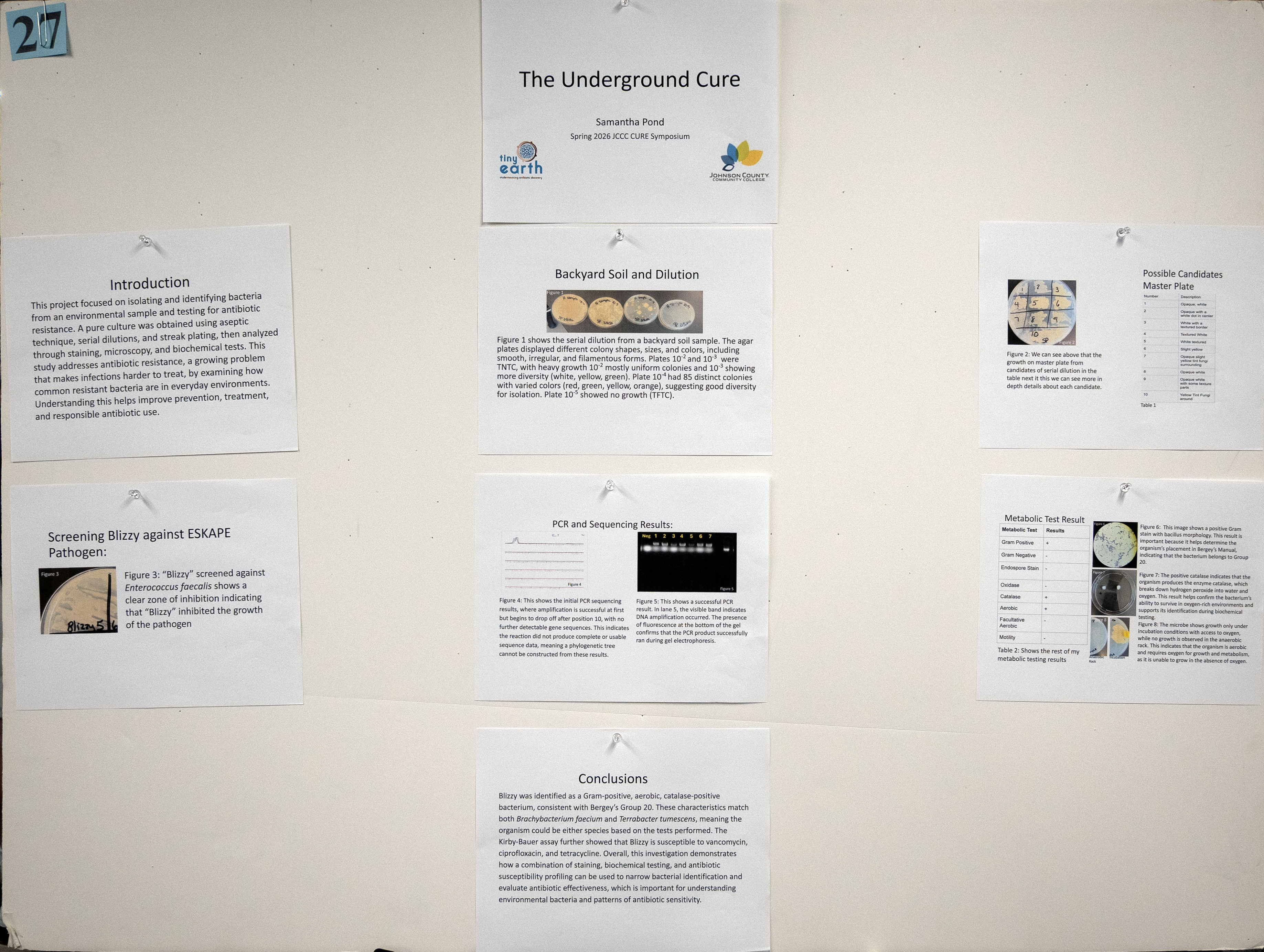
Antibiotic resistance is a growing health concern, being able to make new discoveries is vital for treating infections that are caused by harmful bacteria. Soil environments are a valuable source of finding diverse microorganisms that may have the ability to produce some compounds. The soil sample that was used in this study was collected from a backyard that has a history of farmland which makes it very diverse. Over the course of this semester the soil microbes were isolated, cultured, and screened to test if there was any inhibition of growth against pathogens. Many of the isolated candidates were tested, “Zeus” gave positive feedback of inhibition against Staphylococcus epidermidis, while “Blizzy” and “Kai” also showed positive feedback of inhibition but against Enterococcus faecalis. With gaining this information an inference can be made that these findings can lead us to believe that the capability of producing substances that can limit pathogen growth. The most promising candidate has been identified using genetic sequencing and metabolic techniques. This research adds to how discovering new antimicrobial agents and emphasizes the importance of exploring more natural environments for better solutions to antibiotic resistance.
Image
The Underground Cure
CoLab, COM 247
Antibiotic resistance is a growing health concern, being able to make new discoveries is vital for treating infections that are caused by harmful bacteria. Soil environments are a valuable source of finding diverse microorganisms that may have the ability to produce some compounds. The soil sample that was used in this study was collected from a backyard that has a history of farmland which makes it very diverse. Over the course of this semester the soil microbes were isolated, cultured, and screened to test if there was any inhibition of growth against pathogens. Many of the isolated candidates were tested, “Zeus” gave positive feedback of inhibition against Staphylococcus epidermidis, while “Blizzy” and “Kai” also showed positive feedback of inhibition but against Enterococcus faecalis. With gaining this information an inference can be made that these findings can lead us to believe that the capability of producing substances that can limit pathogen growth. The most promising candidate has been identified using genetic sequencing and metabolic techniques. This research adds to how discovering new antimicrobial agents and emphasizes the importance of exploring more natural environments for better solutions to antibiotic resistance.
Comments
The faculty mentor for this project was Heather Seitz.