

Antimicrobials in the Front Yard!
Location
CoLab, COM 115
Start Date
30-4-2026 8:15 AM
Document Type
Poster
Description
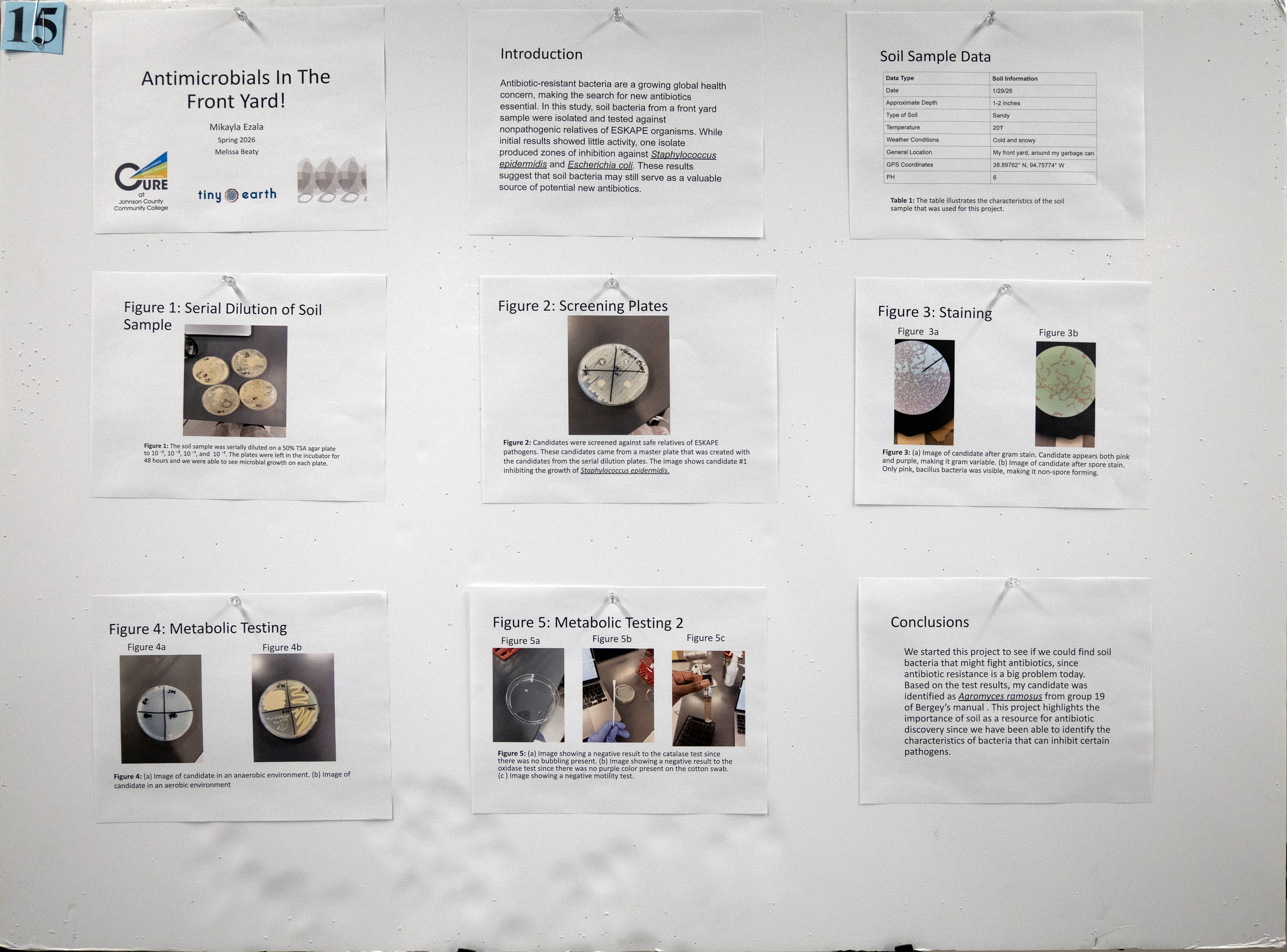
The rise of antibiotic-resistant bacteria is a serious global health problem, making it important to discover new antibiotics. This semester, microbiology students collected soil and determined if the bacteria from the soil can produce substances to fight harmful microbes. A soil sample collected just from the front yard was diluted and grown on agar plates to isolate different bacteria. These bacteria were tested against safe relatives of ESKAPE pathogens. While some samples did not show any inhibition at first, continued testing led to the discovery of candidates that were able to slow or stop the growth of some of the safe relatives. Candidate #4, named Sandy, showed the most zones of inhibition, but only for two organisms: Staphylococcus epidermis and Escherichia coli. This inhibition means that Sandy is likely producing a substance that can stop these bacteria from growing, which is an important sign of possible antibiotic activity. Although it did not affect all the organisms tested, these results show that soil bacteria can still be a valuable source of new antibiotics and are worth studying further.
Image
Antimicrobials in the Front Yard!
CoLab, COM 115
The rise of antibiotic-resistant bacteria is a serious global health problem, making it important to discover new antibiotics. This semester, microbiology students collected soil and determined if the bacteria from the soil can produce substances to fight harmful microbes. A soil sample collected just from the front yard was diluted and grown on agar plates to isolate different bacteria. These bacteria were tested against safe relatives of ESKAPE pathogens. While some samples did not show any inhibition at first, continued testing led to the discovery of candidates that were able to slow or stop the growth of some of the safe relatives. Candidate #4, named Sandy, showed the most zones of inhibition, but only for two organisms: Staphylococcus epidermis and Escherichia coli. This inhibition means that Sandy is likely producing a substance that can stop these bacteria from growing, which is an important sign of possible antibiotic activity. Although it did not affect all the organisms tested, these results show that soil bacteria can still be a valuable source of new antibiotics and are worth studying further.
Comments
The faculty mentor for this project was Melissa Beaty.