

Hidden Resistance at our Homes
Location
CoLab, COM 248
Start Date
30-4-2026 12:00 PM
Document Type
Poster
Description
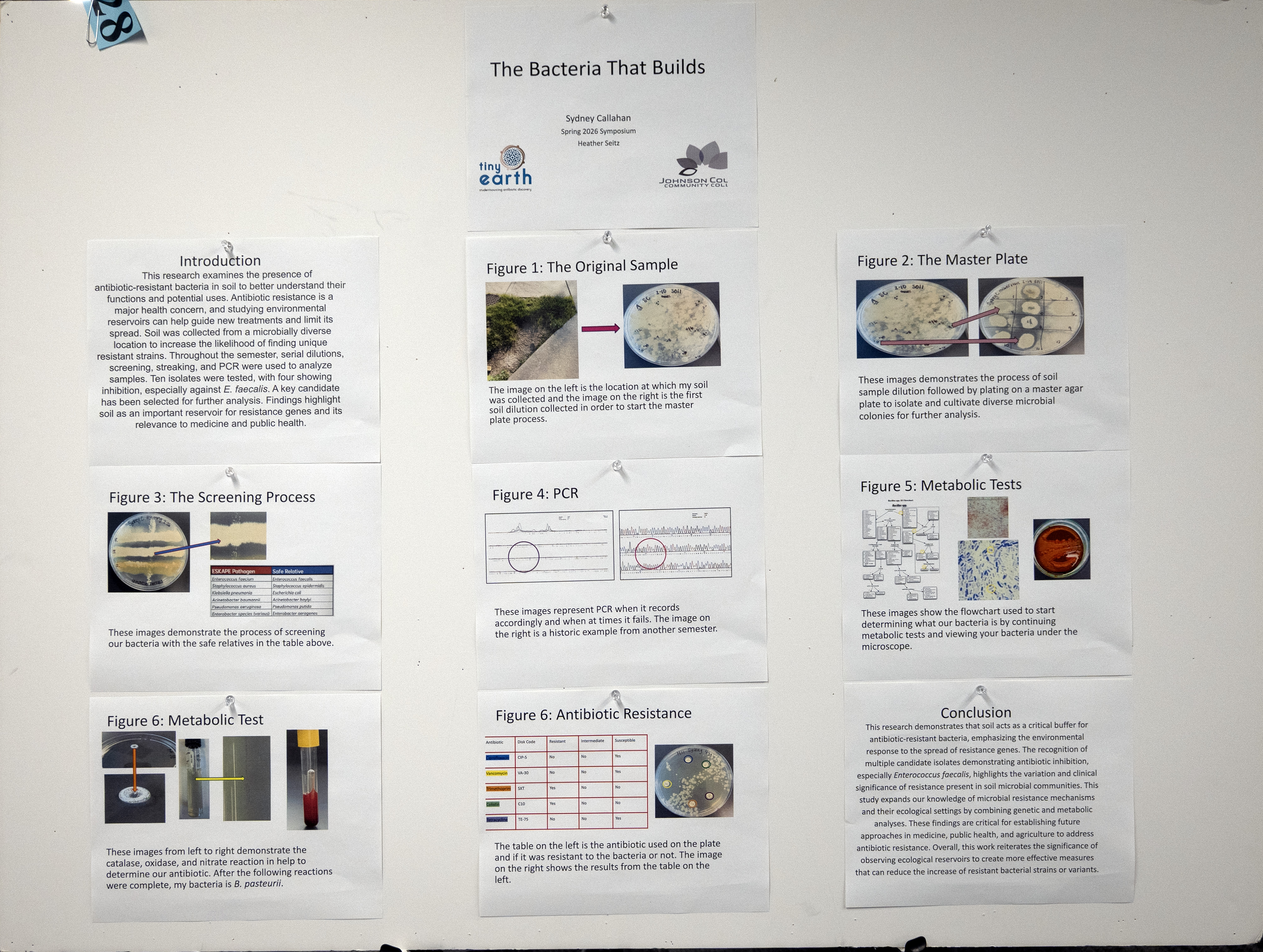
This research endeavor seeks to examine the existence of antibiotic-resistant bacteria present in soil to better understand their root functions and potential uses. This analysis is essential since antibiotic resistance is a significant overall health risk, and knowledge of biological and environmental reservoirs of antibiotics can help avoid the growth of resistant bacteria and direct the establishment of new treatment methods. I chose the location where I collected my soil because the soil in this space possesses a wide range of microbial abundance, which raises the probability of discovering distinctive antibiotic-resistant varieties that may not be available at other locations. Throughout the semester, we have conducted a series of serial dilutions, screening, streaking, and PCR testing on our soil samples in order to recognize and evaluate possible resistant bacteria. During this process, I screened ten candidate microbial isolates, with four displaying positive inhibition against several safe relatives, and E. faecalis showing the highest number of positives. I have also selected my most intriguing candidate using both genetic and metabolic techniques, which will be concluded before the poster symposium. The initial findings demonstrate the existence of possible antibiotic-resistant bacteria, emphasizing soil as an essential reservoir for resistance genes. These results lead to improved understanding in microbiology, providing useful applications for medical researchers, public health organizations, and agricultural industries. Ultimately, this study strengthens our awareness of environmental factors that contribute to antibiotic resistance.
Image
Hidden Resistance at our Homes
CoLab, COM 248
This research endeavor seeks to examine the existence of antibiotic-resistant bacteria present in soil to better understand their root functions and potential uses. This analysis is essential since antibiotic resistance is a significant overall health risk, and knowledge of biological and environmental reservoirs of antibiotics can help avoid the growth of resistant bacteria and direct the establishment of new treatment methods. I chose the location where I collected my soil because the soil in this space possesses a wide range of microbial abundance, which raises the probability of discovering distinctive antibiotic-resistant varieties that may not be available at other locations. Throughout the semester, we have conducted a series of serial dilutions, screening, streaking, and PCR testing on our soil samples in order to recognize and evaluate possible resistant bacteria. During this process, I screened ten candidate microbial isolates, with four displaying positive inhibition against several safe relatives, and E. faecalis showing the highest number of positives. I have also selected my most intriguing candidate using both genetic and metabolic techniques, which will be concluded before the poster symposium. The initial findings demonstrate the existence of possible antibiotic-resistant bacteria, emphasizing soil as an essential reservoir for resistance genes. These results lead to improved understanding in microbiology, providing useful applications for medical researchers, public health organizations, and agricultural industries. Ultimately, this study strengthens our awareness of environmental factors that contribute to antibiotic resistance.
Comments
The faculty mentor for this project was Heather Seitz.