

Finding Antibiotic Producing Bacteria in Soil
Location
CoLab, COM 238
Start Date
30-4-2026 12:00 PM
Document Type
Poster
Description
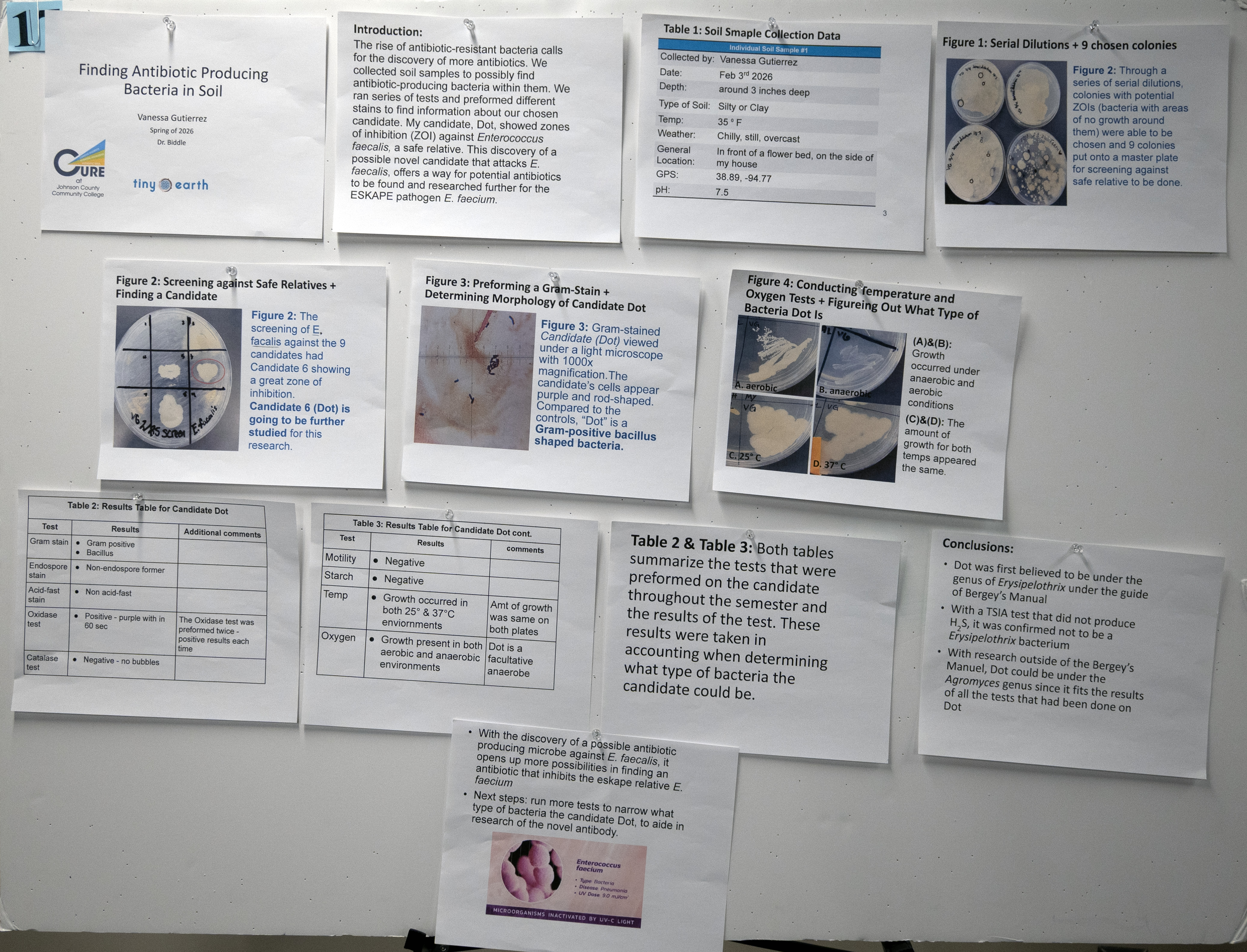
The rise of antibiotic-resistant bacteria calls for the discovery of more antibiotics. We collected soil samples to possibly find antibiotic-producing bacteria within them. With the collected soil sample, I serially diluted it. With the serial dilutions, I spotted colonies with possible zones of inhibition and created a master plate from nine of those colonies. With the master plate, I screened the nine colonies against six safe relatives of ESKAPE pathogens, Escherichia coli, Staphylococcus epidermidis, Enterococcus faecalis, Pseudomonas putida, Enterobacter aerogenes, and Acinetobacter baylyi. With the candidate that had an inhibition zone against E. faecalis, I performed a Gram stain, acid-fast stain, and endospore stain. The candidate has a zone of inhibition against E. faecalis, a Gram-positive, safe relative of Enterococcus faecium. The discovery of a novel candidate that attacks E. faecalis offers a way for potential antibiotics to be found and researched further for the ESKAPE pathogen, E. faecium.
Image
Finding Antibiotic Producing Bacteria in Soil
CoLab, COM 238
The rise of antibiotic-resistant bacteria calls for the discovery of more antibiotics. We collected soil samples to possibly find antibiotic-producing bacteria within them. With the collected soil sample, I serially diluted it. With the serial dilutions, I spotted colonies with possible zones of inhibition and created a master plate from nine of those colonies. With the master plate, I screened the nine colonies against six safe relatives of ESKAPE pathogens, Escherichia coli, Staphylococcus epidermidis, Enterococcus faecalis, Pseudomonas putida, Enterobacter aerogenes, and Acinetobacter baylyi. With the candidate that had an inhibition zone against E. faecalis, I performed a Gram stain, acid-fast stain, and endospore stain. The candidate has a zone of inhibition against E. faecalis, a Gram-positive, safe relative of Enterococcus faecium. The discovery of a novel candidate that attacks E. faecalis offers a way for potential antibiotics to be found and researched further for the ESKAPE pathogen, E. faecium.
Comments
The faculty mentor for this project was Eulandria Biddle.