

A Dipeptide-Based Approach Against Rising Antibiotic Resistance
Location
CoLab, COM 214
Start Date
30-4-2026 10:45 AM
Document Type
Poster
Description
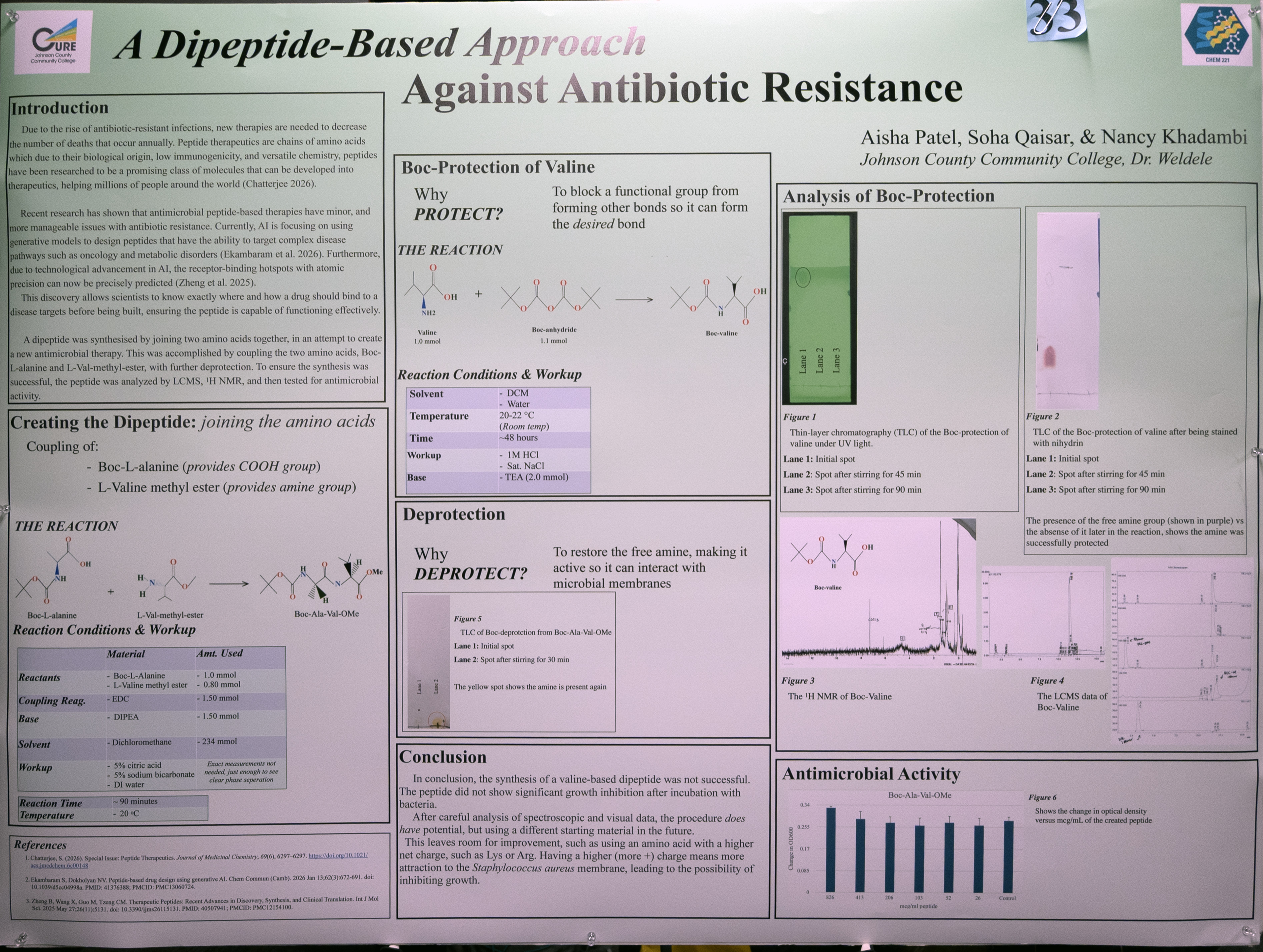
Due to the rise of antibiotic-resistant infections, new therapies are needed to decrease the amount of deaths which occur due to this problem annually. Recent research has shown that antimicrobial peptide based therapies have minor, and more manageable issues with antibiotic resistance. In this experiment, a dipeptide was synthesised by joining two amino acids together, in an attempt to create a new antimicrobial therapy. This was accomplished by protecting the amino group on one amino acid, valine, coupling the two amino acids together, removing the protecting group, and finally, testing the purified peptide. To ensure the synthesis was successful, the peptide was analyzed by 1H NMR and liquid chromatography mass spectrometry, and tested for antimicrobial activity.
Image
A Dipeptide-Based Approach Against Rising Antibiotic Resistance
CoLab, COM 214
Due to the rise of antibiotic-resistant infections, new therapies are needed to decrease the amount of deaths which occur due to this problem annually. Recent research has shown that antimicrobial peptide based therapies have minor, and more manageable issues with antibiotic resistance. In this experiment, a dipeptide was synthesised by joining two amino acids together, in an attempt to create a new antimicrobial therapy. This was accomplished by protecting the amino group on one amino acid, valine, coupling the two amino acids together, removing the protecting group, and finally, testing the purified peptide. To ensure the synthesis was successful, the peptide was analyzed by 1H NMR and liquid chromatography mass spectrometry, and tested for antimicrobial activity.
Comments
The faculty mentor for this project was Meagan Weldele.