

Location
CoLab, COM 100
Start Date
1-5-2025 9:45 AM
Document Type
Poster
Description
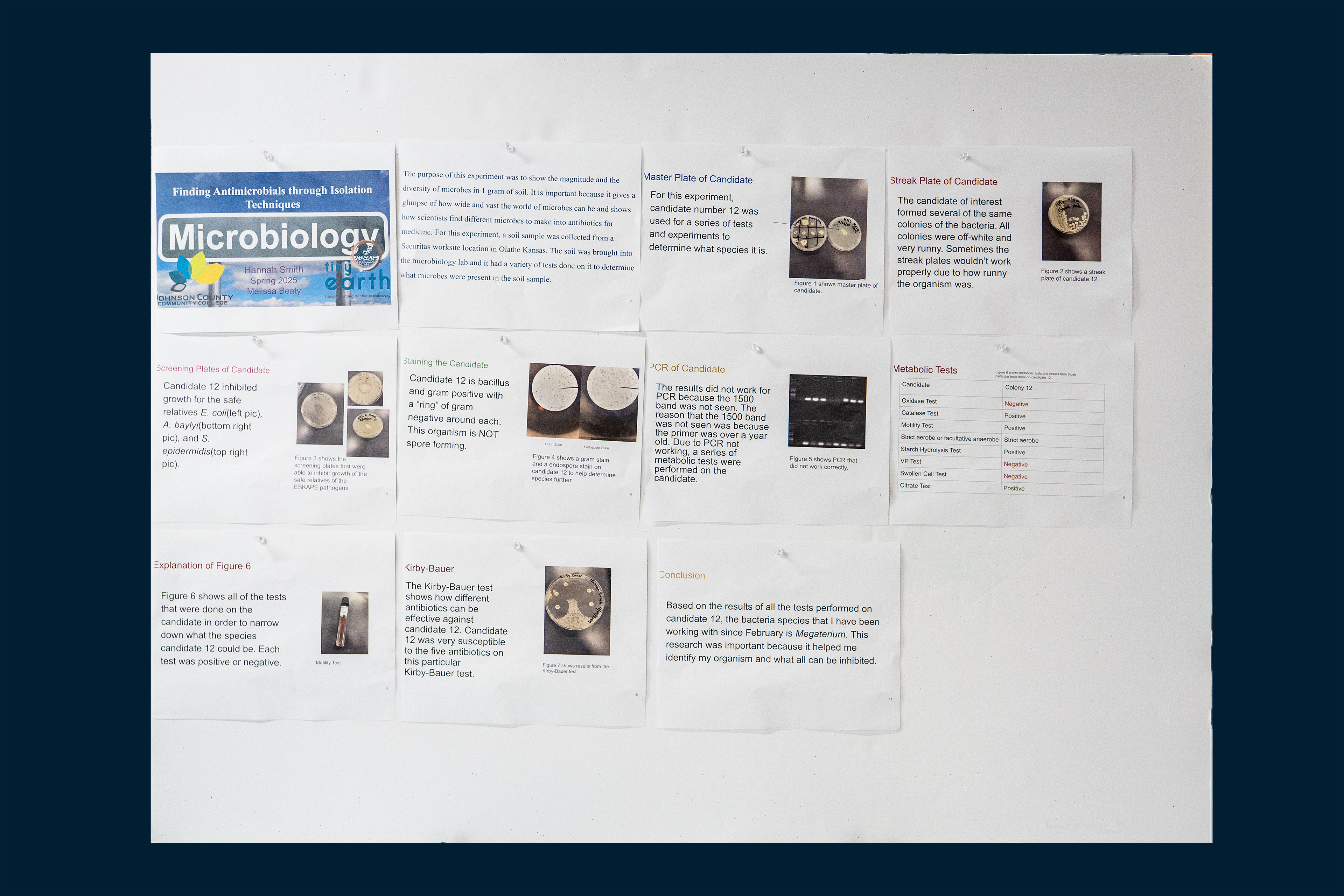
The purpose of this experiment was to show the magnitude and the diversity of microbes in 1 gram of soil. It is important because it gives a glimpse of how wide and vast the world of microbes can be and shows how scientists find different microbes to make into antibiotics for medicine. The results showed a vast number of microbes with countless different species of bacteria that live in soil. The soil sample was collected from a Securitas worksite location in Olathe Kansas, and used for serial dilution. Serial dilution is a way to dilute the soil sample to a more manageable size so that the researcher can observe and gather data from that dissolution. In this experiment, researchers were able to view individual colonies and see several antibiotic candidates. Cfu/ml was able to be calculated for each given sample. Metabolic testing, Polymerase Chain Reaction(PCR), and gel electrophoresis were used to determine the identity of the candidate.
Image
Finding Antimicrobials Through Isolation Techniques
CoLab, COM 100
The purpose of this experiment was to show the magnitude and the diversity of microbes in 1 gram of soil. It is important because it gives a glimpse of how wide and vast the world of microbes can be and shows how scientists find different microbes to make into antibiotics for medicine. The results showed a vast number of microbes with countless different species of bacteria that live in soil. The soil sample was collected from a Securitas worksite location in Olathe Kansas, and used for serial dilution. Serial dilution is a way to dilute the soil sample to a more manageable size so that the researcher can observe and gather data from that dissolution. In this experiment, researchers were able to view individual colonies and see several antibiotic candidates. Cfu/ml was able to be calculated for each given sample. Metabolic testing, Polymerase Chain Reaction(PCR), and gel electrophoresis were used to determine the identity of the candidate.
Comments
The faculty mentor for this project was Melissa Beaty, Biology.