

Location
CoLab, COM 100
Start Date
1-5-2025 9:45 AM
Document Type
Poster
Description
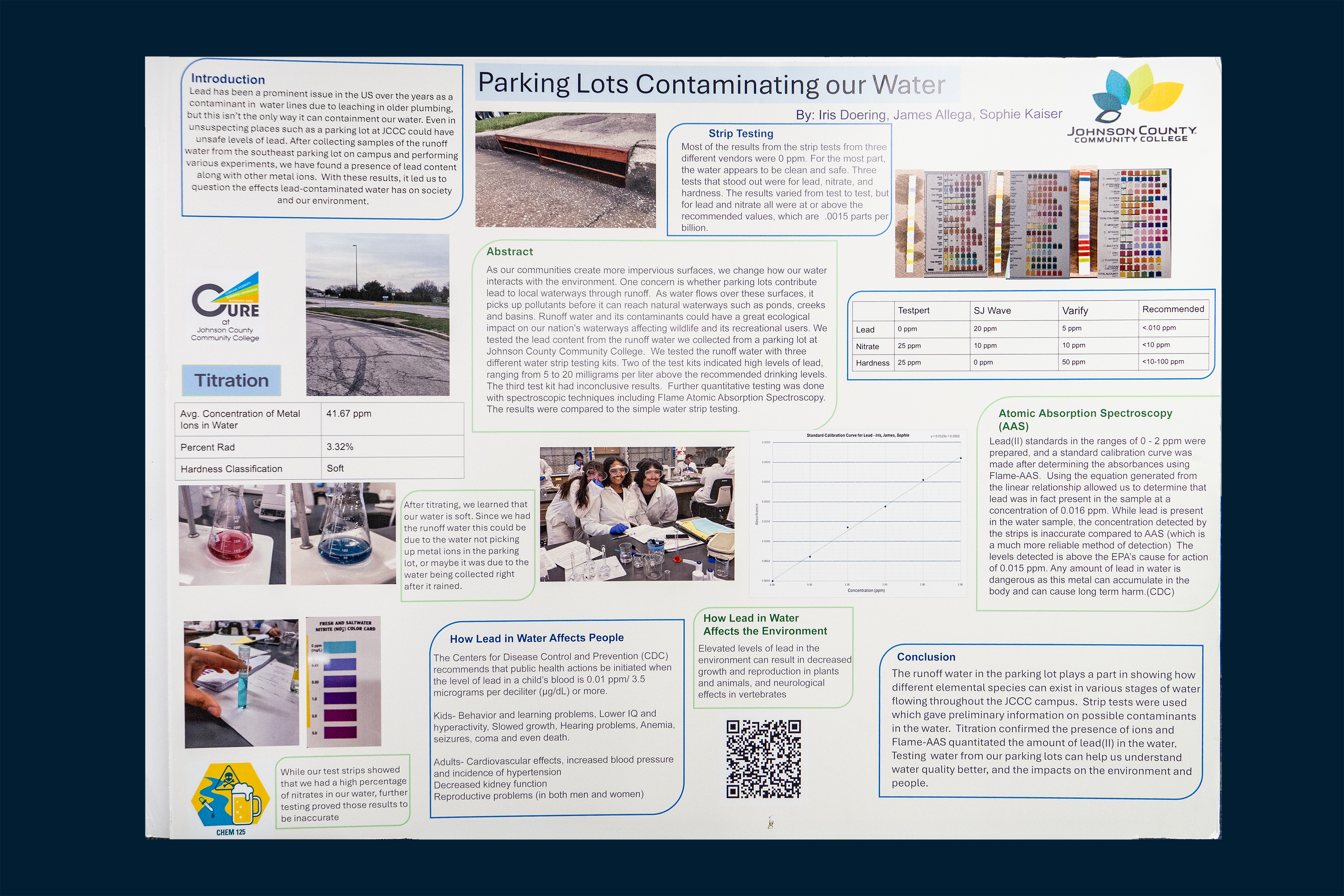
As our communities create more impervious surfaces, we change how our water interacts with the environment. One concern is whether parking lots contribute lead to local waterways through runoff. As water flows over these surfaces, it picks up pollutants before it is able to reach natural waterways such as ponds, creeks and basins. Runoff water and its contaminants could have a great ecological impact on our nation's waterways affecting wildlife and its recreational users. We tested the lead content from the runoff water we collected from a parking lot at Johnson County Community College. We tested the runoff water with three different water strip testing kits. Two of the test kits indicated high levels of lead, ranging from 5 to 20 milligrams per liter above the recommended drinking levels. The third test kit had inconclusive results. Further quantitative testing was done with spectroscopic techniques including Flame Atomic Absorption Spectroscopy. The results were compared to the simple water strip testing.
Image
Are Parking Lots Contaminating Our Water
CoLab, COM 100
As our communities create more impervious surfaces, we change how our water interacts with the environment. One concern is whether parking lots contribute lead to local waterways through runoff. As water flows over these surfaces, it picks up pollutants before it is able to reach natural waterways such as ponds, creeks and basins. Runoff water and its contaminants could have a great ecological impact on our nation's waterways affecting wildlife and its recreational users. We tested the lead content from the runoff water we collected from a parking lot at Johnson County Community College. We tested the runoff water with three different water strip testing kits. Two of the test kits indicated high levels of lead, ranging from 5 to 20 milligrams per liter above the recommended drinking levels. The third test kit had inconclusive results. Further quantitative testing was done with spectroscopic techniques including Flame Atomic Absorption Spectroscopy. The results were compared to the simple water strip testing.
Comments
The faculty mentor for this project was Lori Slavin, Chemistry.