

Location
CoLab, COM 100
Start Date
1-5-2025 9:45 AM
Document Type
Poster
Description
Research of most effective germination techniques for butterfly milkweed seeds. Significance includes developing methods for individuals to have the opportunity to grow milkweed to contribute to the conservation efforts of the monarch butterfly. Researchers aimed to study which method of scarification—sand or hydrogen peroxide—was more effective in germinating butterfly milkweed seeds. Researchers set up 80 butterfly milkweed seeds across 4 separate containers, with 20 seeds in each container—2 petri dishes with H2O2 and 2 bags of sand. After letting the containers sit for 4 weeks, researchers set up the seeds to germinate for 6 weeks and recorded results afterwards. The hydrogen peroxide groups produced higher germination rates and larger sprouts than the sand groups, but some margin of error may be included for factors such as temperature and light during germination. Additional replications are needed with attention to light exposure and temperature regulation. Implications of this research include conservation of monarch butterfly populations and habitat restoration.
Image
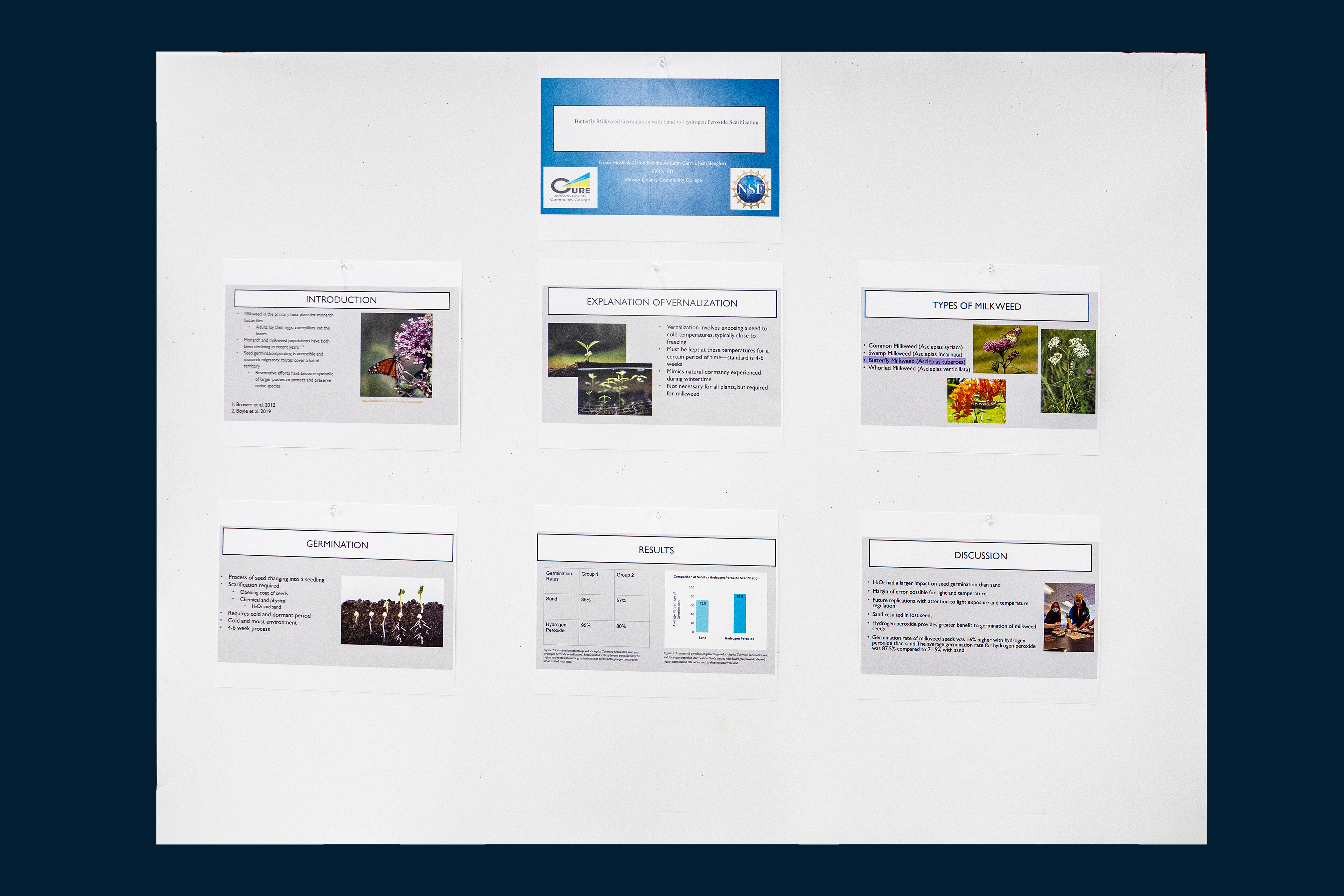
Increase of Germination for Asclepias Tuberosa Using Chemical and Non-Chemical Scarification
CoLab, COM 100
Research of most effective germination techniques for butterfly milkweed seeds. Significance includes developing methods for individuals to have the opportunity to grow milkweed to contribute to the conservation efforts of the monarch butterfly. Researchers aimed to study which method of scarification—sand or hydrogen peroxide—was more effective in germinating butterfly milkweed seeds. Researchers set up 80 butterfly milkweed seeds across 4 separate containers, with 20 seeds in each container—2 petri dishes with H2O2 and 2 bags of sand. After letting the containers sit for 4 weeks, researchers set up the seeds to germinate for 6 weeks and recorded results afterwards. The hydrogen peroxide groups produced higher germination rates and larger sprouts than the sand groups, but some margin of error may be included for factors such as temperature and light during germination. Additional replications are needed with attention to light exposure and temperature regulation. Implications of this research include conservation of monarch butterfly populations and habitat restoration.
Comments
The faculty mentor for this project was Sarah Powell, Environmental Science.