

Location
CoLab, COM 100
Start Date
1-5-2025 12:15 PM
Document Type
Poster
Description
Attention-Deficit/Hyperactivity Disorder (ADHD) is a neurodevelopmental disorder (NDD) that affects individuals across all age groups. Diagnosing ADHD remains challenging due to its reliance on subjective self-reports and behavioral assessments, which can lead to underdiagnosis or delayed diagnosis. Identifying a biomarker for ADHD could improve diagnostic accuracy and facilitate research into alternative treatments beyond stimulant medications. Multiple studies suggest a link between ADHD, decreased contrast sensitivity, and a thinner inferior ganglion cell complex. This literature review explores the association between reduced contrast sensitivity, a thinner ganglion cell complex (GCC), and ADHD to identify a potential biomarker. The findings highlight the need for further research into the relationship between retinal characteristics and ADHD, and a proposed study is presented.
Image
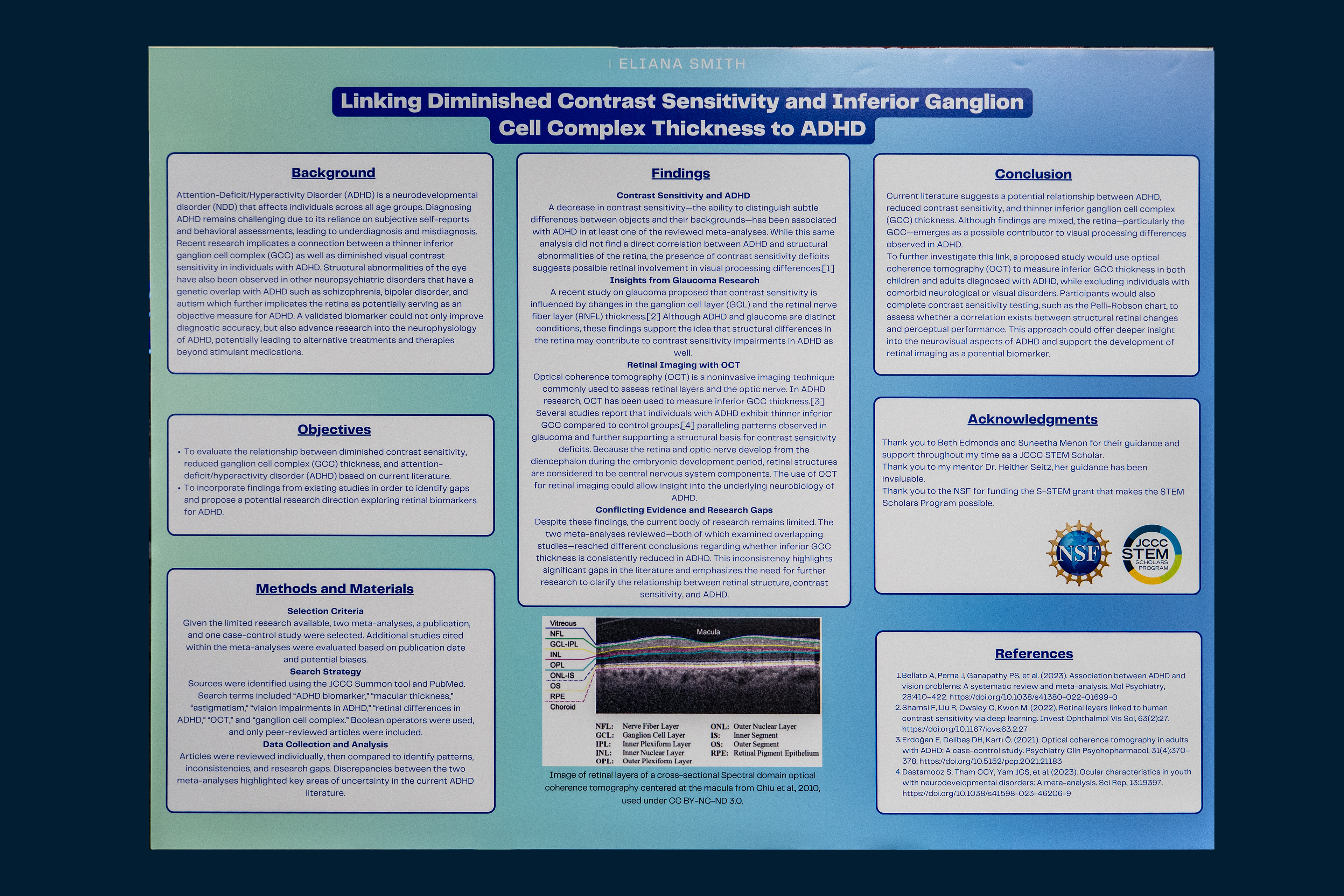
Linking Diminished Contrast Sensitivity and Inferior Ganglion Cell Complex Thickness to ADHD
CoLab, COM 100
Attention-Deficit/Hyperactivity Disorder (ADHD) is a neurodevelopmental disorder (NDD) that affects individuals across all age groups. Diagnosing ADHD remains challenging due to its reliance on subjective self-reports and behavioral assessments, which can lead to underdiagnosis or delayed diagnosis. Identifying a biomarker for ADHD could improve diagnostic accuracy and facilitate research into alternative treatments beyond stimulant medications. Multiple studies suggest a link between ADHD, decreased contrast sensitivity, and a thinner inferior ganglion cell complex. This literature review explores the association between reduced contrast sensitivity, a thinner ganglion cell complex (GCC), and ADHD to identify a potential biomarker. The findings highlight the need for further research into the relationship between retinal characteristics and ADHD, and a proposed study is presented.
Comments
The faculty mentor for this project was Beth Edmonds, STEM Scholars.