

Location
CoLab, COM 100
Start Date
1-5-2025 11:00 AM
Document Type
Poster
Description
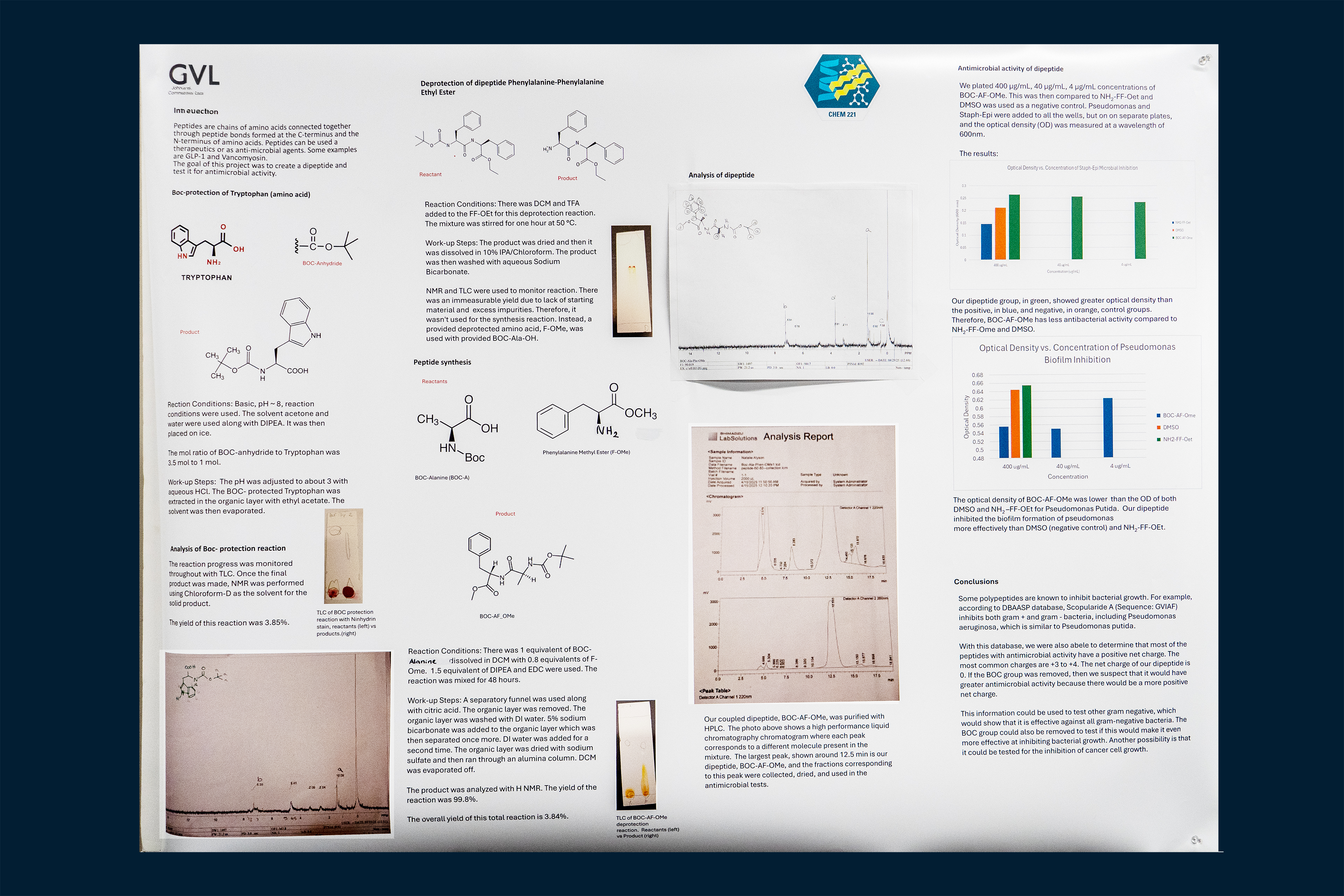
For this CURE project, a peptide bond will be formed by joining tryptophan with another amino acid, phenylalenine-phenylalenine. Then the synthesized polypeptide will be tested for antimicrobial activity. Current research suggests that some small polypeptides could inhibit microbial growth. First, to join tryptophan with the phenylalanine-phenylalanine. A protecting-group will be added to the free amine group on tryptophan. This will performed by reacting BOC anhydride, the protection-molecule, with tryptophan under basic conditions using DIPEA as a base, and then water plus acetone for the solvent. The reaction progress will be monitored by Thin Layer Chromatography (TLC). The BOC-protected tryptophan will be isolated by dropping the pH using HCl, washing with ethyl acetate, and using column chromatography. Then, the protecting group already attached to the free amine group of phenylalanine-phenylalanine will be removed using dichloromethane, THF, and heat for approximately one hour. The carboxylic acid end of phenylalanine-phenylalanine will remain protected and unable to form unwanted side-reactions. The protecting group on tryptophan and the removal of the protecting group on phenylalanine-phenylalanine is necessary to reduce chances of unwanted side-reactions from occurring but also to allow the coupling of the free amine group of phenylalanine-phenylalanine and the carboxylic acid group of tryptophan. Once tryptophan and phenylalanine-phenylalanine are prepped, they can be joined together with a new peptide bond using EDC as a coupling-reagent. Finally, the protecting groups will be removed from the product and anti-microbial activity will be qualitatively confirmed.
Image
Polypeptide Synthesis Project: Tryptophan
CoLab, COM 100
For this CURE project, a peptide bond will be formed by joining tryptophan with another amino acid, phenylalenine-phenylalenine. Then the synthesized polypeptide will be tested for antimicrobial activity. Current research suggests that some small polypeptides could inhibit microbial growth. First, to join tryptophan with the phenylalanine-phenylalanine. A protecting-group will be added to the free amine group on tryptophan. This will performed by reacting BOC anhydride, the protection-molecule, with tryptophan under basic conditions using DIPEA as a base, and then water plus acetone for the solvent. The reaction progress will be monitored by Thin Layer Chromatography (TLC). The BOC-protected tryptophan will be isolated by dropping the pH using HCl, washing with ethyl acetate, and using column chromatography. Then, the protecting group already attached to the free amine group of phenylalanine-phenylalanine will be removed using dichloromethane, THF, and heat for approximately one hour. The carboxylic acid end of phenylalanine-phenylalanine will remain protected and unable to form unwanted side-reactions. The protecting group on tryptophan and the removal of the protecting group on phenylalanine-phenylalanine is necessary to reduce chances of unwanted side-reactions from occurring but also to allow the coupling of the free amine group of phenylalanine-phenylalanine and the carboxylic acid group of tryptophan. Once tryptophan and phenylalanine-phenylalanine are prepped, they can be joined together with a new peptide bond using EDC as a coupling-reagent. Finally, the protecting groups will be removed from the product and anti-microbial activity will be qualitatively confirmed.
Comments
The faculty mentor for this project was Meagan Weldele, Chemistry.