

Location
CoLab, COM 100
Start Date
1-5-2025 11:00 AM
Document Type
Poster
Description
According to the World Health Organization, at least 1.7 billion people use a contaminated drinking-water source in 2022. Contaminated sources of water can transmit deadly diseases and are estimated to cause roughly 500,000 deaths each year. Monitoring our water is essential to determine the level of contaminants and filtration needed to provide safe drinking water. The natural land around the JCCC campus runs directly into the Indian Creek, which, while not being a main water source, eventually flows into the Missouri River, which is a water source for the Johnson County Area. JCCC has five water sampling sites around campus, we chose to focus on testing the post-basin water sample. Our sample being post-basin means it has already gone through the natural filtration of the native plants. The goal of this research is to determine the effectiveness of JCCC’s stormwater management system and the quality of water, as well as the accuracy of everyday test equipment. The post-basin water was found to be hard water, or water containing high mineral content, and sulfate was the only tested parameter found to be above the recommended range for drinking water. Additional experiments focusing on the calcium ion concentration will be discussed.
Image
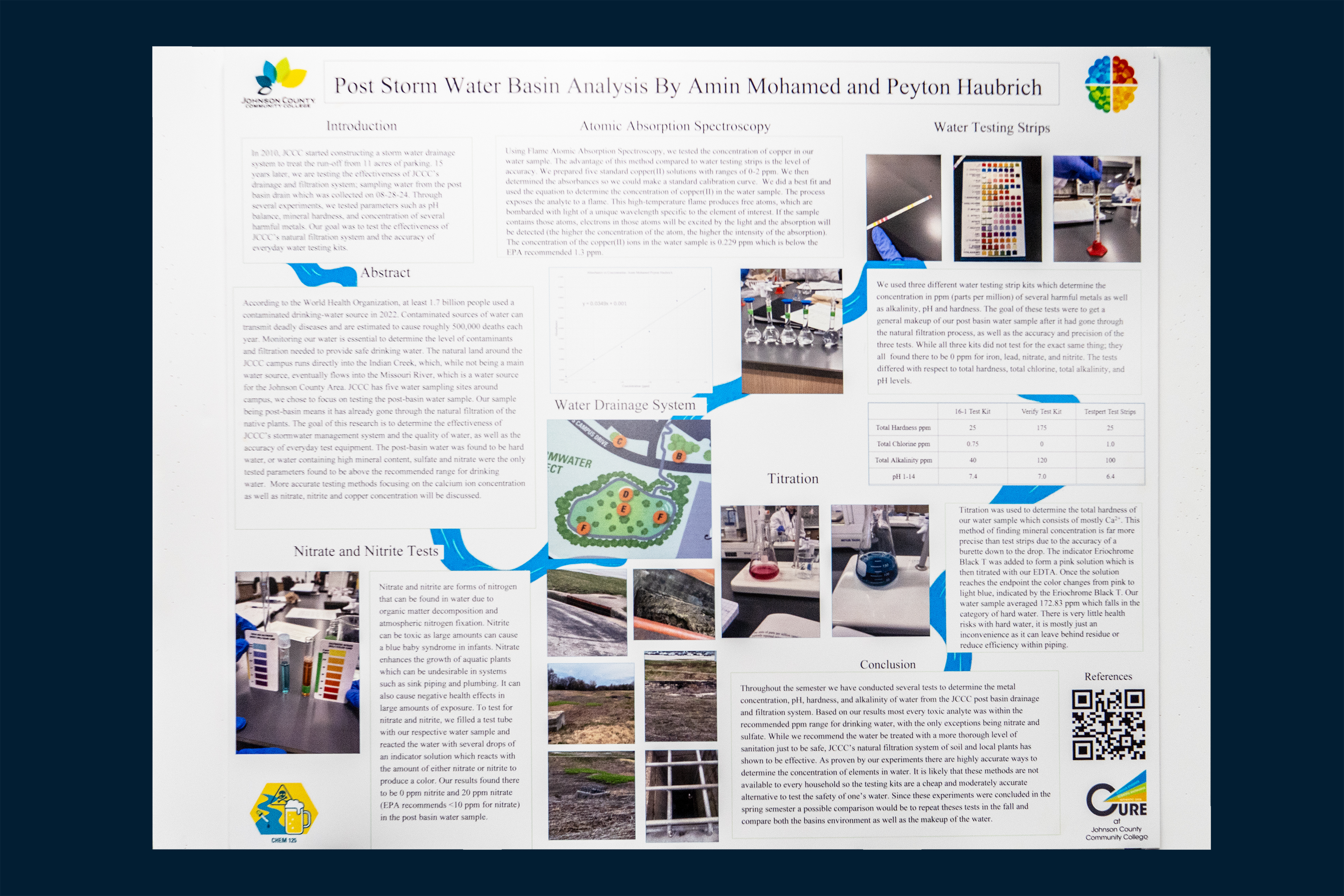
Post Storm Water Basin Analysis
CoLab, COM 100
According to the World Health Organization, at least 1.7 billion people use a contaminated drinking-water source in 2022. Contaminated sources of water can transmit deadly diseases and are estimated to cause roughly 500,000 deaths each year. Monitoring our water is essential to determine the level of contaminants and filtration needed to provide safe drinking water. The natural land around the JCCC campus runs directly into the Indian Creek, which, while not being a main water source, eventually flows into the Missouri River, which is a water source for the Johnson County Area. JCCC has five water sampling sites around campus, we chose to focus on testing the post-basin water sample. Our sample being post-basin means it has already gone through the natural filtration of the native plants. The goal of this research is to determine the effectiveness of JCCC’s stormwater management system and the quality of water, as well as the accuracy of everyday test equipment. The post-basin water was found to be hard water, or water containing high mineral content, and sulfate was the only tested parameter found to be above the recommended range for drinking water. Additional experiments focusing on the calcium ion concentration will be discussed.
Comments
The faculty mentor for this project was Lori Slavin, Chemistry.