

Location
CoLab, COM 100
Start Date
1-5-2025 9:45 AM
Document Type
Poster
Description
Antibiotic resistance is a growing concern in healthcare as infectious pathogens are rapidly developing resistance to conventional antibiotics faster than new types of antibiotics are being discovered. The ESKAPE pathogens are a group of multidrug-resistant organisms responsible for a significant portion of antibiotic-resistant infections seen in healthcare. Therefore, researching for new antibiotics that can treat these pathogens can be very useful when conventional antibiotics are no longer effective against them. In my microbiology lab class, we collected soil samples, performed serial dilutions to isolate potential bacterial candidates onto master plates, and created screening plates with the hopes of finding candidates that showed potential for producing novel antibiotics. I was able to isolate a bacterial candidate from a soil sample outside my apartment that demonstrated antimicrobial activity against the safe relatives for two of the ESKAPE pathogens. This bacterial candidate, which I named Helia Saladin, showed strong inhibition against the safe relatives Enterococcus faecalis (E. faecalis) and Eschericia coli (E. coli), suggesting Helia’s potential for antimicrobial properties against the actual infectious pathogens associated with these safe relatives as a possible future novel antibiotic.
Image
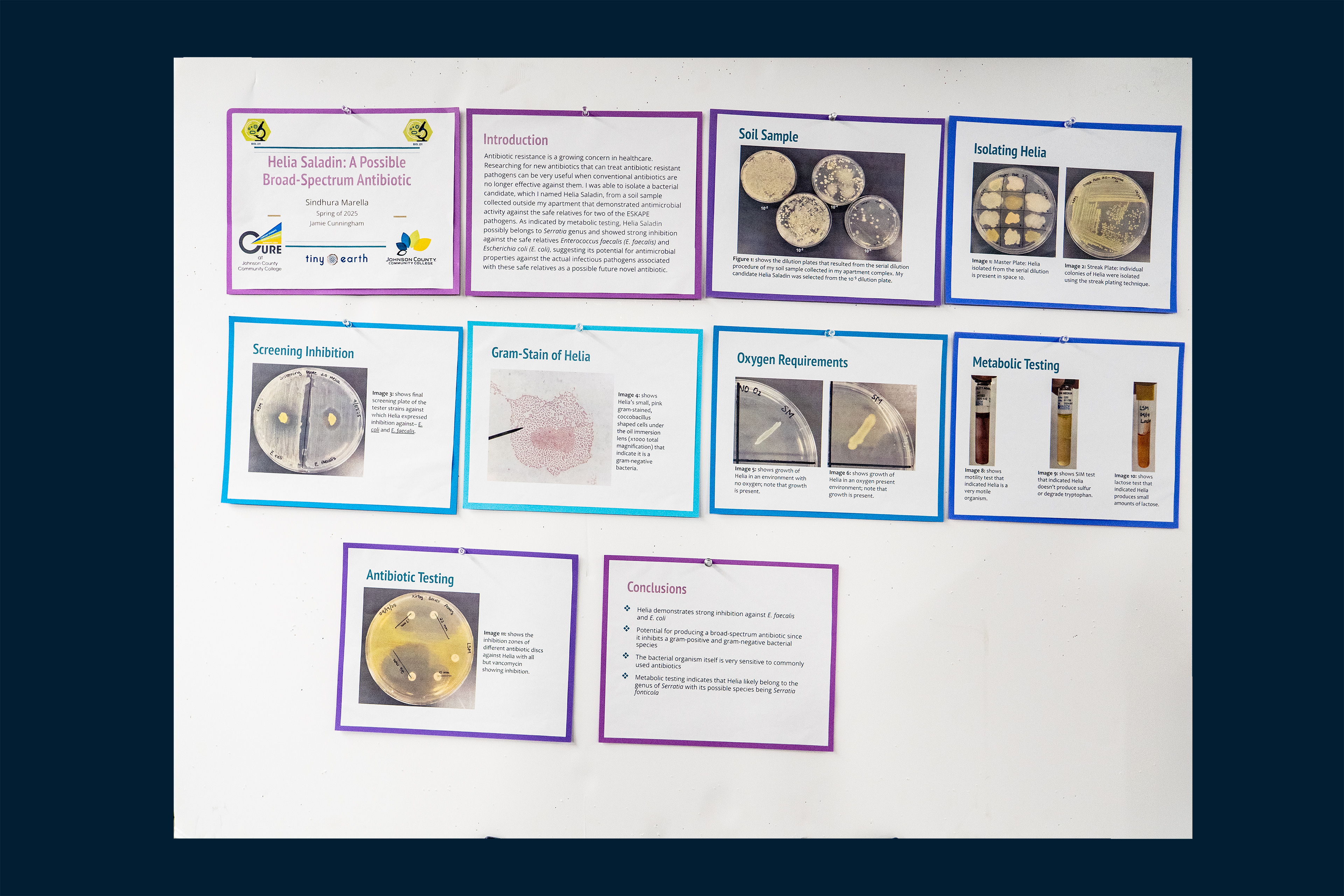
Helia Saladin: A Possible Broad-Spectrum Antibiotic
CoLab, COM 100
Antibiotic resistance is a growing concern in healthcare as infectious pathogens are rapidly developing resistance to conventional antibiotics faster than new types of antibiotics are being discovered. The ESKAPE pathogens are a group of multidrug-resistant organisms responsible for a significant portion of antibiotic-resistant infections seen in healthcare. Therefore, researching for new antibiotics that can treat these pathogens can be very useful when conventional antibiotics are no longer effective against them. In my microbiology lab class, we collected soil samples, performed serial dilutions to isolate potential bacterial candidates onto master plates, and created screening plates with the hopes of finding candidates that showed potential for producing novel antibiotics. I was able to isolate a bacterial candidate from a soil sample outside my apartment that demonstrated antimicrobial activity against the safe relatives for two of the ESKAPE pathogens. This bacterial candidate, which I named Helia Saladin, showed strong inhibition against the safe relatives Enterococcus faecalis (E. faecalis) and Eschericia coli (E. coli), suggesting Helia’s potential for antimicrobial properties against the actual infectious pathogens associated with these safe relatives as a possible future novel antibiotic.
Comments
The faculty mentor for this project was Jamie Cunningham, Biology.