

Location
CoLab, COM 100
Start Date
1-5-2025 6:45 PM
Document Type
Poster
Description
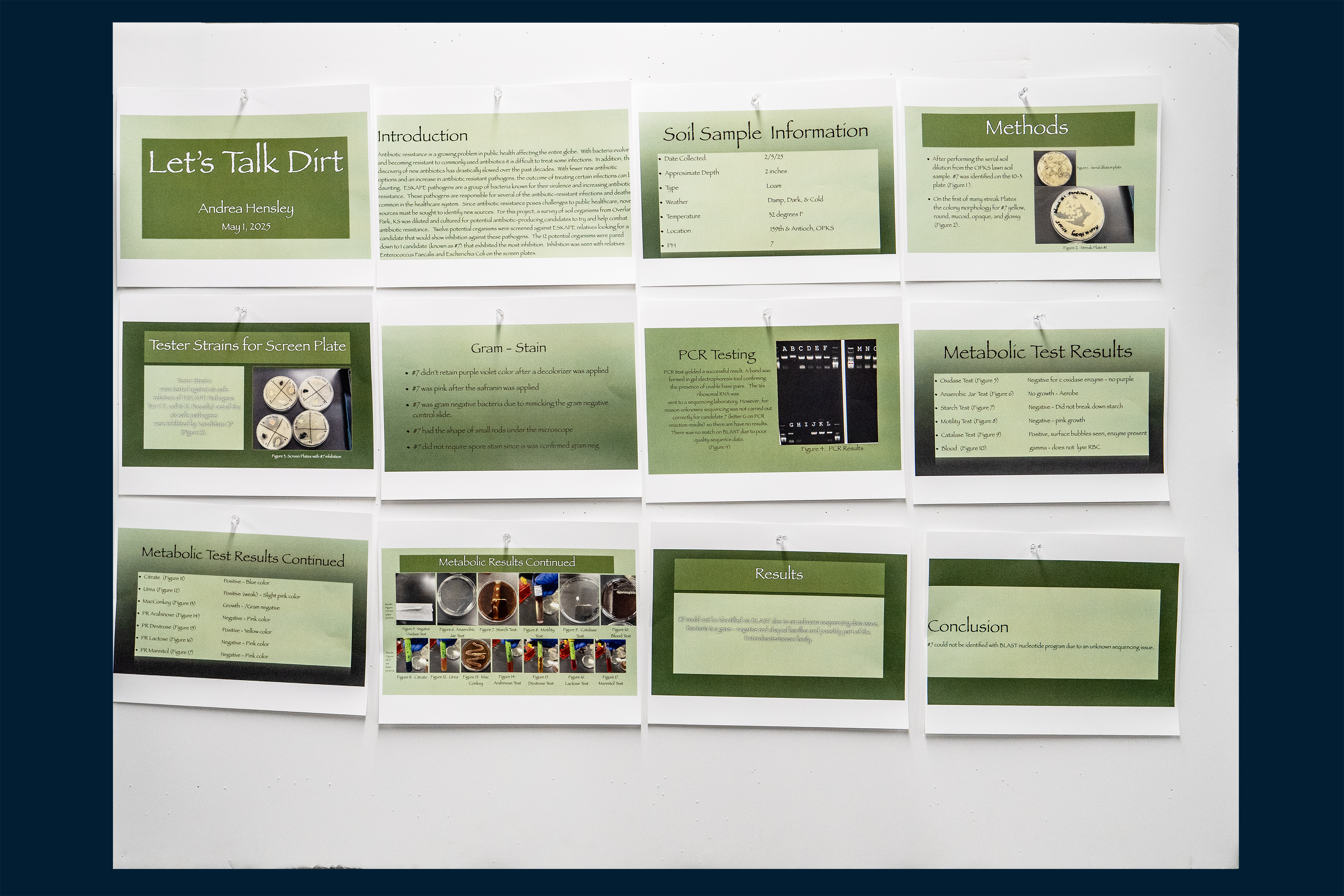
Antibiotic resistance is a serious growing problem in public health affecting the entire globe. With bacteria evolving and becoming resistant to commonly used antibiotics it is more and more difficult to treat some infections. In addition, the discovery of new antibiotics has drastically slowed over the past decades coming to a halt in the 1980’s. With fewer new antibiotic options and an increase in antibiotic resistant pathogens treating certain infections can be so difficult that it can potentially lead to death of those infected. ESKAPE pathogens are a group of bacteria known for their virulence and increasing antibiotic resistance. These ESKAPE pathogens are responsible for several of the antibiotic-resistant infections and deaths common in the healthcare system. Since antibiotic resistance poses such significant challenges to public healthcare, novel sources must be sought to identify new sources. For this project, a survey of soil organisms from Overland Park, KS was diluted and cultured for potential antibiotic-producing candidates to try and help combat the antibiotic resistance problem. The original screen consisted of 12 potential organisms screened against ESKAPE relatives to look for any candidate that showed inhibition against these pathogens. The 12 potential organisms were further pared down to 1 candidate (known as candidate #7) that exhibited the most inhibition with ESKAPE relatives’ growth. Inhibition was seen with relatives Enterococcus Faecalis and Escherichia Coli on the screen plates. Candidate #7 is a Gram-negative rod.
Image
Let's Talk Dirt
CoLab, COM 100
Antibiotic resistance is a serious growing problem in public health affecting the entire globe. With bacteria evolving and becoming resistant to commonly used antibiotics it is more and more difficult to treat some infections. In addition, the discovery of new antibiotics has drastically slowed over the past decades coming to a halt in the 1980’s. With fewer new antibiotic options and an increase in antibiotic resistant pathogens treating certain infections can be so difficult that it can potentially lead to death of those infected. ESKAPE pathogens are a group of bacteria known for their virulence and increasing antibiotic resistance. These ESKAPE pathogens are responsible for several of the antibiotic-resistant infections and deaths common in the healthcare system. Since antibiotic resistance poses such significant challenges to public healthcare, novel sources must be sought to identify new sources. For this project, a survey of soil organisms from Overland Park, KS was diluted and cultured for potential antibiotic-producing candidates to try and help combat the antibiotic resistance problem. The original screen consisted of 12 potential organisms screened against ESKAPE relatives to look for any candidate that showed inhibition against these pathogens. The 12 potential organisms were further pared down to 1 candidate (known as candidate #7) that exhibited the most inhibition with ESKAPE relatives’ growth. Inhibition was seen with relatives Enterococcus Faecalis and Escherichia Coli on the screen plates. Candidate #7 is a Gram-negative rod.
Comments
The faculty mentor for this project was Matthew Ducote, Biology.