

Location
CoLab, COM 100
Start Date
1-5-2025 6:45 PM
Document Type
Poster
Description
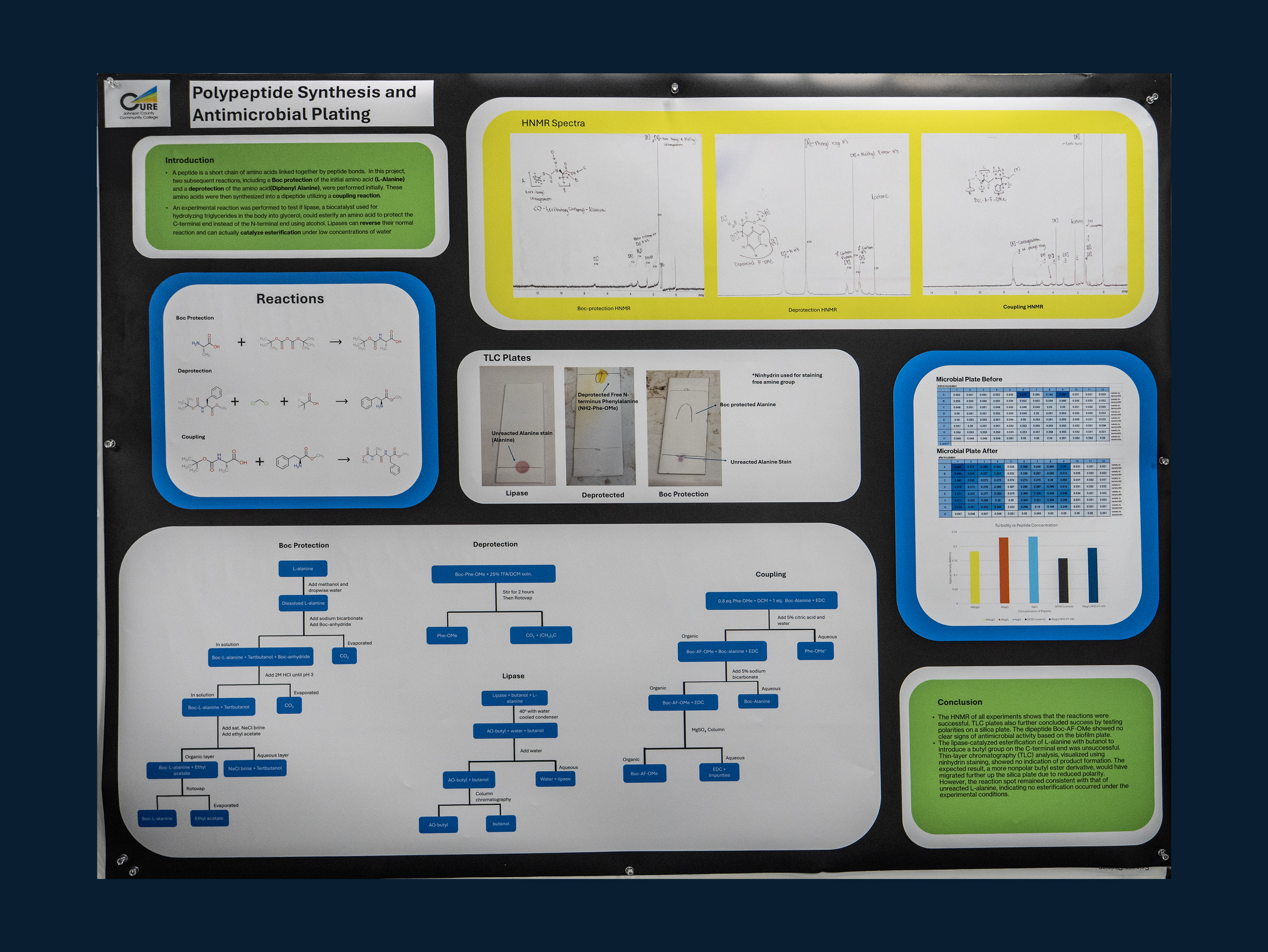
Peptide synthesis is a fundamental aspect of biochemistry with applications in pharmaceuticals and protein engineering. This project explores two synthetic approaches to peptide modification and extension. First, alanine is BOC-protected using BOC anhydride to safeguard the amine group during subsequent reactions. In parallel, a dipeptide ester is deprotected at the C-terminal end to allow nucleophilic attack by the N-terminal amine of the protected alanine, facilitating the formation of a tri-peptide through amide bond formation. The second approach involves enzymatic esterification of the peptide's C-terminal end using lipase and an alcohol, leveraging biocatalysis for regioselective modification. This study evaluates the efficiency of chemical versus enzymatic approaches in peptide synthesis and modification. Analytical techniques such as thin-layer chromatography (TLC), nuclear magnetic resonance (NMR), and mass spectrometry (MS) will be employed to confirm structural integrity and reaction progress. The results will provide insights into the effectiveness of protecting group strategies and enzymatic catalysis in peptide chemistry, contributing to the development of efficient synthetic methodologies for bioactive peptides.
Image
Polypeptide Synthesis and Esterification using Enzyme Driven Amino Protection via Esterification
CoLab, COM 100
Peptide synthesis is a fundamental aspect of biochemistry with applications in pharmaceuticals and protein engineering. This project explores two synthetic approaches to peptide modification and extension. First, alanine is BOC-protected using BOC anhydride to safeguard the amine group during subsequent reactions. In parallel, a dipeptide ester is deprotected at the C-terminal end to allow nucleophilic attack by the N-terminal amine of the protected alanine, facilitating the formation of a tri-peptide through amide bond formation. The second approach involves enzymatic esterification of the peptide's C-terminal end using lipase and an alcohol, leveraging biocatalysis for regioselective modification. This study evaluates the efficiency of chemical versus enzymatic approaches in peptide synthesis and modification. Analytical techniques such as thin-layer chromatography (TLC), nuclear magnetic resonance (NMR), and mass spectrometry (MS) will be employed to confirm structural integrity and reaction progress. The results will provide insights into the effectiveness of protecting group strategies and enzymatic catalysis in peptide chemistry, contributing to the development of efficient synthetic methodologies for bioactive peptides.
Comments
The faculty mentor for this project was Meagan Weldele, Chemistry.