

Location
CoLab, COM 100
Start Date
1-5-2025 6:45 PM
Document Type
Poster
Description
Purpose: This review examines educational strategies for integrating diversity, social justice, and social determinants of health into entry-level healthcare training to improve cultural competency. Methods: We addressed three questions: (1) which DEI topics are included in medical, nursing, and healthcare training, (2) what educational strategies are used, and (3) how student learning and training impact are assessed. We searched Ovid MEDLINE, Embase, and Web of Science for studies published from 2010 to January 2023. After title, abstract, and full-text screening, 45 studies met inclusion criteria. Results: Topics covered in curricula were categorized into four themes: cultural competence, social determinants of health disparities, anti-racism pedagogy, and others. Educational strategies included immersion experiences, hybrid courses, workshops, role-play, simulations, case studies, documentaries, clubs, and self-evaluations. Pre- and post-intervention knowledge was commonly measured via Likert scales and surveys, showing statistical growth and positive student feedback. Most studies focused on nursing, followed by medicine and pharmacy, with fewer in other health professions. Conclusion: Findings highlight the need for standardized DEI training across healthcare education to improve patient-centered care. Expanding diversity-related education in underrepresented health professions, such as physical therapy, is essential for individualized rehabilitation and chronic disease prevention. Future research should focus on standardizing training methodologies and assessing long-term impacts on clinical competence and patient outcomes.
Image
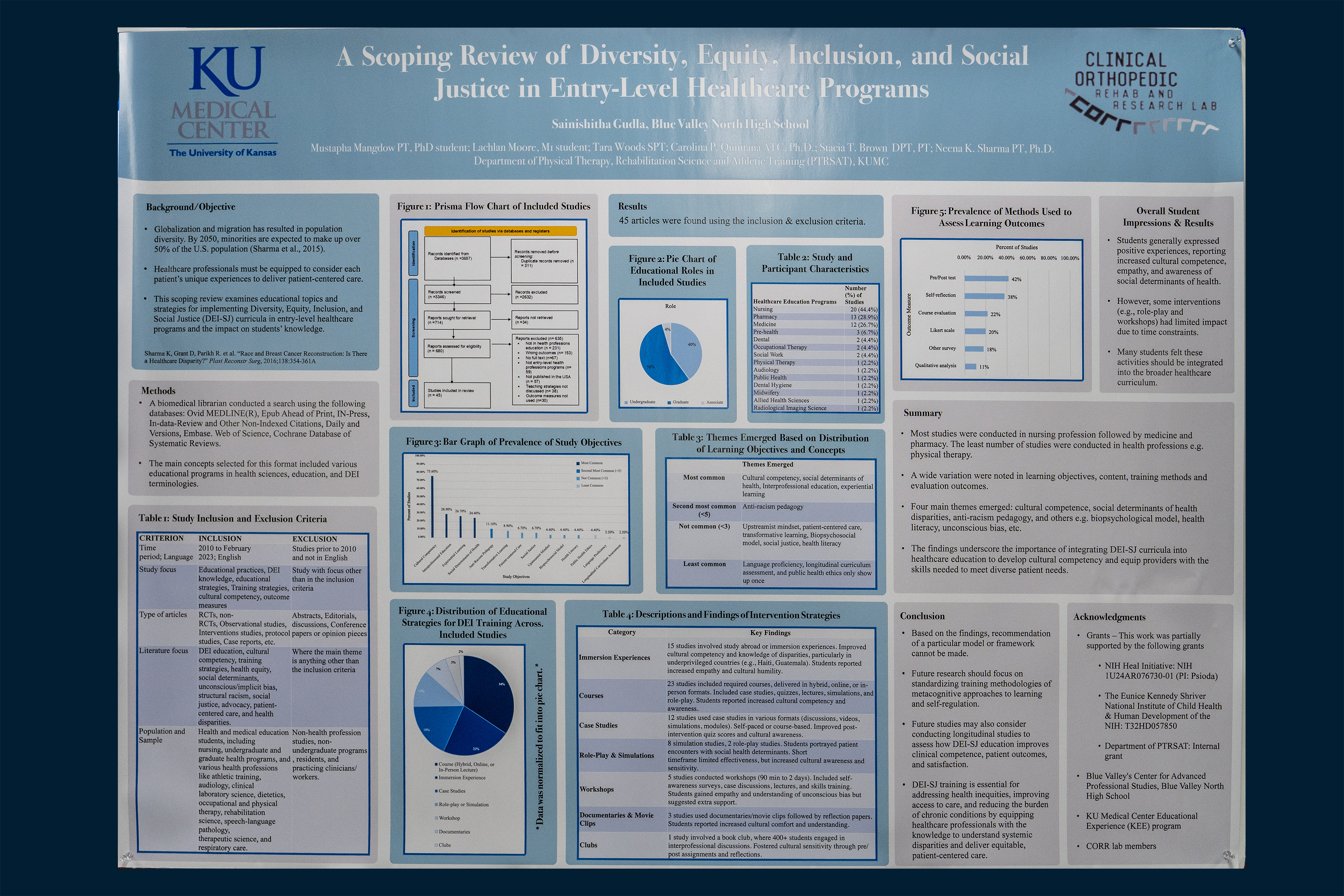
A Scoping Review of Diversity, Equity, Inclusion, and Social Justice and Cultural Competency in Entry-Level Healthcare Programs
CoLab, COM 100
Purpose: This review examines educational strategies for integrating diversity, social justice, and social determinants of health into entry-level healthcare training to improve cultural competency. Methods: We addressed three questions: (1) which DEI topics are included in medical, nursing, and healthcare training, (2) what educational strategies are used, and (3) how student learning and training impact are assessed. We searched Ovid MEDLINE, Embase, and Web of Science for studies published from 2010 to January 2023. After title, abstract, and full-text screening, 45 studies met inclusion criteria. Results: Topics covered in curricula were categorized into four themes: cultural competence, social determinants of health disparities, anti-racism pedagogy, and others. Educational strategies included immersion experiences, hybrid courses, workshops, role-play, simulations, case studies, documentaries, clubs, and self-evaluations. Pre- and post-intervention knowledge was commonly measured via Likert scales and surveys, showing statistical growth and positive student feedback. Most studies focused on nursing, followed by medicine and pharmacy, with fewer in other health professions. Conclusion: Findings highlight the need for standardized DEI training across healthcare education to improve patient-centered care. Expanding diversity-related education in underrepresented health professions, such as physical therapy, is essential for individualized rehabilitation and chronic disease prevention. Future research should focus on standardizing training methodologies and assessing long-term impacts on clinical competence and patient outcomes.
Comments
The faculty mentor for this project was Nan Abbot, HCIS.