

Location
CoLab, COM 100
Start Date
1-5-2025 5:30 PM
Document Type
Poster
Description
With the rise of antibiotic resistance, the effectiveness of commonly used medications is rapidly declining. The goal of this research is to identify potential new bacteria that produce antibiotics capable of inhibiting resistant pathogens. Soil was taken from a suburban front yard in Eudora, Kansas, and diluted to show possible inhibition. The twelve candidates that produced inhibition were then placed on a master plate, and after a week of growth, screened against ESKAPE pathogen relatives. ESKAPE pathogens are six extremely resistant bacteria that cause major problems in clinical settings. The bacteria that demonstrated the most inhibition with these pathogens was then isolated and viewed under the microscope. The bacteria that was identified is an unknown gram-negative rod without spores. Further research on this bacteria will be conducted to determine its genus and species.
Image
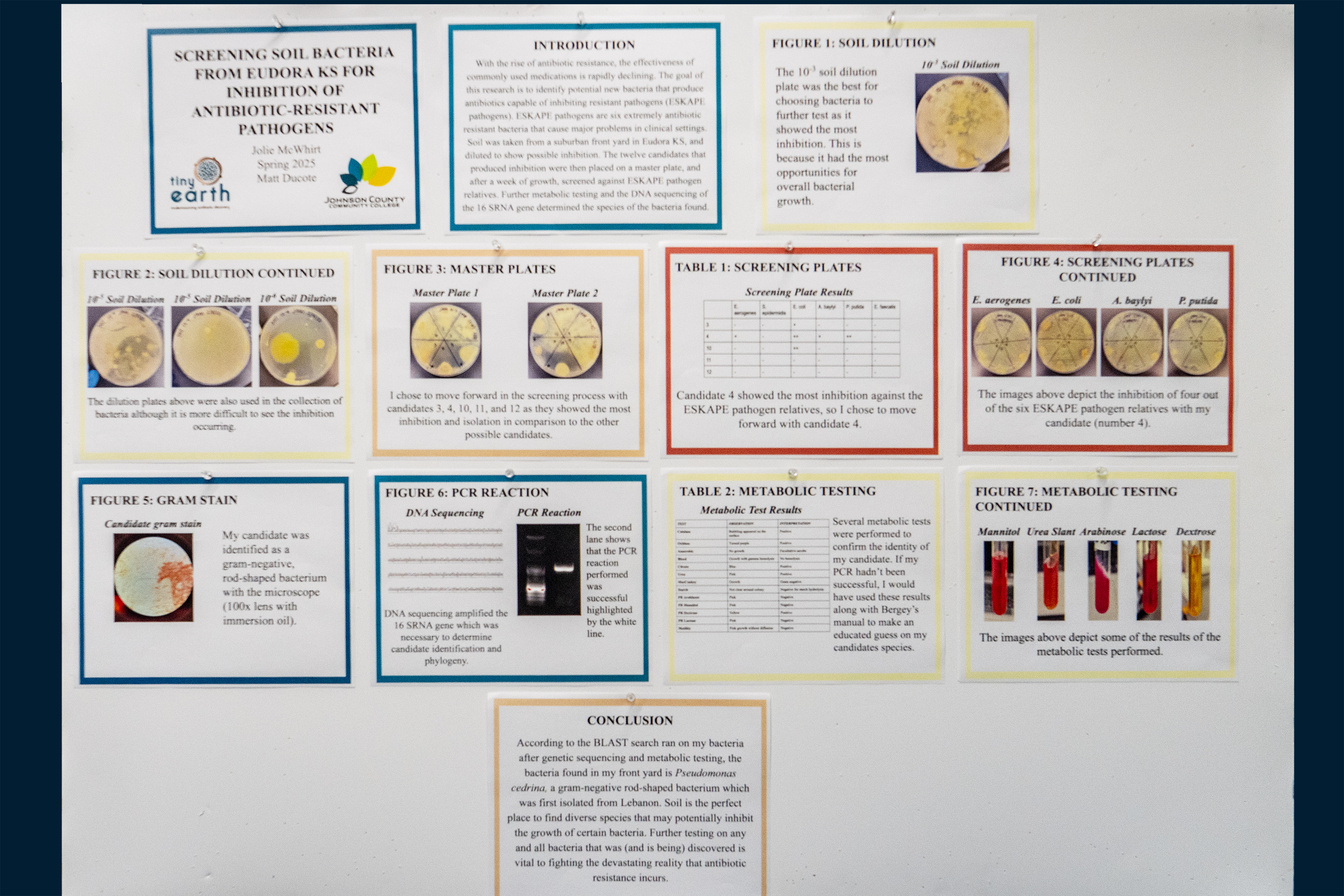
Screening Soil Bacteria from Eudora Kansas for Inhibition of Antibiotic-Resistant Pathogens
CoLab, COM 100
With the rise of antibiotic resistance, the effectiveness of commonly used medications is rapidly declining. The goal of this research is to identify potential new bacteria that produce antibiotics capable of inhibiting resistant pathogens. Soil was taken from a suburban front yard in Eudora, Kansas, and diluted to show possible inhibition. The twelve candidates that produced inhibition were then placed on a master plate, and after a week of growth, screened against ESKAPE pathogen relatives. ESKAPE pathogens are six extremely resistant bacteria that cause major problems in clinical settings. The bacteria that demonstrated the most inhibition with these pathogens was then isolated and viewed under the microscope. The bacteria that was identified is an unknown gram-negative rod without spores. Further research on this bacteria will be conducted to determine its genus and species.
Comments
The faculty mentor for this project was Matthew Ducote, Biology.