

Location
CoLab, COM 100
Start Date
1-5-2025 5:30 PM
Document Type
Poster
Description
Antibiotic resistance is a growing concern in healthcare, driving the need for novel antimicrobial agents. Soil, a rich source of microbial diversity, holds the potential for discovering new microorganisms with natural mechanisms that could help combat resistant pathogens. In this study, soil samples were collected from residential areas at a depth of approximately three feet to explore microbial populations with possible antibiotic properties under our own feet. Among the isolates, a novel microbe, designated Magneto, demonstrated the ability to inhibit the growth of both Escherichia coli and Mycobacterium smegmatis. This finding suggests that Magneto may produce antimicrobial compounds with potential clinical applications. Identifying and characterizing such microbes could provide valuable insights into new antimicrobial strategies, contributing to the ongoing fight against antibiotic resistance.
Image
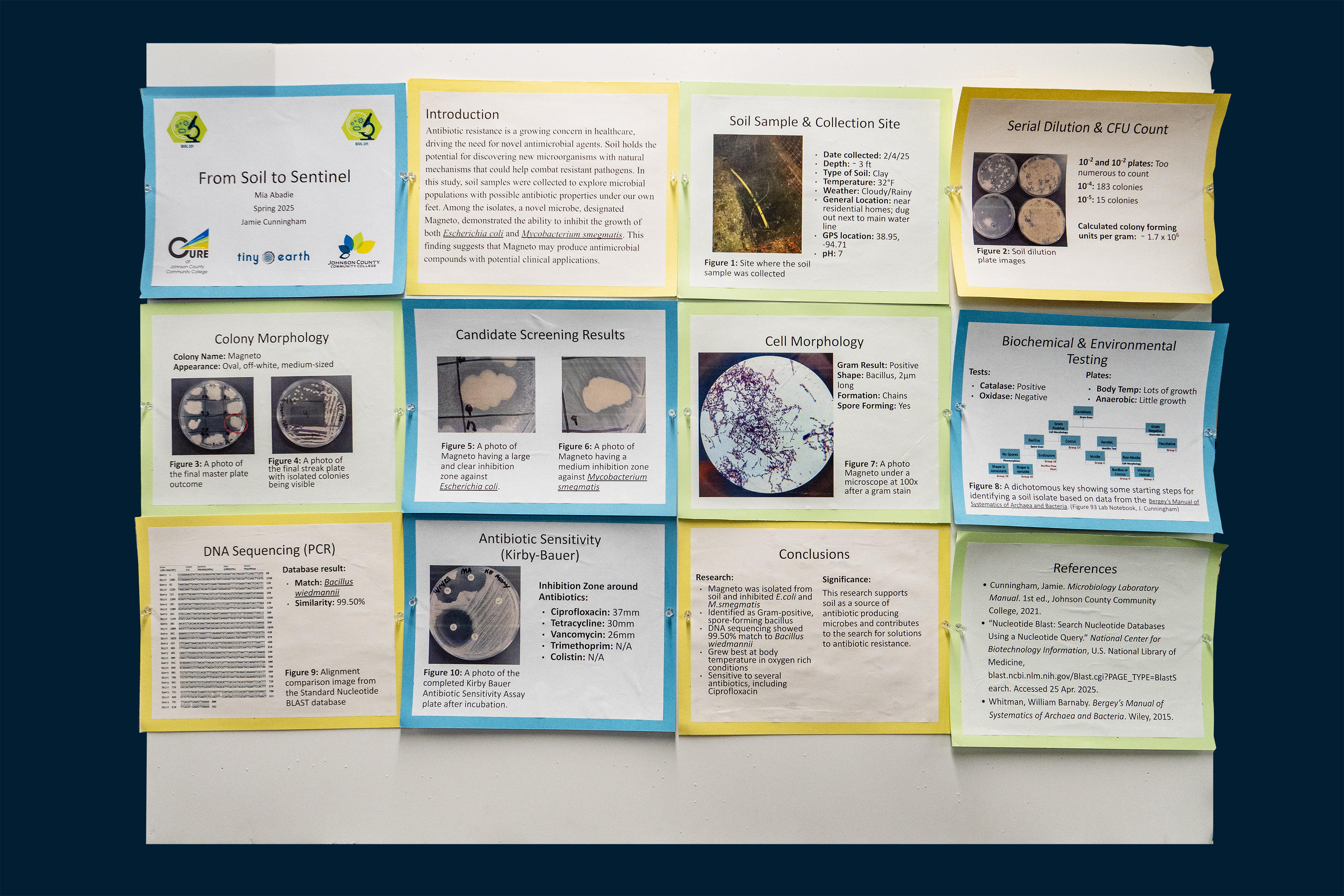
From Soil to Sentinel
CoLab, COM 100
Antibiotic resistance is a growing concern in healthcare, driving the need for novel antimicrobial agents. Soil, a rich source of microbial diversity, holds the potential for discovering new microorganisms with natural mechanisms that could help combat resistant pathogens. In this study, soil samples were collected from residential areas at a depth of approximately three feet to explore microbial populations with possible antibiotic properties under our own feet. Among the isolates, a novel microbe, designated Magneto, demonstrated the ability to inhibit the growth of both Escherichia coli and Mycobacterium smegmatis. This finding suggests that Magneto may produce antimicrobial compounds with potential clinical applications. Identifying and characterizing such microbes could provide valuable insights into new antimicrobial strategies, contributing to the ongoing fight against antibiotic resistance.
Comments
The faculty mentor for this project was Jamie Cunningham, Biology.